Claude 3 \ Anthropic vs Pythia
In the clash of Claude 3 \ Anthropic vs Pythia, which AI Large Language Model (LLM) tool emerges victorious? We assess reviews, pricing, alternatives, features, upvotes, and more.
If you had to choose between Claude 3 \ Anthropic and Pythia, which one would you go for?
Let's take a closer look at Claude 3 \ Anthropic and Pythia, both of which are AI-driven large language model (llm) tools, and see what sets them apart. The upvote count shows a clear preference for Claude 3 \ Anthropic. Claude 3 \ Anthropic has received 8 upvotes from aitools.fyi users, while Pythia has received 6 upvotes.
You don't agree with the result? Cast your vote to help us decide!
Claude 3 \ Anthropic

What is Claude 3 \ Anthropic?
Claude 3 is Anthropic's third-generation large language model family, released in March 2024. It includes three tiers: Haiku for speed and cost, Sonnet for balanced performance, and Opus for the highest reasoning depth. Each model targets a different tradeoff between intelligence, latency, and price.
The family handles text, code, analysis, and vision tasks. Claude 3 models process photos, charts, graphs, and technical diagrams. They support a 200K token context window at launch, with inputs exceeding 1 million tokens available to select customers. Opus and Sonnet launched on claude.ai and the Claude API in 159 countries, with Haiku following shortly after.
Anthropic built Claude 3 with Constitutional AI safety methods and Responsible Scaling Policy guardrails. The models are available through the Claude API, Amazon Bedrock, and Google Cloud Vertex AI. Sonnet powers the free tier on claude.ai, while Opus is available to Claude Pro subscribers.
Pythia
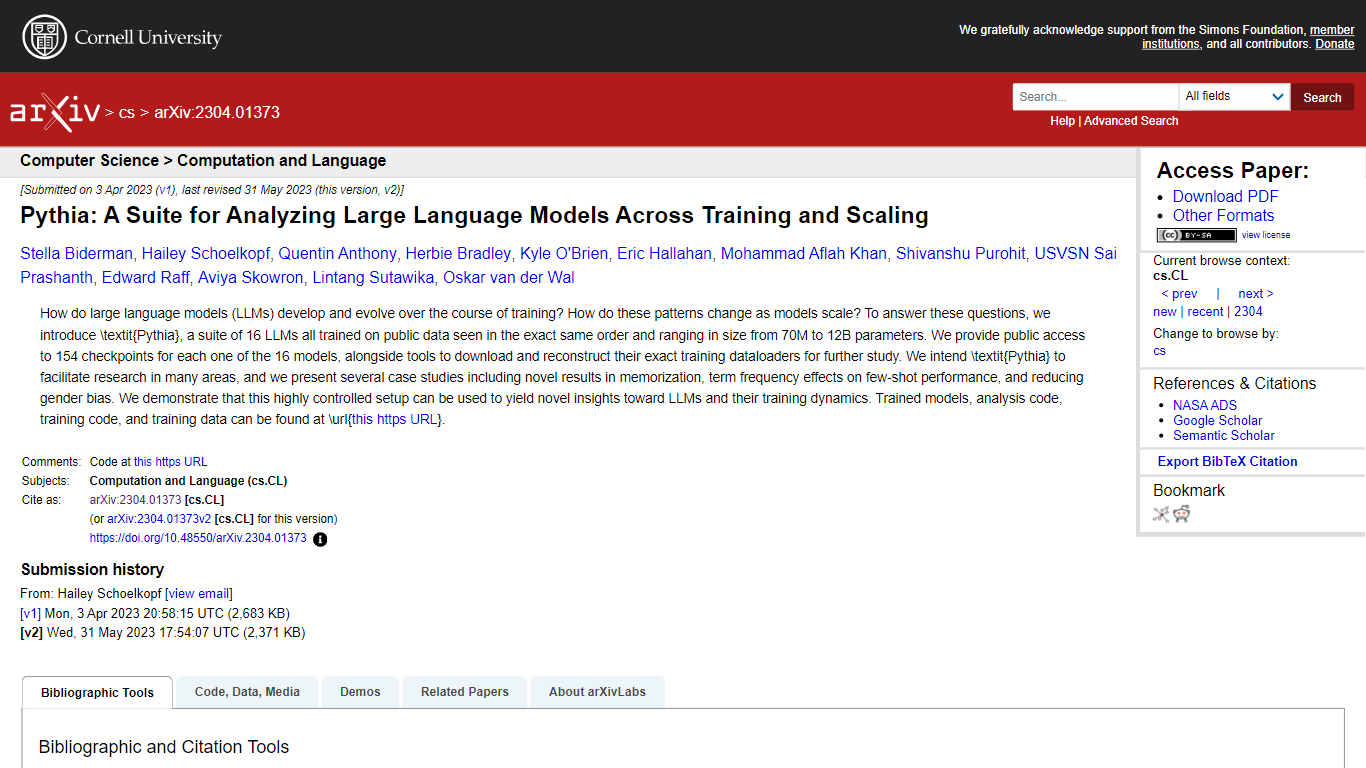
What is Pythia?
Researchers studying transformer training need checkpoints taken throughout pretraining, not just a finished weight file. Pythia delivers that by training matched LLM families on public data in a fixed order, then releasing weights, checkpoints, training code, and dataloader tools so you can inspect behavior at specific steps.
Where most LLM releases ship one finished checkpoint, Pythia publishes 154 snapshots per model and keeps data order constant across sizes. That control makes it useful for memorization studies, scaling comparisons, and causal training interventions, but it is not aimed at plug-and-play chat deployment the way instruction-tuned assistants are.
The suite targets machine learning researchers, interpretability labs, and alignment teams who need reproducible training trajectories. Typical work includes comparing checkpoints for memorization, testing how term frequency affects few-shot scores, and reproducing published case studies from the repository.
Claude 3 \ Anthropic Upvotes
Pythia Upvotes
Claude 3 \ Anthropic Top Features
Three model tiers (Haiku, Sonnet, Opus) let you pick the right balance of speed, cost, and reasoning depth
200K token context window at launch, with 1M+ token inputs available to select enterprise customers
Vision support for photos, charts, graphs, PDFs, and technical diagrams
Haiku reads a ~10k token research paper with charts in under three seconds for live chat workloads
Available on claude.ai, the Claude API, Amazon Bedrock, and Google Cloud Vertex AI
Pythia Top Features
154 checkpoints per model at steps 0, 1, 2, 4, 8, 16, 32, 64, 128, 256, 512, 1000, then every 1000 steps
16 model variants across 8 sizes from 70M to 12B, each with standard and deduped Pile training runs
Every model sees about 300 billion tokens in the same data order during training
Weights load from Hugging Face with revision tags such as step3000 via GPTNeoXForCausalLM
Apache 2.0 license covers the repository code and released model weights
Claude 3 \ Anthropic Category
- Large Language Model (LLM)
Pythia Category
- Large Language Model (LLM)
Claude 3 \ Anthropic Pricing Type
- Freemium
Pythia Pricing Type
- Free