
Last updated 07-26-2026
Category:
Reviews:
Join thousands of AI enthusiasts in the World of AI!
Pythia
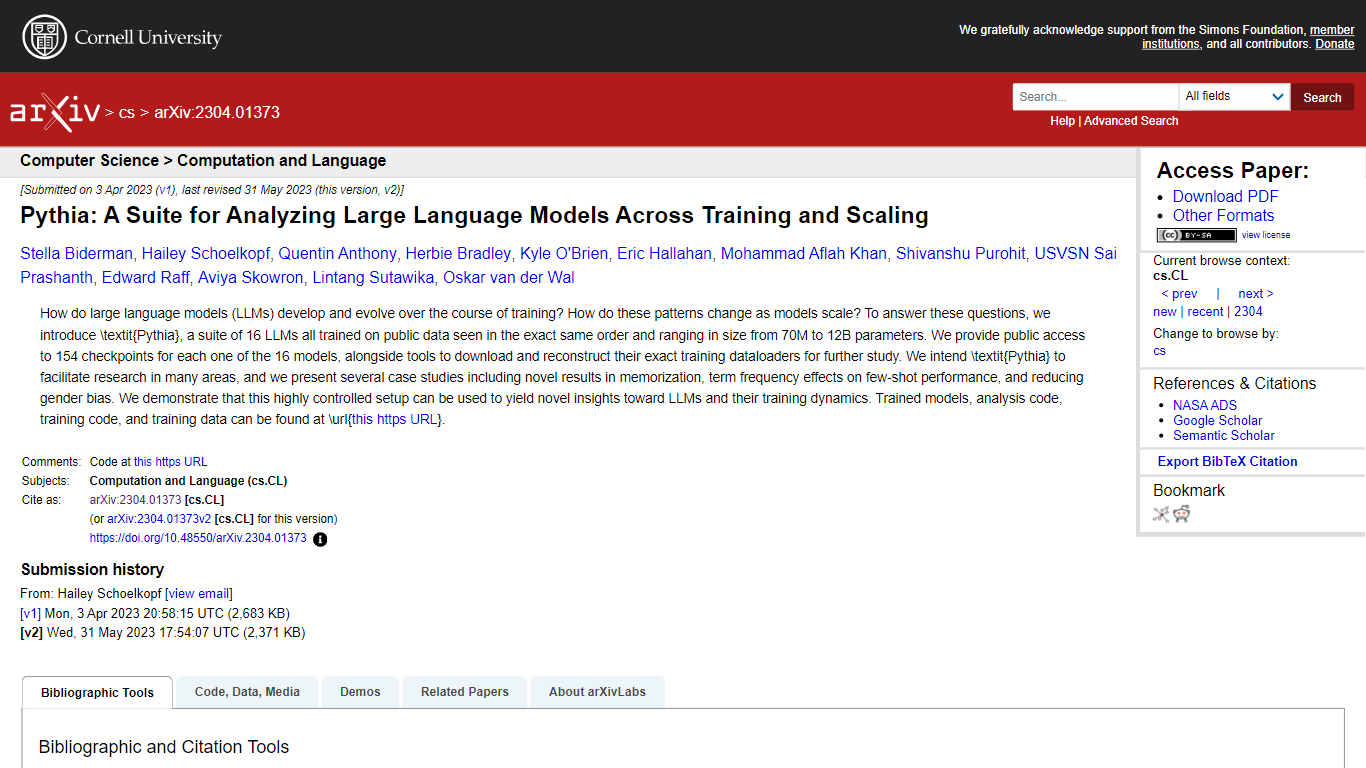
Researchers studying transformer training need checkpoints taken throughout pretraining, not just a finished weight file. Pythia delivers that by training matched LLM families on public data in a fixed order, then releasing weights, checkpoints, training code, and dataloader tools so you can inspect behavior at specific steps.
Where most LLM releases ship one finished checkpoint, Pythia publishes 154 snapshots per model and keeps data order constant across sizes. That control makes it useful for memorization studies, scaling comparisons, and causal training interventions, but it is not aimed at plug-and-play chat deployment the way instruction-tuned assistants are.
The suite targets machine learning researchers, interpretability labs, and alignment teams who need reproducible training trajectories. Typical work includes comparing checkpoints for memorization, testing how term frequency affects few-shot scores, and reproducing published case studies from the repository.
154 checkpoints per model at steps 0, 1, 2, 4, 8, 16, 32, 64, 128, 256, 512, 1000, then every 1000 steps
16 model variants across 8 sizes from 70M to 12B, each with standard and deduped Pile training runs
Every model sees about 300 billion tokens in the same data order during training
Weights load from Hugging Face with revision tags such as step3000 via GPTNeoXForCausalLM
Apache 2.0 license covers the repository code and released model weights
154 checkpoints per model make it practical to study learning dynamics instead of guessing from a final weight snapshot.
All models train on the same data in the same order, which supports causal comparisons across sizes and training steps.
Weights, configs, memmapped training data, and reproduction scripts are public under Apache 2.0.
Hugging Face revisions let you load specific training steps such as step3000 without maintaining private checkpoint storage.
Reproducing full training runs requires serious GPU capacity and comfort with GPT-NeoX, Docker, and large memmapped datasets.
Not every intermediate GPT-NeoX optimizer state is hosted at scale, so some step-level analysis needs a direct request to the maintainers.
Published benchmark tables in the repository warn they were run on an older lm-evaluation-harness commit and may not match current harness results.
What is Pythia?
Pythia is EleutherAI's open suite of large language models for studying training and scaling. It releases matched model families, 154 checkpoints per model, and scripts to reconstruct the exact training dataloader order.
How many Pythia model sizes are available?
Pythia includes 8 parameter sizes from 70M to 12B, each trained on the standard Pile and on a deduplicated Pile variant. Additional 14M and 31M models were added for alignment research on sparse autoencoders.
Is Pythia free to use?
Yes. Pythia is free and open source under the Apache 2.0 license. Model weights are hosted on Hugging Face under the EleutherAI organization, and the training code lives in the public GitHub repository.
How do I load a specific Pythia checkpoint?
Pythia checkpoints on Hugging Face can be loaded with transformers by setting a revision such as step3000 on models like EleutherAI/pythia-70m-deduped. The repository README includes a Python quickstart for GPTNeoXForCausalLM and AutoTokenizer.
What training data does Pythia use?
Pythia models are trained on The Pile, with parallel runs on a deduplicated version of that corpus. Each model consumes about 300 billion tokens, and the repository provides pre-tokenized memmapped files plus scripts to rebuild the training dataloader.
Who maintains Pythia?
Pythia is maintained by EleutherAI. The project repository links to the ICML paper, benchmark tables, case-study folders, and contact emails for checkpoint requests that are not hosted on Hugging Face.