Pythia vs ggml.ai
Explore the showdown between Pythia vs ggml.ai and find out which AI Large Language Model (LLM) tool wins. We analyze upvotes, features, reviews, pricing, alternatives, and more.
When comparing Pythia and ggml.ai, which one rises above the other?
When we contrast Pythia with ggml.ai, both of which are exceptional AI-operated large language model (llm) tools, and place them side by side, we can spot several crucial similarities and divergences. In the race for upvotes, ggml.ai takes the trophy. The number of upvotes for ggml.ai stands at 7, and for Pythia it's 6.
Feeling rebellious? Cast your vote and shake things up!
Pythia
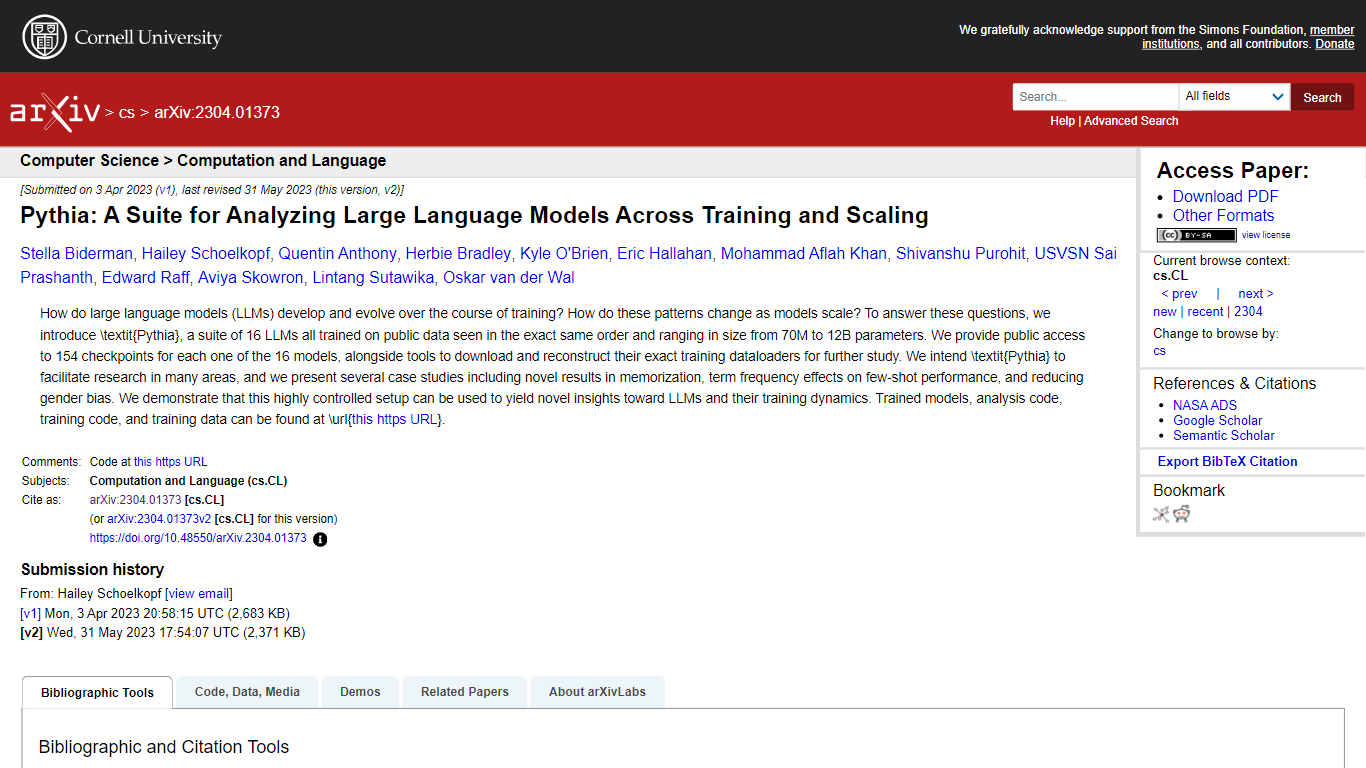

What is Pythia?
Researchers studying transformer training need checkpoints taken throughout pretraining, not just a finished weight file. Pythia delivers that by training matched LLM families on public data in a fixed order, then releasing weights, checkpoints, training code, and dataloader tools so you can inspect behavior at specific steps.
Where most LLM releases ship one finished checkpoint, Pythia publishes 154 snapshots per model and keeps data order constant across sizes. That control makes it useful for memorization studies, scaling comparisons, and causal training interventions, but it is not aimed at plug-and-play chat deployment the way instruction-tuned assistants are.
The suite targets machine learning researchers, interpretability labs, and alignment teams who need reproducible training trajectories. Typical work includes comparing checkpoints for memorization, testing how term frequency affects few-shot scores, and reproducing published case studies from the repository.
ggml.ai
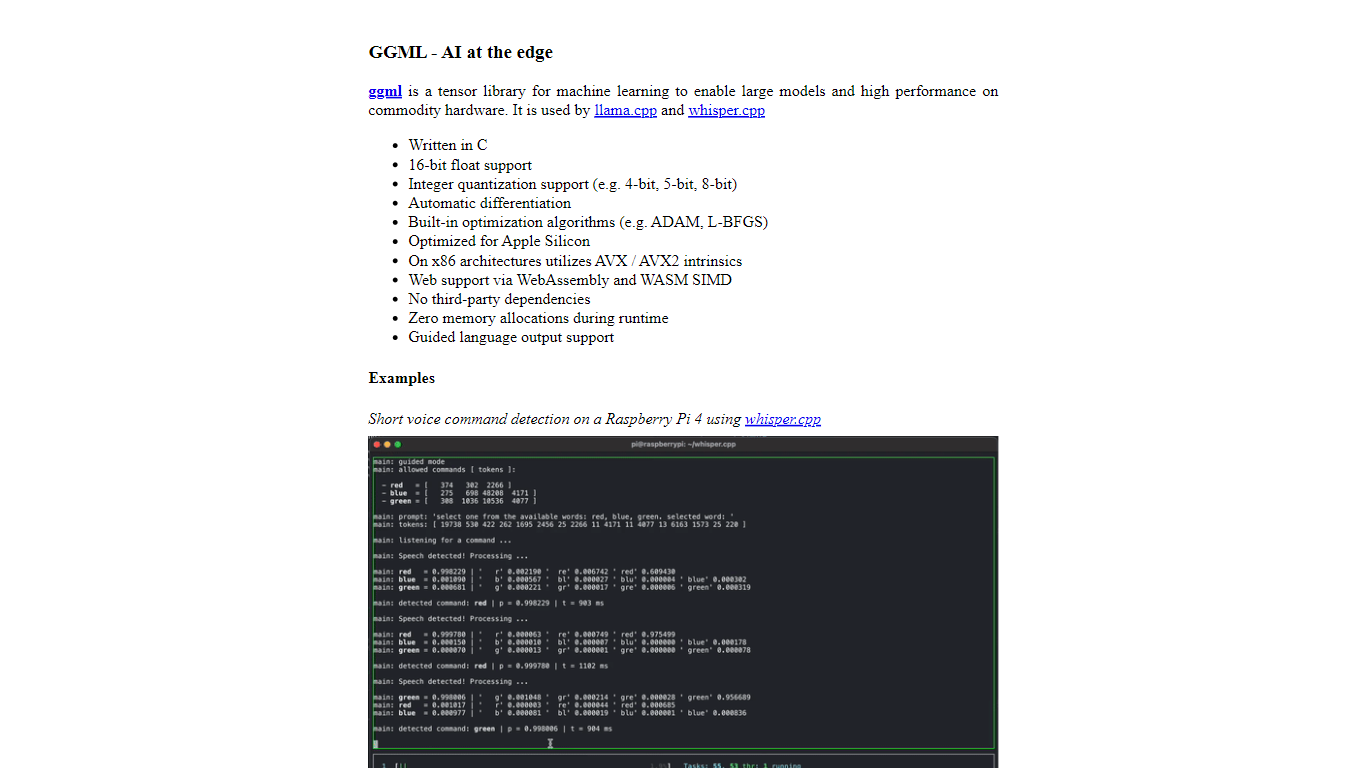
What is ggml.ai?
ggml runs large language and speech models on everyday CPUs and GPUs through a compact C tensor library built for on-device inference. ML engineers and app developers adopt it via llama.cpp and whisper.cpp when they want LLaMA or Whisper workloads without cloud-only dependencies.
Frameworks like PyTorch optimize for training clusters and heavy runtimes. ggml keeps the core library minimal with zero runtime memory allocations, no third-party dependencies, and integer quantization so llama.cpp can serve Meta LLaMA weights on laptops and Apple Silicon.
The ggml.ai company was founded in 2023 by Georgi Gerganov to support the library and was acquired by Hugging Face in 2026. The core ggml project stays MIT licensed with open development on GitHub.
Pythia Upvotes
ggml.ai Upvotes
Pythia Top Features
154 checkpoints per model at steps 0, 1, 2, 4, 8, 16, 32, 64, 128, 256, 512, 1000, then every 1000 steps
16 model variants across 8 sizes from 70M to 12B, each with standard and deduped Pile training runs
Every model sees about 300 billion tokens in the same data order during training
Weights load from Hugging Face with revision tags such as step3000 via GPTNeoXForCausalLM
Apache 2.0 license covers the repository code and released model weights
ggml.ai Top Features
Powers llama.cpp for Meta LLaMA inference and whisper.cpp for OpenAI Whisper speech models
Written in C with zero runtime memory allocations during inference
Integer quantization support for smaller models on commodity hardware
No third-party dependencies in the core tensor library
Cross-platform low-level implementation with broad hardware support
MIT licensed open-core library with public development on GitHub
Pythia Category
- Large Language Model (LLM)
ggml.ai Category
- Large Language Model (LLM)
Pythia Pricing Type
- Free
ggml.ai Pricing Type
- Free