Coderbuds vs PSEUDO.AI
In the battle of Coderbuds vs PSEUDO.AI, which AI Developer tool comes out on top? We compare reviews, pricing, alternatives, upvotes, features, and more.
Between Coderbuds and PSEUDO.AI, which one is superior?
Upon comparing Coderbuds with PSEUDO.AI, which are both AI-powered developer tools, The upvote count shows a clear preference for PSEUDO.AI. PSEUDO.AI has garnered 7 upvotes, and Coderbuds has garnered 6 upvotes.
Think we got it wrong? Cast your vote and show us who's boss!
Coderbuds

What is Coderbuds?
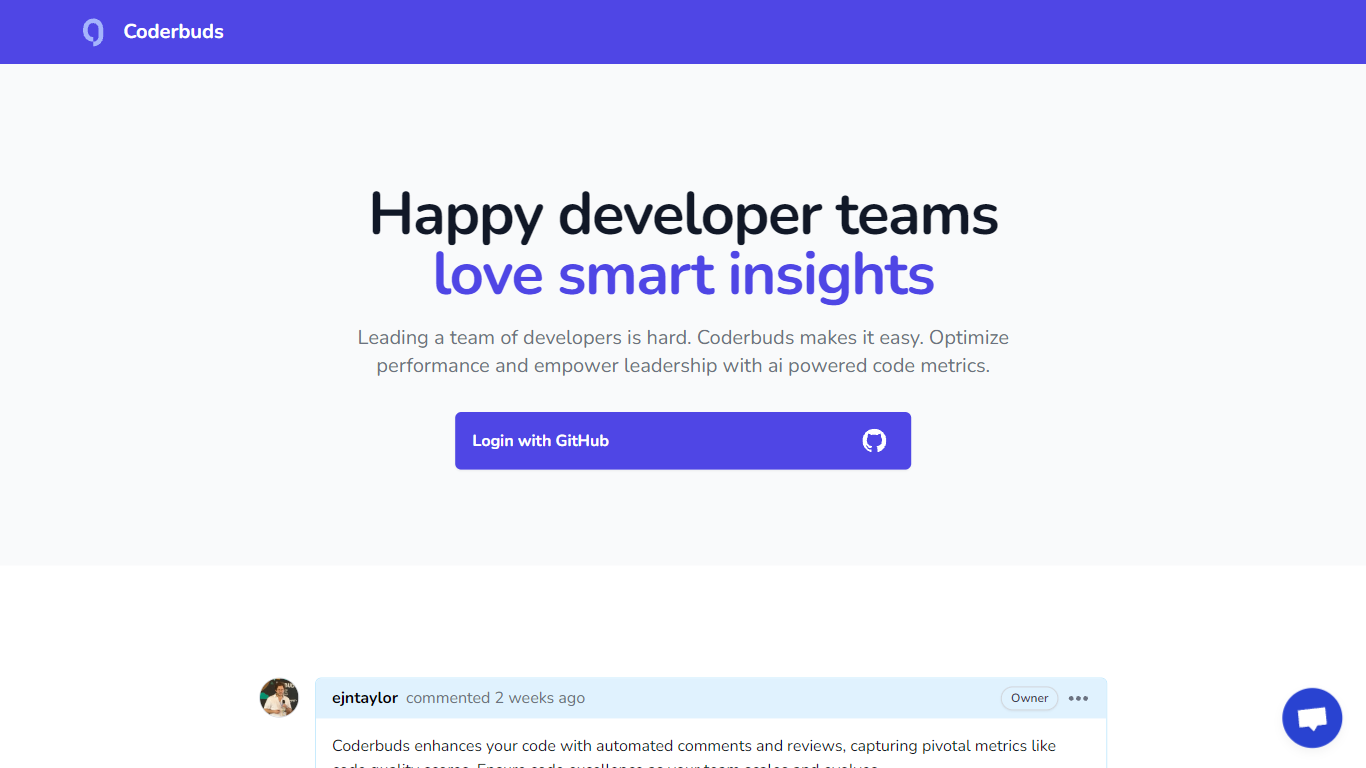
Coderbuds reads pull requests, reviews, and deployments from GitHub or Bitbucket, then surfaces delivery, collaboration, and team-health metrics for engineering leaders. It connects Jira, Linear, Slack, and Microsoft Teams so managers can see lead time, review delays, and DORA-style performance without building a data warehouse. Engineers get the same insights pushed into coding agents through MCP.
Most DORA dashboards stop at reporting what already happened. Coderbuds also feeds team conventions, org maps, and playbooks into Claude Code, Cursor, Codex, and Copilot before code reaches review, so standards show up in the prompt instead of a comment thread two days later. The Patchstack case study on the site cites lead time dropping from about four days to one day over six months.
Engineering managers use it to spot bottlenecks and walk into leadership meetings with numbers. Individual engineers see coaching on their own PR patterns first, and satisfaction surveys stay anonymous at the team level. Source code never leaves your repository; Coderbuds stores only PR metadata like titles, timestamps, and line counts.
PSEUDO.AI

What is PSEUDO.AI?
PSEUDO.AI turns source code into human-readable pseudocode in your browser. You enter a prompt or code snippet, pick a language, and the app returns plain-language steps that read like structured pseudocode rather than raw syntax. It runs on the web at pseudoai.vercel.app with no install, and targets teams who need to explain implementation details to people who do not read code daily.
Most code explainers summarize what a snippet does in prose. PSEUDO.AI keeps the output closer to pseudocode structure, which makes handoffs to designers, product owners, or junior developers easier to scan. The trade-off is focus: it is built for pseudocode conversion, not debugging, testing, or repo-wide documentation. That narrow scope is the point when the goal is shared comprehension, not a full IDE workflow.
Software developers use it to translate tricky logic before code reviews or stakeholder meetings. Computer science students and instructors lean on it when a textbook example needs a readable walkthrough. Product managers and mentors who sit in technical discussions but do not write production code get a format they can follow without parsing braces and semicolons.
Coderbuds Upvotes
PSEUDO.AI Upvotes
Coderbuds Top Features
DORA and SPACE dashboards with six months of history included
$12 per active developer per month on annual billing, with a free start and no credit card
Connects GitHub, Bitbucket, Jira, Linear, Slack, and Microsoft Teams
MCP server pushes team conventions into Cursor, Claude Code, Codex, and Copilot
Pre-flight checks flag PR size and convention fit before review starts
10,000+ pull requests analyzed across customer workspaces
PSEUDO.AI Top Features
Choose from 12 languages on the converter page, including C, C++, C#, Java, Python 3, JavaScript, Node.js, PHP, Kotlin, Swift, and SQL.
Runs entirely in the browser at pseudoai.vercel.app with no downloads required, per the homepage FAQ.
Uses an OpenAI-trained GPT model to generate pseudocode from your code input, according to the site FAQ.
Three-step workflow on the converter: enter a prompt or topic, pick a language, then click GO and copy the output.
Homepage FAQ lists Java, Python, C++, and JavaScript among supported languages, with a broader list on the live converter.
Coderbuds Category
- Developer
PSEUDO.AI Category
- Developer
Coderbuds Pricing Type
- Freemium
PSEUDO.AI Pricing Type
- Free