Cognee vs ALBERT
In the contest of Cognee vs ALBERT, which AI Large Language Model (LLM) tool is the champion? We evaluate pricing, alternatives, upvotes, features, reviews, and more.
If you had to choose between Cognee and ALBERT, which one would you go for?
When we examine Cognee and ALBERT, both of which are AI-enabled large language model (llm) tools, what unique characteristics do we discover? The upvote count reveals a draw, with both tools earning the same number of upvotes. Every vote counts! Cast yours and contribute to the decision of the winner.
Disagree with the result? Upvote your favorite tool and help it win!
Cognee

What is Cognee?
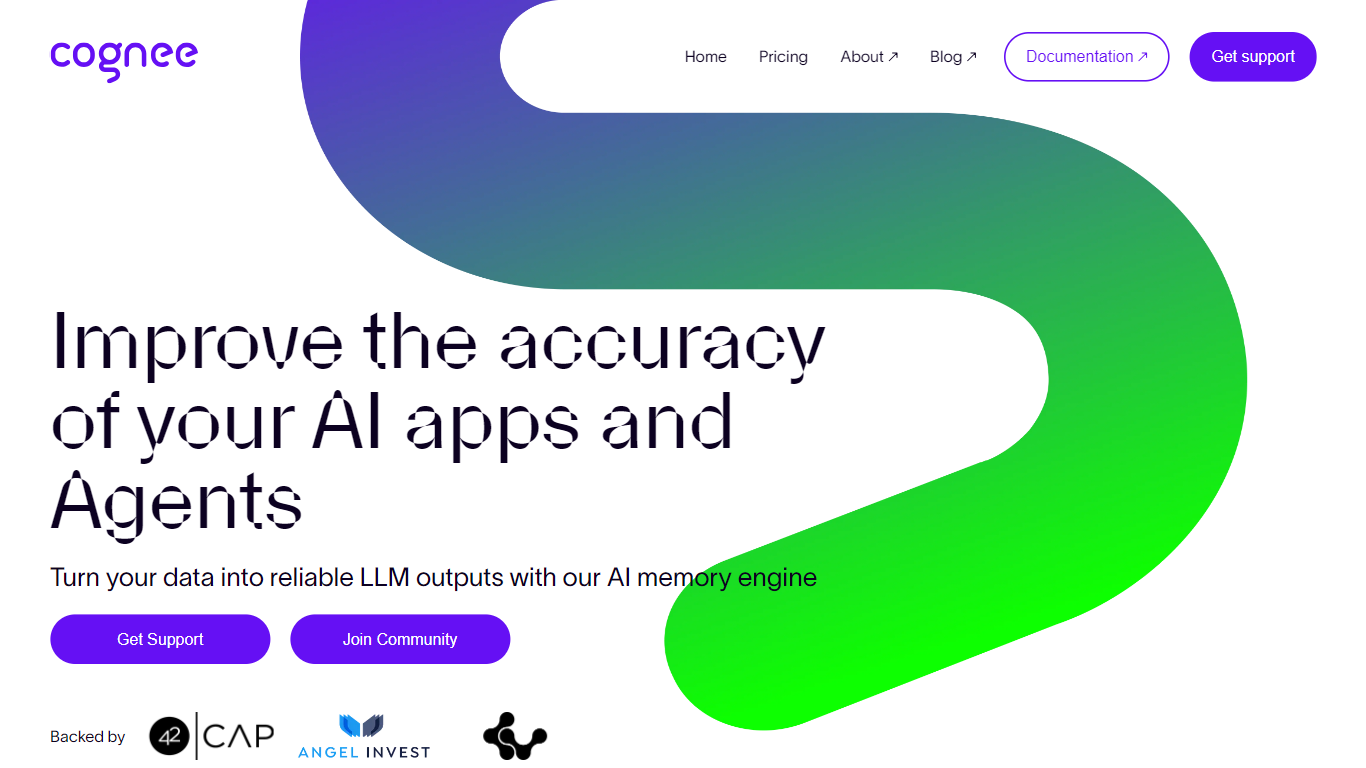
Cognee turns documents, chats, tickets, and API data into graph memory language model agents can recall across sessions. It builds linked entity graphs from that context so agents stop restarting from scratch each run. You can connect Slack, GitHub, or Linear so coding agents and support bots share one permission-aware company brain.
Plain RAG returns similar text chunks. Cognee pairs vector search with knowledge graphs and auto-generated ontologies, so recall pulls connected entities and cited facts rather than isolated snippets. The SDK centers on four verbs, remember, recall, forget, and improve, and the same surface ships over HTTP and MCP for Claude Code, Codex, and OpenClaw.
Platform teams use it for coding agent memory, GraphRAG pipelines, deal intelligence, and customer-facing agents that need grounded answers. Run it with pip locally, self-host in Docker or on-prem, or move to Cognee Cloud when you want managed scale. The project reports 30.4k GitHub stars and 5M+ SDK runs per month, with production deployments at Bayer and Knowunity.
ALBERT
What is ALBERT?
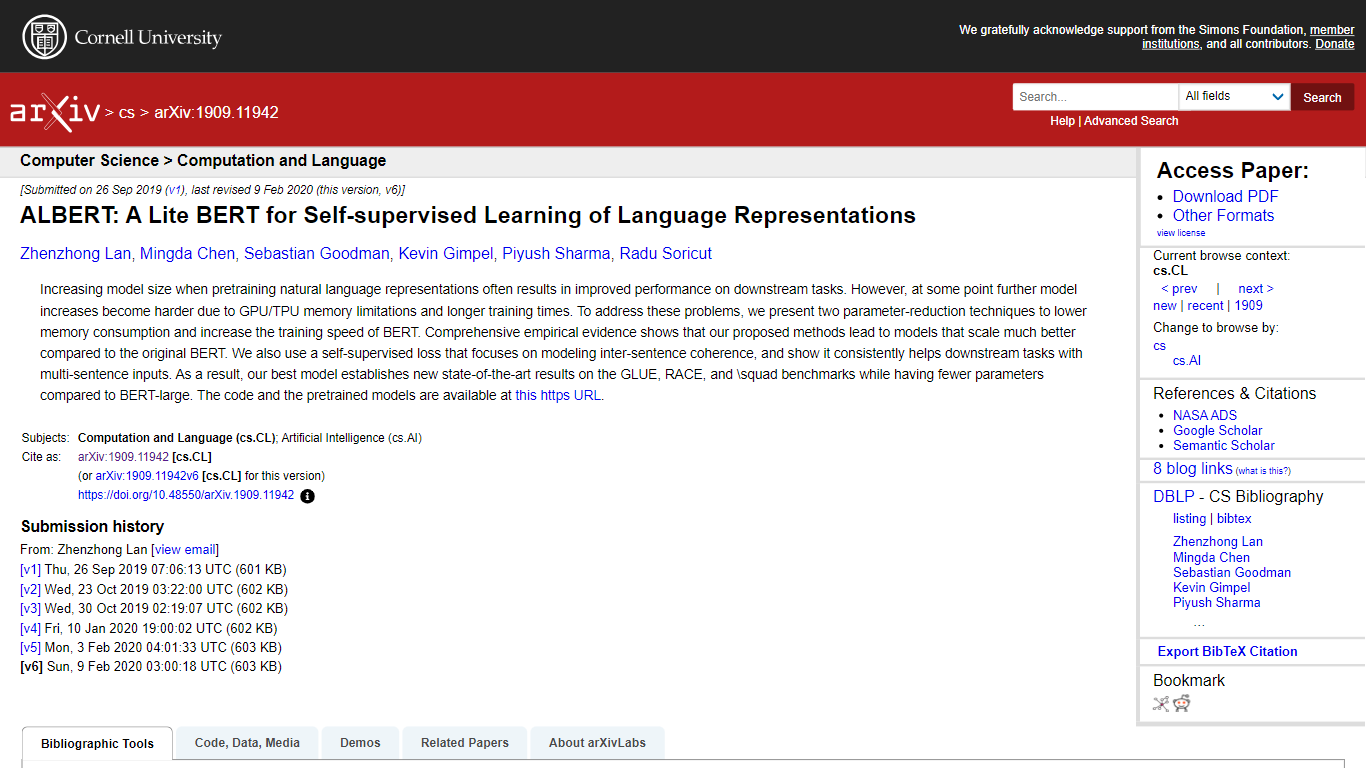
ALBERT is an open source language model from Google Research that shrinks BERT's parameter count while matching or beating its benchmark scores. The name stands for A Lite BERT, and the architecture uses two tricks: factorized embedding parameterization splits the vocabulary matrix into smaller pieces, and cross-layer parameter sharing reuses weights across transformer layers.
Where BERT-large hits GPU memory walls during pretraining, ALBERT scales to larger hidden sizes with fewer total parameters. It also swaps BERT's next-sentence prediction loss for sentence-order prediction (SOP), which the authors found more effective for multi-sentence downstream tasks. The best ALBERT configuration set records on GLUE (89.4), RACE (89.4% accuracy), and SQuAD 2.0 (92.2 F1) at the time of publication.
Pretrained models and training code ship free on GitHub and load through Hugging Face Transformers. Researchers and NLP engineers use ALBERT when they need BERT-level performance on limited hardware or want a lighter model for fine-tuning on classification, question answering, and token-level tasks.
Cognee Upvotes
ALBERT Upvotes
Cognee Top Features
pip install cognee connects Claude Code, Codex, or any MCP client in minutes
remember, recall, forget, and improve as the core API across SDK, HTTP, and MCP
30.4k GitHub stars and 5M+ SDK runs per month listed on the homepage
Hybrid graph and vector memory links entities across long conversations and sources
Free Cognee Cloud tier includes 1M tokens and one workspace at $0 per month
Ingest from Slack, Notion, Linear, Google Drive, S3, and code repos into one recall layer
BEAM 100K benchmark shows Cognee scoring 0.79 on the SDK results page
ALBERT Top Features
Factorized embedding parameterization reduces memory vs standard BERT vocabulary matrices
Cross-layer parameter sharing cuts learnable weights across transformer layers
Sentence-order prediction (SOP) loss replaces BERT's next-sentence prediction
89.4% accuracy on RACE and 92.2 F1 on SQuAD 2.0 benchmark results
Pretrained models and code available on GitHub and Hugging Face Transformers
Cognee Category
- Large Language Model (LLM)
ALBERT Category
- Large Language Model (LLM)
Cognee Pricing Type
- Freemium
ALBERT Pricing Type
- Free