Cognee vs ggml.ai
In the clash of Cognee vs ggml.ai, which AI Large Language Model (LLM) tool emerges victorious? We assess reviews, pricing, alternatives, features, upvotes, and more.
If you had to choose between Cognee and ggml.ai, which one would you go for?
Let's take a closer look at Cognee and ggml.ai, both of which are AI-driven large language model (llm) tools, and see what sets them apart. The upvote count shows a clear preference for ggml.ai. ggml.ai has been upvoted 7 times by aitools.fyi users, and Cognee has been upvoted 6 times.
Want to flip the script? Upvote your favorite tool and change the game!
Cognee

What is Cognee?
Cognee turns documents, chats, tickets, and API data into graph memory language model agents can recall across sessions. It builds linked entity graphs from that context so agents stop restarting from scratch each run. You can connect Slack, GitHub, or Linear so coding agents and support bots share one permission-aware company brain.
Plain RAG returns similar text chunks. Cognee pairs vector search with knowledge graphs and auto-generated ontologies, so recall pulls connected entities and cited facts rather than isolated snippets. The SDK centers on four verbs, remember, recall, forget, and improve, and the same surface ships over HTTP and MCP for Claude Code, Codex, and OpenClaw.
Platform teams use it for coding agent memory, GraphRAG pipelines, deal intelligence, and customer-facing agents that need grounded answers. Run it with pip locally, self-host in Docker or on-prem, or move to Cognee Cloud when you want managed scale. The project reports 30.4k GitHub stars and 5M+ SDK runs per month, with production deployments at Bayer and Knowunity.
ggml.ai
What is ggml.ai?
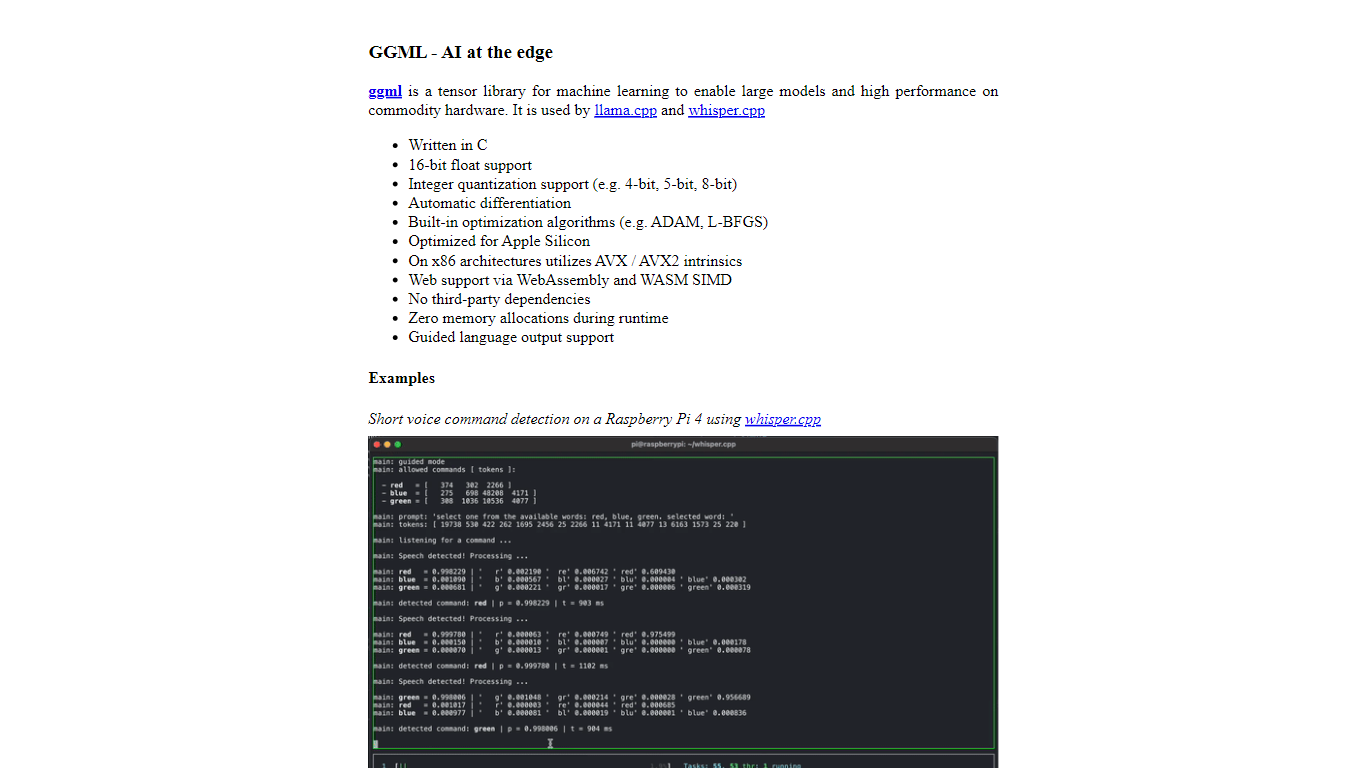
ggml runs large language and speech models on everyday CPUs and GPUs through a compact C tensor library built for on-device inference. ML engineers and app developers adopt it via llama.cpp and whisper.cpp when they want LLaMA or Whisper workloads without cloud-only dependencies.
Frameworks like PyTorch optimize for training clusters and heavy runtimes. ggml keeps the core library minimal with zero runtime memory allocations, no third-party dependencies, and integer quantization so llama.cpp can serve Meta LLaMA weights on laptops and Apple Silicon.
The ggml.ai company was founded in 2023 by Georgi Gerganov to support the library and was acquired by Hugging Face in 2026. The core ggml project stays MIT licensed with open development on GitHub.
Cognee Upvotes
ggml.ai Upvotes
Cognee Top Features
pip install cognee connects Claude Code, Codex, or any MCP client in minutes
remember, recall, forget, and improve as the core API across SDK, HTTP, and MCP
30.4k GitHub stars and 5M+ SDK runs per month listed on the homepage
Hybrid graph and vector memory links entities across long conversations and sources
Free Cognee Cloud tier includes 1M tokens and one workspace at $0 per month
Ingest from Slack, Notion, Linear, Google Drive, S3, and code repos into one recall layer
BEAM 100K benchmark shows Cognee scoring 0.79 on the SDK results page
ggml.ai Top Features
Powers llama.cpp for Meta LLaMA inference and whisper.cpp for OpenAI Whisper speech models
Written in C with zero runtime memory allocations during inference
Integer quantization support for smaller models on commodity hardware
No third-party dependencies in the core tensor library
Cross-platform low-level implementation with broad hardware support
MIT licensed open-core library with public development on GitHub
Cognee Category
- Large Language Model (LLM)
ggml.ai Category
- Large Language Model (LLM)
Cognee Pricing Type
- Freemium
ggml.ai Pricing Type
- Free