Cohere vs ggml.ai
In the clash of Cohere vs ggml.ai, which AI Large Language Model (LLM) tool emerges victorious? We assess reviews, pricing, alternatives, features, upvotes, and more.
When we put Cohere and ggml.ai head to head, which one emerges as the victor?
Let's take a closer look at Cohere and ggml.ai, both of which are AI-driven large language model (llm) tools, and see what sets them apart. ggml.ai is the clear winner in terms of upvotes. ggml.ai has been upvoted 7 times by aitools.fyi users, and Cohere has been upvoted 6 times.
Feeling rebellious? Cast your vote and shake things up!
Cohere

What is Cohere?
Cohere provides AI tools that help businesses automate tasks, improve search capabilities, and generate content using large language models. It offers products like North, which streamlines workplace productivity, and Compass, an intelligent search system for uncovering business insights.
What distinguishes Cohere is its focus on data sovereignty and security, allowing deployments in virtual private clouds, on-premises, or dedicated managed environments. This ensures enterprises maintain control over their data while leveraging advanced AI capabilities.
Cohere also supports advanced retrieval models such as Embed and Rerank to enhance semantic search and relevance. Its generative models, including Command and Transcribe, support multilingual content creation and accurate speech-to-text transcription.
Developers can access Cohere's API and developer tools to build customized AI applications, with options to train models on proprietary data for tailored solutions. The company’s research arm, Cohere Labs, advances machine learning through open science and community engagement.
By combining security, scalability, and customization, Cohere enables enterprises across industries like financial services, healthcare, manufacturing, and telecommunications to transform operations and decision-making with AI.
ggml.ai
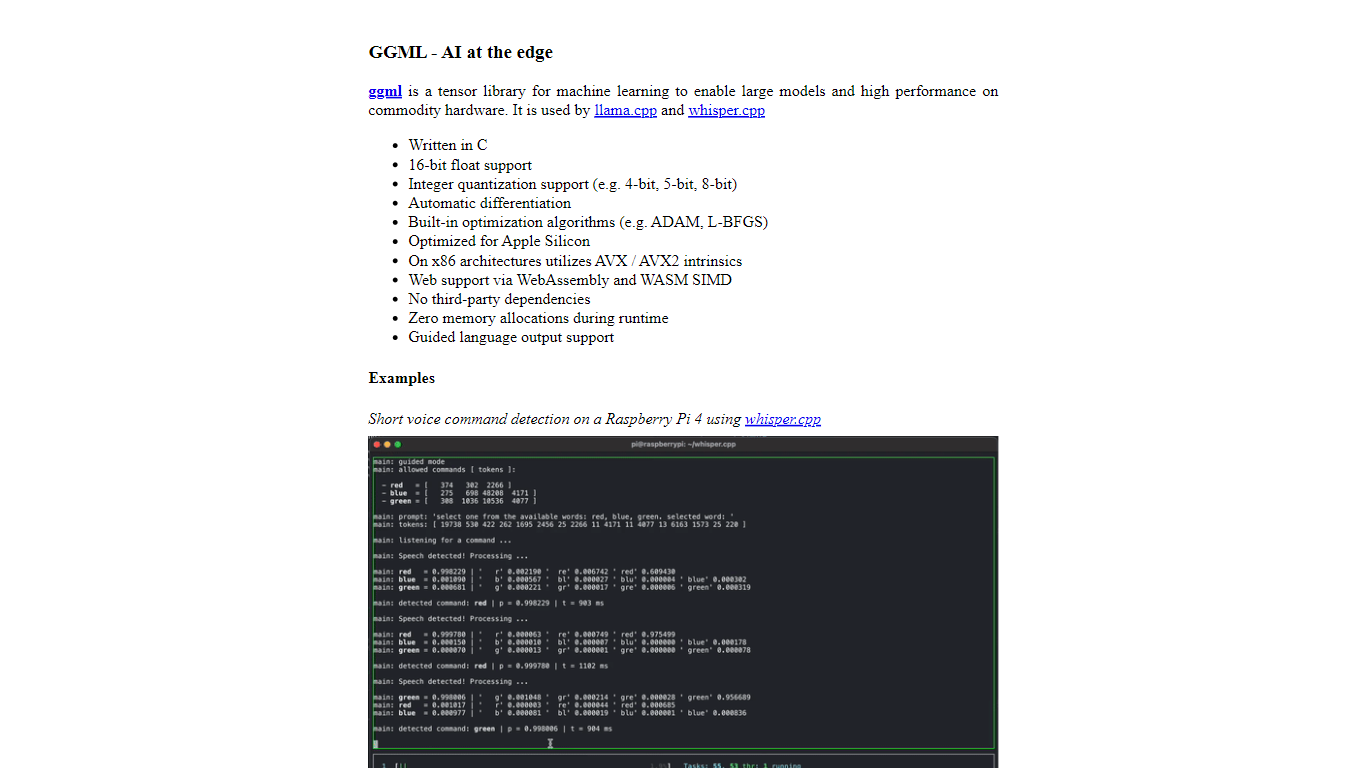
What is ggml.ai?
ggml runs large language and speech models on everyday CPUs and GPUs through a compact C tensor library built for on-device inference. ML engineers and app developers adopt it via llama.cpp and whisper.cpp when they want LLaMA or Whisper workloads without cloud-only dependencies.
Frameworks like PyTorch optimize for training clusters and heavy runtimes. ggml keeps the core library minimal with zero runtime memory allocations, no third-party dependencies, and integer quantization so llama.cpp can serve Meta LLaMA weights on laptops and Apple Silicon.
The ggml.ai company was founded in 2023 by Georgi Gerganov to support the library and was acquired by Hugging Face in 2026. The core ggml project stays MIT licensed with open development on GitHub.
Cohere Upvotes
ggml.ai Upvotes
Cohere Top Features
🛠️ North AI Platform: Automate tasks and streamline workflows with an enterprise-ready AI workplace system.
🔍 Compass Search System: Discover business insights with intelligent, managed search and document parsing.
🤖 Command Generative Models: Use high-performance, multilingual AI models for diverse content generation.
🎙️ Transcribe Speech-to-Text: Convert audio into accurate transcripts supporting multiple languages.
🔎 Embed & Rerank Models: Enhance search relevance and semantic understanding for faster, personalized results.
ggml.ai Top Features
Powers llama.cpp for Meta LLaMA inference and whisper.cpp for OpenAI Whisper speech models
Written in C with zero runtime memory allocations during inference
Integer quantization support for smaller models on commodity hardware
No third-party dependencies in the core tensor library
Cross-platform low-level implementation with broad hardware support
MIT licensed open-core library with public development on GitHub
Cohere Category
- Large Language Model (LLM)
ggml.ai Category
- Large Language Model (LLM)
Cohere Pricing Type
- Paid
ggml.ai Pricing Type
- Free