Deepnote AI vs STRING
In the contest of Deepnote AI vs STRING, which AI Data Science tool is the champion? We evaluate pricing, alternatives, upvotes, features, reviews, and more.
If you had to choose between Deepnote AI and STRING, which one would you go for?
When we examine Deepnote AI and STRING, both of which are AI-enabled data science tools, what unique characteristics do we discover? The upvote count favors Deepnote AI, making it the clear winner. Deepnote AI has 8 upvotes, and STRING has 6 upvotes.
Don't agree with the result? Cast your vote and be a part of the decision-making process!
Deepnote AI

What is Deepnote AI?
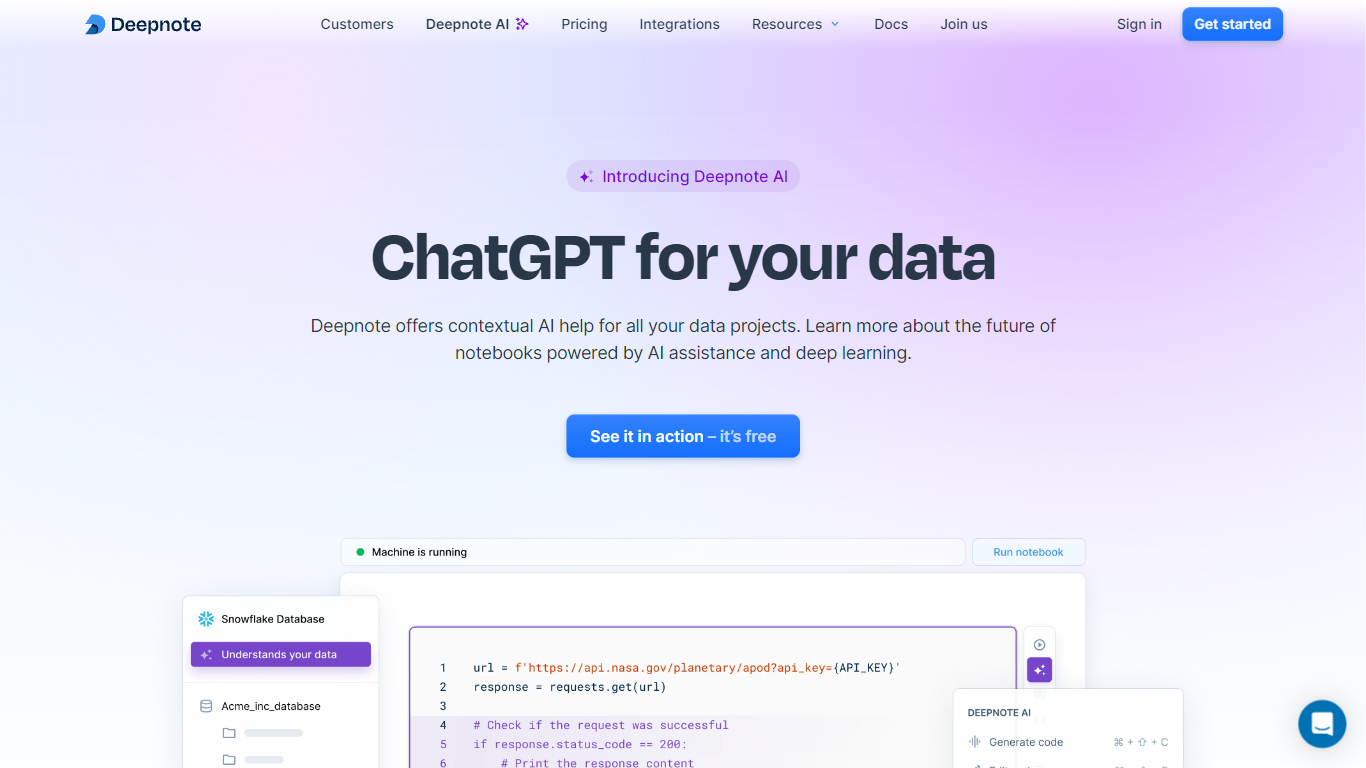
Deepnote AI is the assistant layer inside Deepnote, a collaborative data science notebook platform. It sits alongside your Python cells, SQL blocks, and charts, reading project context, connected warehouse metadata, and notebook history before suggesting code. You can ask in plain language, get full notebooks generated from a prompt, or fix a failing cell without leaving the workspace.
Most coding copilots treat each file as an island. Deepnote AI is built for notebooks tied to live data: its suggestions reference schemas from integrations you already connected, and auto-notebook generation can output runnable Python, SQL, and narrative text in one pass. That trade-off means it is not a general IDE plugin for arbitrary repos; it is narrowly focused on analysis workflows inside Deepnote.
Data scientists, analysts, and analytics engineers use it for exploratory analysis, query drafting, debugging pipeline cells, and turning notebook work into shareable data apps. Teams that already centralize work in Deepnote get the most value, especially when multiple editors collaborate on the same project with revision history and scheduled runs.
STRING
What is STRING?
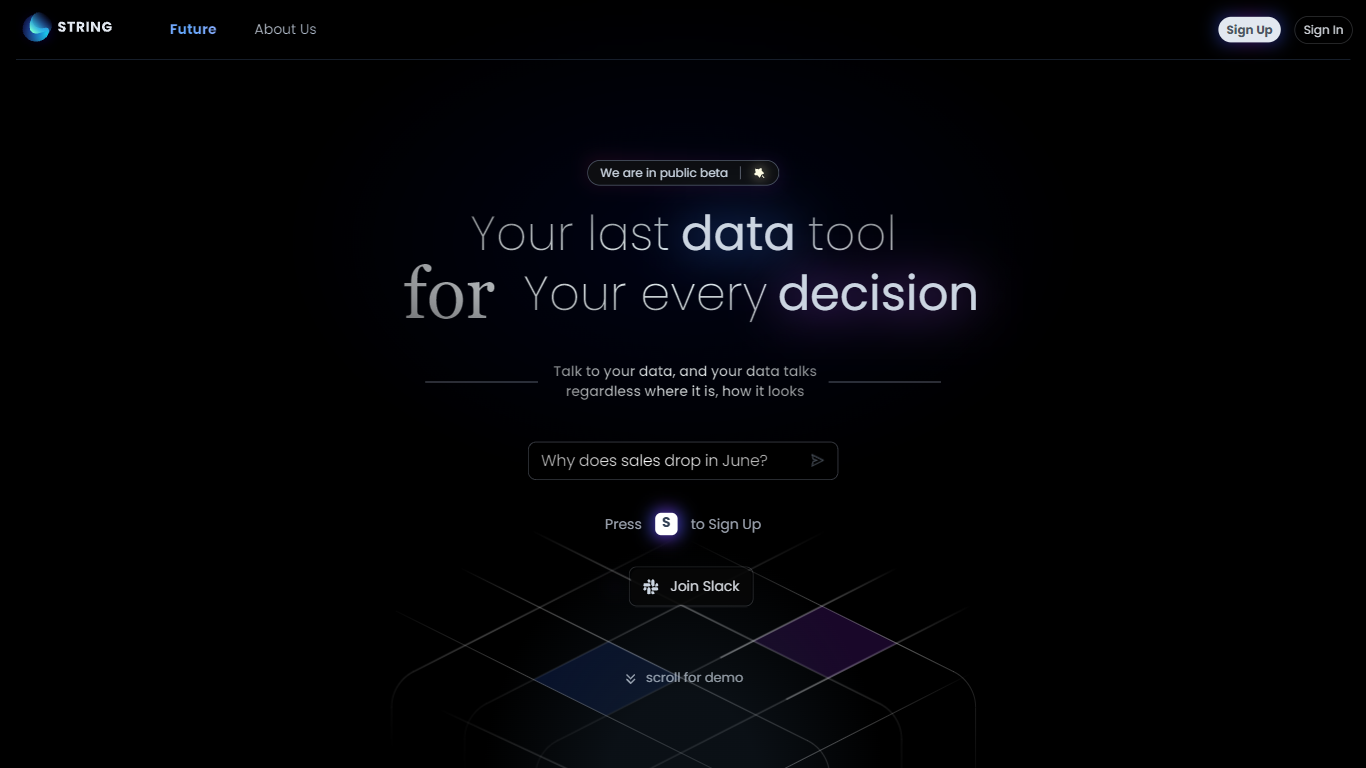
STRING lets you talk to your data through a conversational analytics interface marketed as your last data tool. You sign up for the public beta, connect sources wherever they live, and ask questions in natural language instead of building dashboards first. The product pitch centers on decisions: your data answers back regardless of format or location.
Legacy BI stacks expect hours of SQL and chart assembly before you get a useful answer. STRING's team, with backgrounds at Google, Uber, CMU, and UW, frames the product around AGI-style analytics that listens, understands unstructured text, and takes initiative beyond rigid queries. The Future page contrasts this with older tools that crunch structured tables slowly.
Data analysts, product managers, and operators who want quick answers without standing up a full BI project fit STRING best. It is still in public beta with Slack community access, so teams should expect evolving features rather than a finished enterprise contract page.
Deepnote AI Upvotes
STRING Upvotes
Deepnote AI Top Features
Free plan includes 10 AI code completions and 5 generate, edit, or explain calls per month
Team plan offers GPT-5.5 and Sonnet 4.6 access plus $39 in monthly AI credits per editor
Auto notebook generation builds runnable Python, SQL, and text blocks from a single prompt
Reads connected warehouse schemas and project metadata for context-aware suggestions
Supports 40+ integrations including Snowflake, BigQuery, PostgreSQL, and Databricks via SQL blocks
Workspace admins opt in to AI features; Deepnote holds SOC 2 Type II certification
STRING Top Features
Natural language interface to query data without pre-built dashboard workflows
Public beta signup with Slack community invite for early users
Designed to handle structured databases and unstructured sources like docs and notes
Team includes alumni from Google, Uber, Carnegie Mellon, and University of Washington
Slack community invite linked on homepage for public beta testers
Future roadmap targets proactive analytics that initiates insights beyond user prompts
Deepnote AI Category
- Data Science
STRING Category
- Data Science
Deepnote AI Pricing Type
- Freemium
STRING Pricing Type
- Freemium