FinetuneFast vs Pythia
Dive into the comparison of FinetuneFast vs Pythia and discover which AI Large Language Model (LLM) tool stands out. We examine alternatives, upvotes, features, reviews, pricing, and beyond.
In a comparison between FinetuneFast and Pythia, which one comes out on top?
When we compare FinetuneFast and Pythia, two exceptional large language model (llm) tools powered by artificial intelligence, and place them side by side, several key similarities and differences come to light. FinetuneFast stands out as the clear frontrunner in terms of upvotes. FinetuneFast has 8 upvotes, and Pythia has 6 upvotes.
You don't agree with the result? Cast your vote to help us decide!
FinetuneFast

What is FinetuneFast?
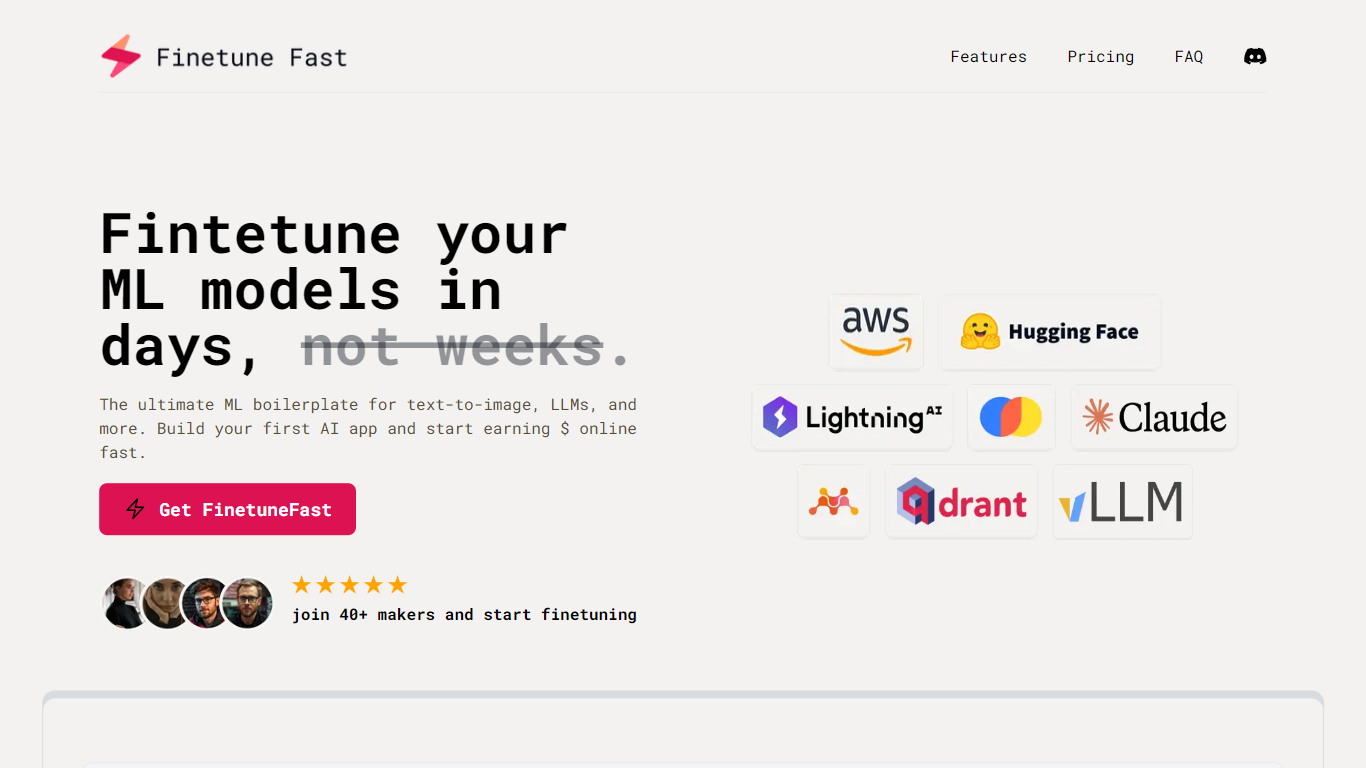
FinetuneFast is a paid boilerplate kit for fine-tuning and deploying machine learning models. It bundles pre-configured training scripts, data loading pipelines, hyperparameter optimization, and deployment templates so developers can move from setup to production faster than building everything from scratch.
The package covers text-to-image, large language models, RAG applications, and related workflows. Included examples reference providers such as AWS Bedrock, Mistral AI, and OpenAI, along with templates for Flux-Schnell text-to-image, Fish-Speech text-to-speech, and retrieval-augmented generation.
After purchase, buyers receive access to GitHub repository materials with documentation. The All In plan adds Discord community access and lifetime updates. Founder Patrick built the product from hands-on ML engineering experience, including work on model training, inference APIs, and scalable infrastructure.
Pythia
What is Pythia?
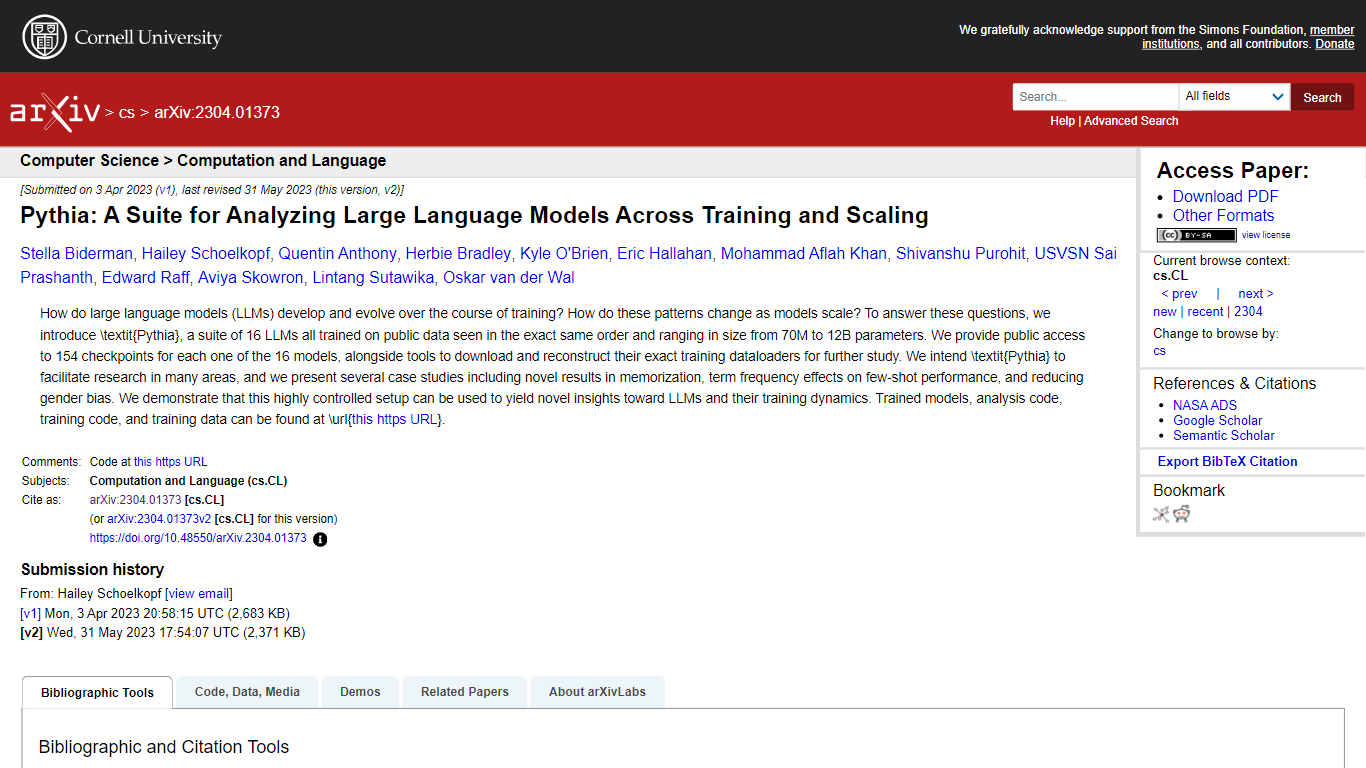
Researchers studying transformer training need checkpoints taken throughout pretraining, not just a finished weight file. Pythia delivers that by training matched LLM families on public data in a fixed order, then releasing weights, checkpoints, training code, and dataloader tools so you can inspect behavior at specific steps.
Where most LLM releases ship one finished checkpoint, Pythia publishes 154 snapshots per model and keeps data order constant across sizes. That control makes it useful for memorization studies, scaling comparisons, and causal training interventions, but it is not aimed at plug-and-play chat deployment the way instruction-tuned assistants are.
The suite targets machine learning researchers, interpretability labs, and alignment teams who need reproducible training trajectories. Typical work includes comparing checkpoints for memorization, testing how term frequency affects few-shot scores, and reproducing published case studies from the repository.
FinetuneFast Upvotes
Pythia Upvotes
FinetuneFast Top Features
Pre-configured training scripts with multi-GPU support and no-code fine-tuning options
Efficient data loading pipelines for preparing and organizing training datasets
Hyperparameter optimization tools to tune model performance
One-click deployment with auto-scaling infrastructure and generated API endpoints
Production-ready inference boilerplates, RAG examples, and AI SaaS starter templates
Model coverage includes Flux-Schnell, Mistral, OpenAI integrations, Fish-Speech TTS, and RAG workflows
Pythia Top Features
154 checkpoints per model at steps 0, 1, 2, 4, 8, 16, 32, 64, 128, 256, 512, 1000, then every 1000 steps
16 model variants across 8 sizes from 70M to 12B, each with standard and deduped Pile training runs
Every model sees about 300 billion tokens in the same data order during training
Weights load from Hugging Face with revision tags such as step3000 via GPTNeoXForCausalLM
Apache 2.0 license covers the repository code and released model weights
FinetuneFast Category
- Large Language Model (LLM)
Pythia Category
- Large Language Model (LLM)
FinetuneFast Pricing Type
- Paid
Pythia Pricing Type
- Free