Galactica vs ggml.ai
Explore the showdown between Galactica vs ggml.ai and find out which AI Large Language Model (LLM) tool wins. We analyze upvotes, features, reviews, pricing, alternatives, and more.
When comparing Galactica and ggml.ai, which one rises above the other?
When we contrast Galactica with ggml.ai, both of which are exceptional AI-operated large language model (llm) tools, and place them side by side, we can spot several crucial similarities and divergences. Galactica is the clear winner in terms of upvotes. Galactica has 8 upvotes, and ggml.ai has 7 upvotes.
Don't agree with the result? Cast your vote and be a part of the decision-making process!
Galactica

What is Galactica?
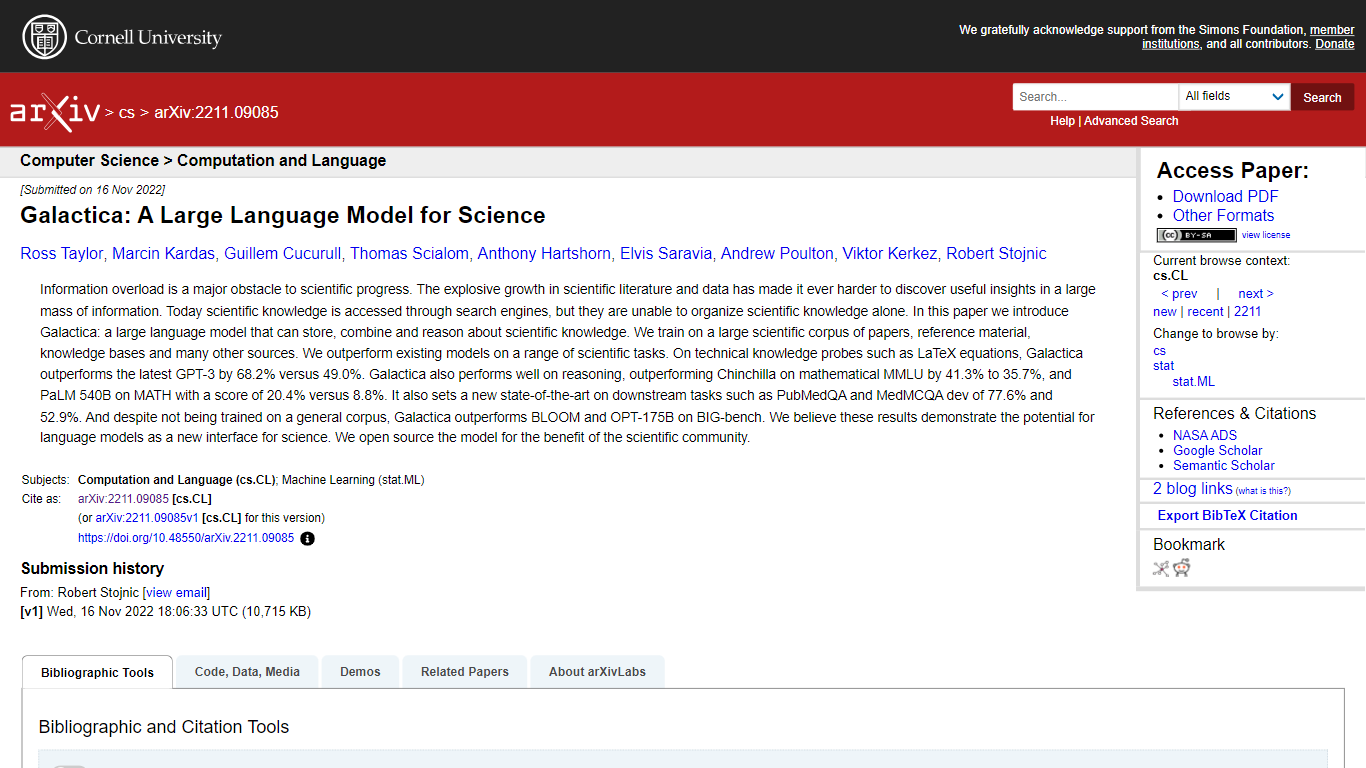
Five open-weight checkpoints from 125M to 120B parameters give researchers a science-trained language model built from 106 billion curated tokens across 48 million papers, textbooks, encyclopedias, and knowledge bases. Galactica stores, combines, and reasons across modalities including LaTeX, Python code, SMILES formulas, and amino acid sequences inside one decoder-only Transformer architecture. Meta's Papers with Code team open sourced the weights for researchers who want to study how language models organize scientific knowledge.
General-purpose LLMs train on broad web crawls where social chatter can dominate the token budget. Galactica used only curated open-access science sources, which the paper argues lets it train for multiple epochs without overfitting. Meta removed the public web demo three days after launch in November 2022 when critics showed confident but fabricated citations and equations, so today you download checkpoints from Hugging Face rather than chat through a hosted interface.
Machine learning researchers can reproduce benchmark numbers from the arXiv paper, including 77.6% on PubMedQA and 52.9% on MedMCQA dev. Computational biologists and chemists can test protein annotation and molecule tasks through Galactica's specialized tokens for amino sequences and SMILES strings. Graduate students exploring scientific QA, citation prediction, or math word problems can experiment with sizes up to 120 billion parameters without training from scratch.
ggml.ai
What is ggml.ai?
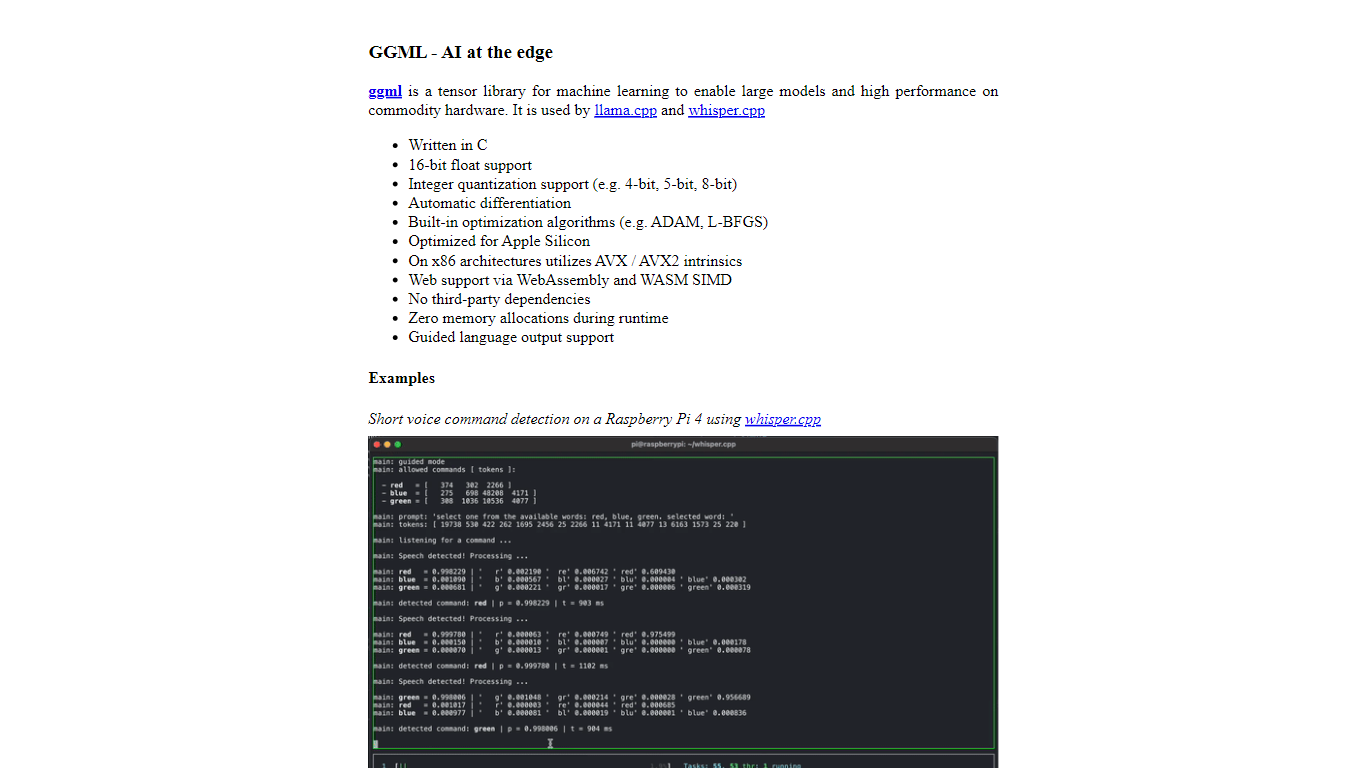
ggml runs large language and speech models on everyday CPUs and GPUs through a compact C tensor library built for on-device inference. ML engineers and app developers adopt it via llama.cpp and whisper.cpp when they want LLaMA or Whisper workloads without cloud-only dependencies.
Frameworks like PyTorch optimize for training clusters and heavy runtimes. ggml keeps the core library minimal with zero runtime memory allocations, no third-party dependencies, and integer quantization so llama.cpp can serve Meta LLaMA weights on laptops and Apple Silicon.
The ggml.ai company was founded in 2023 by Georgi Gerganov to support the library and was acquired by Hugging Face in 2026. The core ggml project stays MIT licensed with open development on GitHub.
Galactica Upvotes
ggml.ai Upvotes
Galactica Top Features
Five checkpoints span 125M, 1.3B, 6.7B, 30B, and 120B parameters
Training corpus totals 106 billion tokens across 48 million scientific papers
Scores 68.2% on LaTeX equation probes versus GPT-3 at 49.0%
Hits 77.6% on PubMedQA and 52.9% on MedMCQA dev benchmarks
30B model reaches 20.4% on MATH versus PaLM 540B at 8.8%
Special tokens cover citations, SMILES formulas, and amino acid sequences
ggml.ai Top Features
Powers llama.cpp for Meta LLaMA inference and whisper.cpp for OpenAI Whisper speech models
Written in C with zero runtime memory allocations during inference
Integer quantization support for smaller models on commodity hardware
No third-party dependencies in the core tensor library
Cross-platform low-level implementation with broad hardware support
MIT licensed open-core library with public development on GitHub
Galactica Category
- Large Language Model (LLM)
ggml.ai Category
- Large Language Model (LLM)
Galactica Pricing Type
- Free
ggml.ai Pricing Type
- Free