Gemini 3 vs ggml.ai
In the face-off between Gemini 3 vs ggml.ai, which AI Large Language Model (LLM) tool takes the crown? We scrutinize features, alternatives, upvotes, reviews, pricing, and more.
In a face-off between Gemini 3 and ggml.ai, which one takes the crown?
If we were to analyze Gemini 3 and ggml.ai, both of which are AI-powered large language model (llm) tools, what would we find? With more upvotes, ggml.ai is the preferred choice. ggml.ai has been upvoted 7 times by aitools.fyi users, and Gemini 3 has been upvoted 6 times.
Think we got it wrong? Cast your vote and show us who's boss!
Gemini 3

What is Gemini 3?
Gemini 3 is Google's frontier large language model, released in November 2025 as the flagship of the Gemini family. It combines reasoning, multimodal understanding, and agentic coding in one model so you can learn from mixed media, build interactive apps, and plan multi-step tasks with less back-and-forth prompting.
Where most frontier models compete on raw benchmark scores alone, Gemini 3 ships across Google's consumer and developer stack on day one: Search AI Mode, the Gemini app, AI Studio, Vertex AI, Gemini CLI, and the Antigravity agentic IDE. That breadth is the trade-off profile. You get one model wired into Gmail, Calendar, and generative search UI, not a standalone API you integrate yourself.
Developers, researchers, and students use Gemini 3 for vibe coding, document analysis, long video lectures, and multi-step planning. Google AI Ultra subscribers in the U.S. can run Gemini Agent for inbox and calendar workflows, while enterprises deploy the same model through Vertex AI and Gemini Enterprise.
Google DeepMind led development with extensive safety testing, including third-party evaluations and a published model card. Related posts on the same blog now cover follow-on models like Gemini 3.7 Flash and Gemini 3.5 Transcribe, while Deep Think remains on a staged rollout to Google AI Ultra subscribers.
ggml.ai
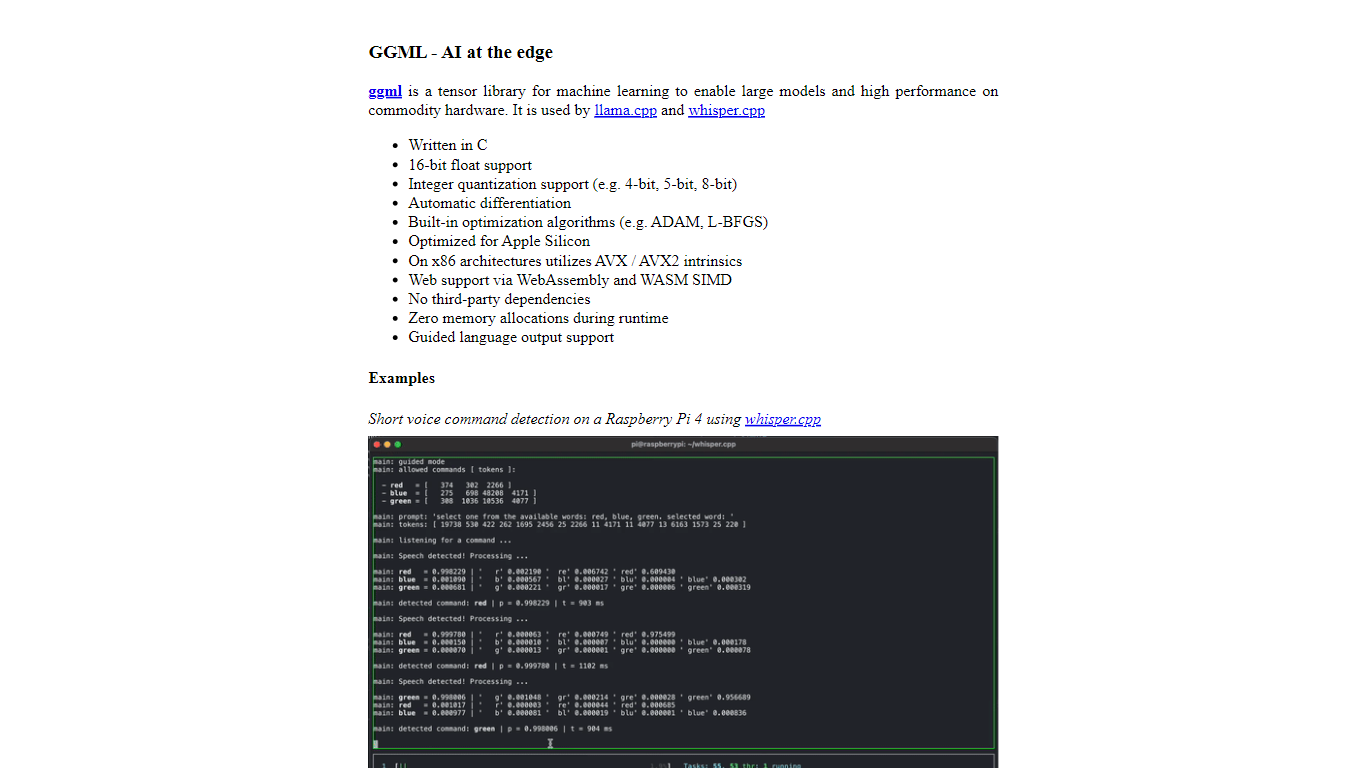
What is ggml.ai?
ggml runs large language and speech models on everyday CPUs and GPUs through a compact C tensor library built for on-device inference. ML engineers and app developers adopt it via llama.cpp and whisper.cpp when they want LLaMA or Whisper workloads without cloud-only dependencies.
Frameworks like PyTorch optimize for training clusters and heavy runtimes. ggml keeps the core library minimal with zero runtime memory allocations, no third-party dependencies, and integer quantization so llama.cpp can serve Meta LLaMA weights on laptops and Apple Silicon.
The ggml.ai company was founded in 2023 by Georgi Gerganov to support the library and was acquired by Hugging Face in 2026. The core ggml project stays MIT licensed with open development on GitHub.
Gemini 3 Upvotes
ggml.ai Upvotes
Gemini 3 Top Features
1501 Elo on LMArena with a 1 million-token context window across text, images, video, audio, and code
Deep Think mode scores 41.0% on Humanity's Last Exam, rolling out to Google AI Ultra subscribers after safety review
Generative UI in AI Mode in Search builds visual layouts and interactive simulations from a single query
1487 Elo on WebDev Arena and 76.2% on SWE-bench Verified for agentic coding
Gemini Agent handles multi-step tasks across Gmail, Calendar, and the web for Google AI Ultra users in the U.S.
Available in Google AI Studio, Vertex AI, Gemini CLI, Antigravity, and third-party platforms like Cursor and GitHub
54.2% on Terminal-Bench 2.0 for terminal-based tool use and computer operation
ggml.ai Top Features
Powers llama.cpp for Meta LLaMA inference and whisper.cpp for OpenAI Whisper speech models
Written in C with zero runtime memory allocations during inference
Integer quantization support for smaller models on commodity hardware
No third-party dependencies in the core tensor library
Cross-platform low-level implementation with broad hardware support
MIT licensed open-core library with public development on GitHub
Gemini 3 Category
- Large Language Model (LLM)
ggml.ai Category
- Large Language Model (LLM)
Gemini 3 Pricing Type
- Freemium
ggml.ai Pricing Type
- Free