ggml.ai vs Alethea AI
In the contest of ggml.ai vs Alethea AI, which AI Large Language Model (LLM) tool is the champion? We evaluate pricing, alternatives, upvotes, features, reviews, and more.
If you had to choose between ggml.ai and Alethea AI, which one would you go for?
When we examine ggml.ai and Alethea AI, both of which are AI-enabled large language model (llm) tools, what unique characteristics do we discover? Interestingly, both tools have managed to secure the same number of upvotes. The power is in your hands! Cast your vote and have a say in deciding the winner.
Not your cup of tea? Upvote your preferred tool and stir things up!
ggml.ai
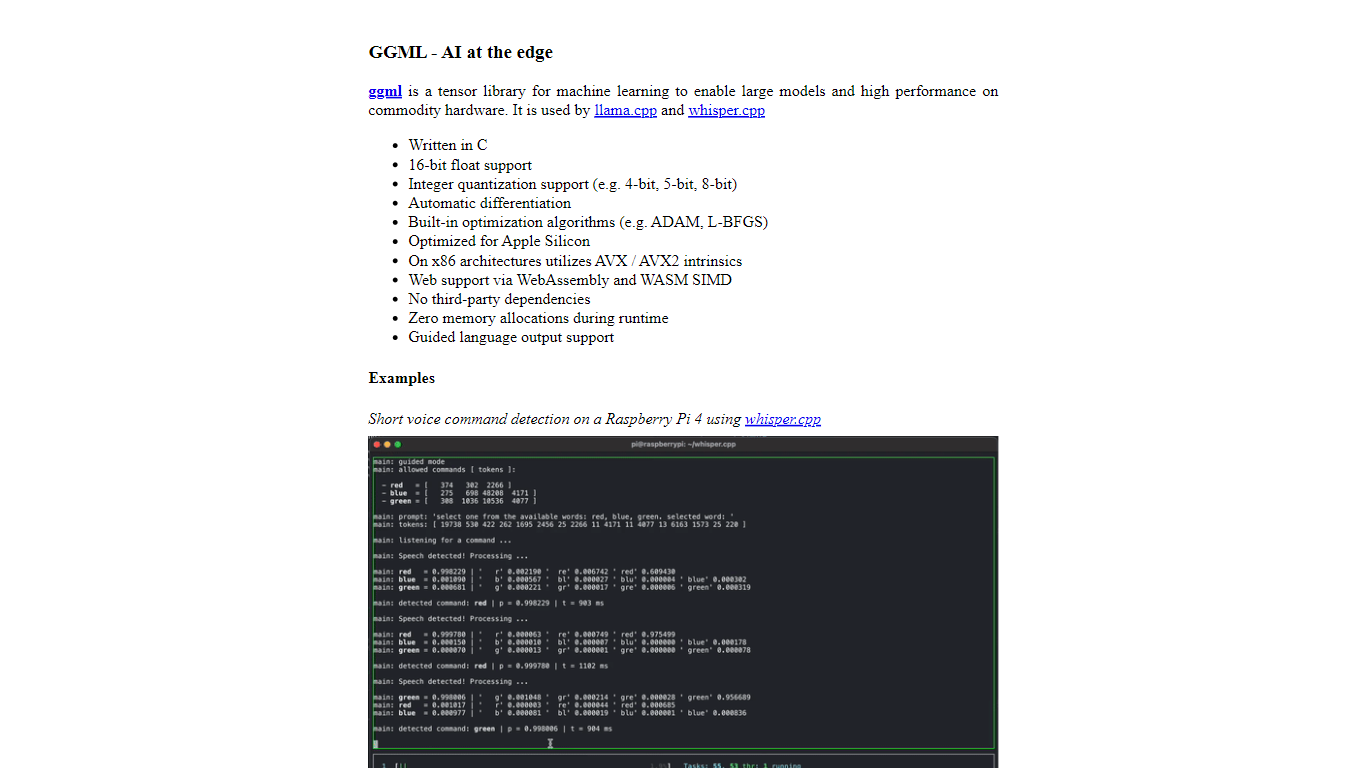

What is ggml.ai?
ggml.ai is at the forefront of AI technology, bringing powerful machine learning capabilities directly to the edge with its innovative tensor library. Built for large model support and high performance on common hardware platforms, ggml.ai enables developers to implement advanced AI algorithms without the need for specialized equipment. The platform, written in the efficient C programming language, offers 16-bit float and integer quantization support, along with automatic differentiation and various built-in optimization algorithms like ADAM and L-BFGS. It boasts optimized performance for Apple Silicon and leverages AVX/AVX2 intrinsics on x86 architectures. Web-based applications can also exploit its capabilities via WebAssembly and WASM SIMD support. With its zero runtime memory allocations and absence of third-party dependencies, ggml.ai presents a minimal and efficient solution for on-device inference.
Projects like whisper.cpp and llama.cpp demonstrate the high-performance inference capabilities of ggml.ai, with whisper.cpp providing speech-to-text solutions and llama.cpp focusing on efficient inference of Meta's LLaMA large language model. Moreover, the company welcomes contributions to its codebase and supports an open-core development model through the MIT license. As ggml.ai continues to expand, it seeks talented full-time developers with a shared vision for on-device inference to join their team.
Designed to push the envelope of AI at the edge, ggml.ai is a testament to the spirit of play and innovation in the AI community.
Alethea AI
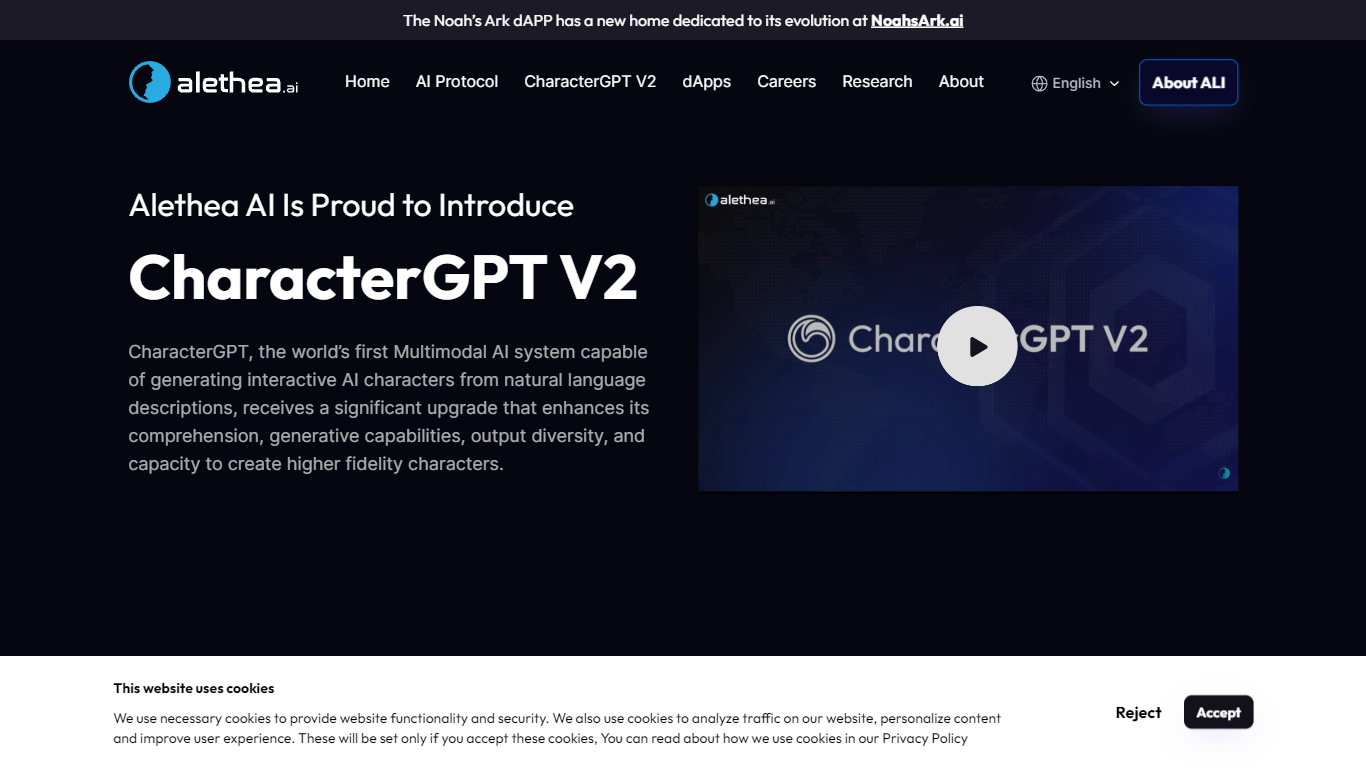
What is Alethea AI?
Alethea AI is a research and development studio that combines the power of Generative AI and Blockchain to enable decentralized ownership and democratic governance of AI. Their website showcases their innovative AI system called CharacterGPT V2, which is capable of generating interactive AI characters from natural language descriptions. With enhancements in comprehension, generative capabilities, output diversity, and character fidelity, CharacterGPT V2 is revolutionizing content creation. Users can quickly generate AI characters with higher fidelity appearances, voices, personalities, and identities. These characters can be tokenized on the blockchain, customized, and trained to fulfill various roles and tasks. CharacterGPT V2 is versatile and can be used to create AI characters for digital twins, digital guides, digital companions, virtual assistants, licensed AI collectibles, AI NPCs, parody, and satire. To access CharacterGPT V2, users can visit the MyCharacter.ai decentralized application (dApp). Alethea AI is a proud contributor to the AI Protocol, which serves as the property rights backbone for the generative AI economy. The AI Protocol enables ownership, interoperability, and governance of AI Characters and Assets. It offers a suite of tools for building AI-powered dApps, allowing for gasless transactions, multi-blockchain compatibility, non-custodial wallet creation, and more. By tokenizing AI Characters on the AI Protocol, creators benefit from provable ownership, data sovereignty, character assets, intelligence customization, and decentralized interoperability.
ggml.ai Upvotes
Alethea AI Upvotes
ggml.ai Top Features
Written in C: Ensures high performance and compatibility across a range of platforms.
Optimization for Apple Silicon: Delivers efficient processing and lower latency on Apple devices.
Support for WebAssembly and WASM SIMD: Facilitates web applications to utilize machine learning capabilities.
No Third-Party Dependencies: Makes for an uncluttered codebase and convenient deployment.
Guided Language Output Support: Enhances human-computer interaction with more intuitive AI-generated responses.
Alethea AI Top Features
Enhanced Comprehension: CharacterGPT V2 has improved comprehensive capabilities allowing for better understanding of user requests and interactions.
Higher Fidelity Characters: Users can generate AI characters with higher fidelity appearances voices personalities and identities.
Customizability: The generated AI characters can be customized and trained to fulfill a variety of roles and tasks.
Tokenization on the Blockchain: AI characters can be tokenized on the blockchain ensuring provable ownership and enabling decentralized trading.
Versatility: CharacterGPT V2 can be used to create AI characters for various use cases such as digital twins digital guides virtual assistants and more.
ggml.ai Category
- Large Language Model (LLM)
Alethea AI Category
- Large Language Model (LLM)
ggml.ai Pricing Type
- Freemium
Alethea AI Pricing Type
- Paid