ggml.ai vs ChatGPT
In the battle of ggml.ai vs ChatGPT, which AI Large Language Model (LLM) tool comes out on top? We compare reviews, pricing, alternatives, upvotes, features, and more.
Between ggml.ai and ChatGPT, which one is superior?
Upon comparing ggml.ai with ChatGPT, which are both AI-powered large language model (llm) tools, With more upvotes, ChatGPT is the preferred choice. ChatGPT has garnered 17 upvotes, and ggml.ai has garnered 7 upvotes.
Don't agree with the result? Cast your vote and be a part of the decision-making process!
ggml.ai
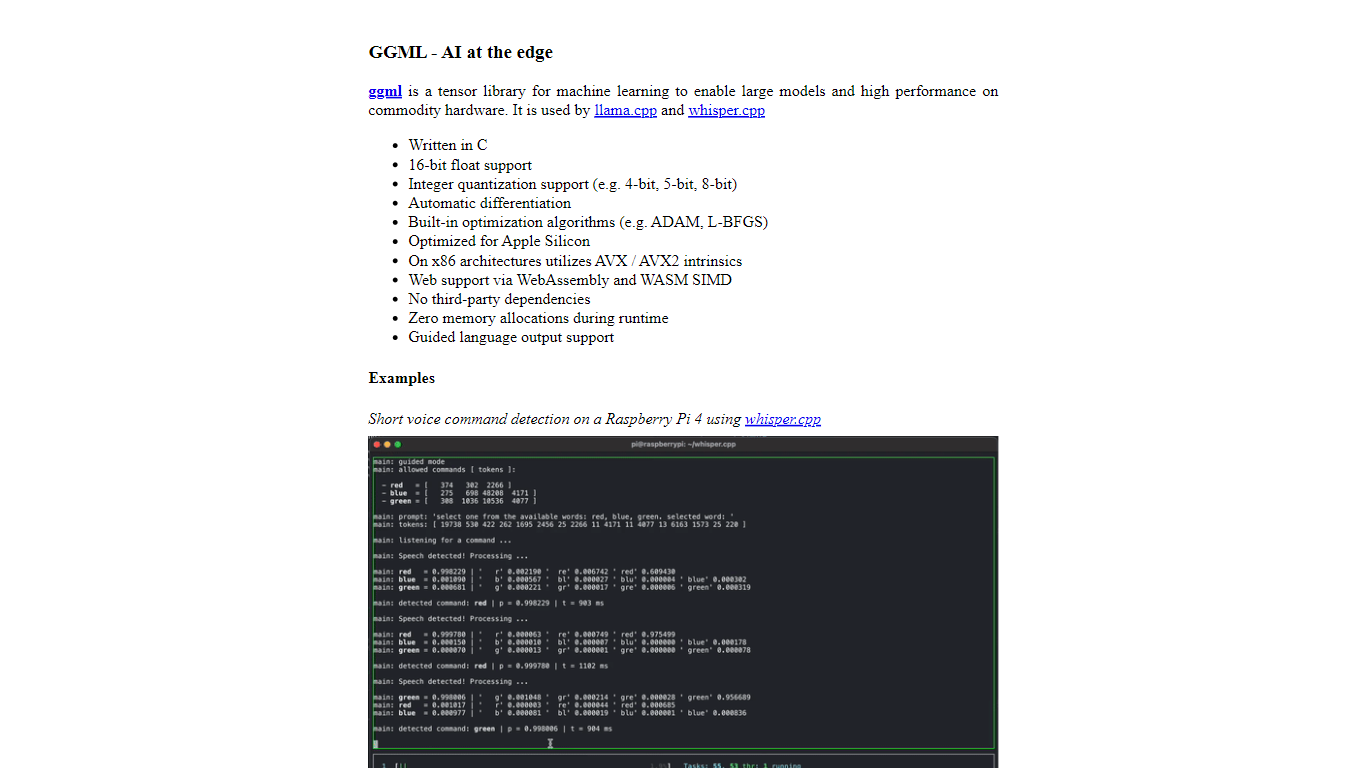

What is ggml.ai?
ggml runs large language and speech models on everyday CPUs and GPUs through a compact C tensor library built for on-device inference. ML engineers and app developers adopt it via llama.cpp and whisper.cpp when they want LLaMA or Whisper workloads without cloud-only dependencies.
Frameworks like PyTorch optimize for training clusters and heavy runtimes. ggml keeps the core library minimal with zero runtime memory allocations, no third-party dependencies, and integer quantization so llama.cpp can serve Meta LLaMA weights on laptops and Apple Silicon.
The ggml.ai company was founded in 2023 by Georgi Gerganov to support the library and was acquired by Hugging Face in 2026. The core ggml project stays MIT licensed with open development on GitHub.
ChatGPT
What is ChatGPT?
ChatGPT is OpenAI's conversational large language model you reach through chatgpt.com on the web, iOS, and Android. You type or speak a prompt, and it answers in plain language, follows up on earlier messages, and can draft code, summarize files, generate images, or run multi-step research from one thread.
Where raw API access leaves wiring to you, ChatGPT bundles frontier GPT-5.6 models, memory, custom GPTs, voice, and agent workflows like ChatGPT Work and Codex behind a single login. The trade-off is less control over model parameters and tighter usage caps on Free and Go than you'd get calling the API directly.
It fits students drafting essays, developers debugging code, marketers shaping campaigns, and business teams that want shared workspaces with admin controls. OpenAI also publishes ChatGPT Business and Enterprise tiers with SSO, unified billing, and policies that keep workspace data out of model training.
ggml.ai Upvotes
ChatGPT Upvotes
ggml.ai Top Features
Powers llama.cpp for Meta LLaMA inference and whisper.cpp for OpenAI Whisper speech models
Written in C with zero runtime memory allocations during inference
Integer quantization support for smaller models on commodity hardware
No third-party dependencies in the core tensor library
Cross-platform low-level implementation with broad hardware support
MIT licensed open-core library with public development on GitHub
ChatGPT Top Features
Free tier includes unlimited text chats with GPT-5.6 Luna, with limits on uploads, image generation, voice, and deep research
Plus unlocks custom GPTs, scheduled tasks, projects, and expanded access to GPT-5.6 reasoning models
Pro offers 5x or 20x more usage plus GPT-5.6 Sol Pro for maximum reasoning and Codex workloads
ChatGPT Work turns a stated goal into a plan, gathers context, and checks in when your approval is needed
Codex helps teams build, debug, and ship code inside the same ChatGPT workspace
Runs on web, iOS, and Android with voice chat, file uploads, memory, search, and data analysis tools
ggml.ai Category
- Large Language Model (LLM)
ChatGPT Category
- Large Language Model (LLM)
ggml.ai Pricing Type
- Free
ChatGPT Pricing Type
- Freemium