LlamaIndex vs ggml.ai
In the face-off between LlamaIndex vs ggml.ai, which AI Large Language Model (LLM) tool takes the crown? We scrutinize features, alternatives, upvotes, reviews, pricing, and more.
In a face-off between LlamaIndex and ggml.ai, which one takes the crown?
If we were to analyze LlamaIndex and ggml.ai, both of which are AI-powered large language model (llm) tools, what would we find? ggml.ai stands out as the clear frontrunner in terms of upvotes. ggml.ai has 7 upvotes, and LlamaIndex has 6 upvotes.
Disagree with the result? Upvote your favorite tool and help it win!
LlamaIndex

What is LlamaIndex?
Developers building LLM apps use LlamaIndex to parse messy documents before retrieval or agent steps. LlamaParse turns PDFs, scans, tables, charts, and handwritten notes into structured markdown and JSON, then adds schema-based extraction, classification, splitting, and indexing on top. Open-source LlamaIndex and Workflows libraries cover the same RAG building blocks for teams that want to self-host pieces of the stack.
Where generic OCR tools stop at plain text, LlamaParse routes pages through task-specific agents with auto-correction loops, so messy layouts survive as clean markdown or JSON without custom templates. Auto Mode picks a parse tier per page and can cut credit spend by up to 80%, which matters when you are processing invoices, claims, or technical manuals at volume rather than one-off uploads.
Teams in finance, insurance, manufacturing, and healthcare use LlamaIndex to feed LLMs and document agents with citation-backed fields instead of brittle copy-paste. Developers get Python and TypeScript SDKs, a REST API, and optional VPC deployment when SaaS data residency is not enough.
ggml.ai
What is ggml.ai?
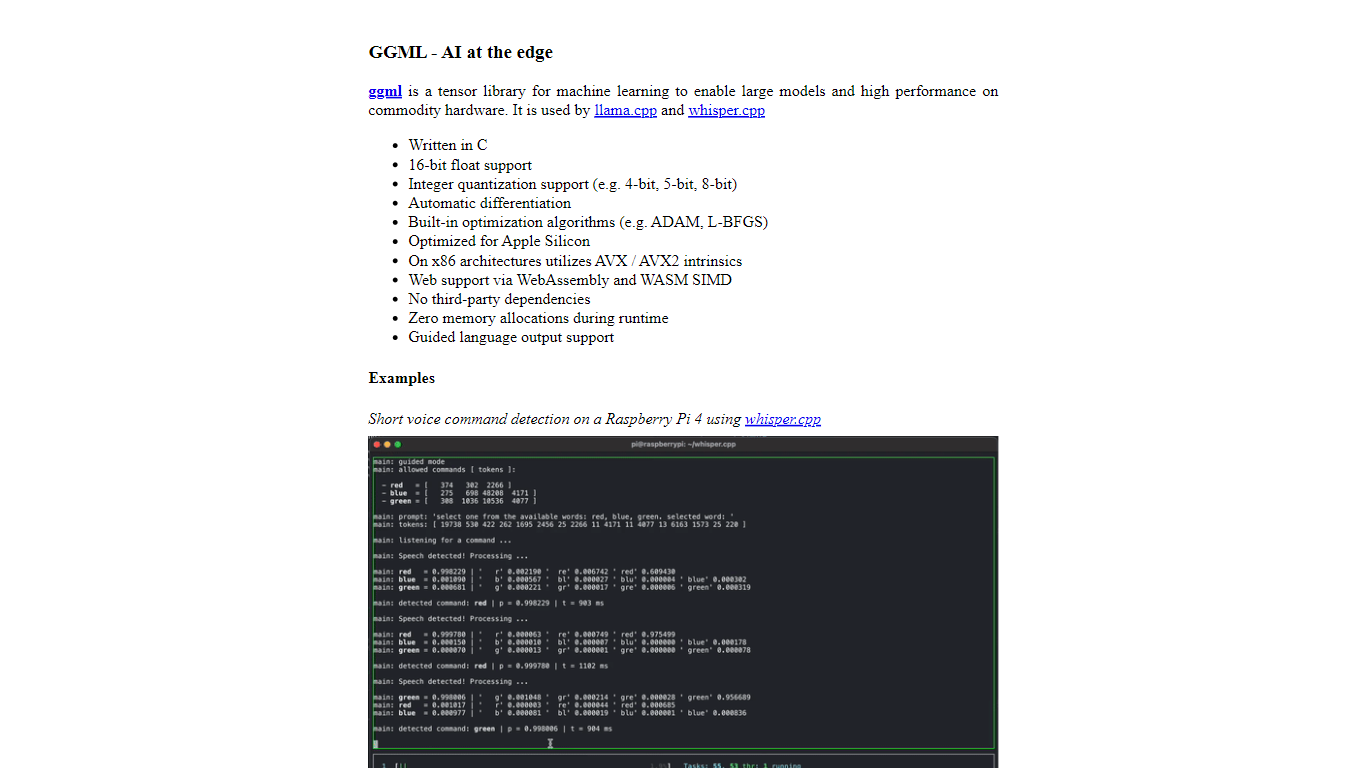
ggml runs large language and speech models on everyday CPUs and GPUs through a compact C tensor library built for on-device inference. ML engineers and app developers adopt it via llama.cpp and whisper.cpp when they want LLaMA or Whisper workloads without cloud-only dependencies.
Frameworks like PyTorch optimize for training clusters and heavy runtimes. ggml keeps the core library minimal with zero runtime memory allocations, no third-party dependencies, and integer quantization so llama.cpp can serve Meta LLaMA weights on laptops and Apple Silicon.
The ggml.ai company was founded in 2023 by Georgi Gerganov to support the library and was acquired by Hugging Face in 2026. The core ggml project stays MIT licensed with open development on GitHub.
LlamaIndex Upvotes
ggml.ai Upvotes
LlamaIndex Top Features
Free tier includes 10,000 credits per month, roughly 1,000 pages at basic parse rates
Parses 130+ file types including PDF, Office docs, spreadsheets, and images
Agentic parse tiers with Auto Mode routing that can save up to 80% on credits
LlamaExtract returns field-level confidence scores and citations tied to source pages
Enterprise plans support VPC deployment with SOC 2, HIPAA, and GDPR compliance
Open-source LiteParse runs locally with no cloud tokens for PDF and Office parsing
Concurrent parse jobs scale from 5 on Free to 100 on Enterprise plans
ggml.ai Top Features
Powers llama.cpp for Meta LLaMA inference and whisper.cpp for OpenAI Whisper speech models
Written in C with zero runtime memory allocations during inference
Integer quantization support for smaller models on commodity hardware
No third-party dependencies in the core tensor library
Cross-platform low-level implementation with broad hardware support
MIT licensed open-core library with public development on GitHub
LlamaIndex Category
- Large Language Model (LLM)
ggml.ai Category
- Large Language Model (LLM)
LlamaIndex Pricing Type
- Freemium
ggml.ai Pricing Type
- Free