ggml.ai vs Helicone
Dive into the comparison of ggml.ai vs Helicone and discover which AI Large Language Model (LLM) tool stands out. We examine alternatives, upvotes, features, reviews, pricing, and beyond.
When comparing ggml.ai and Helicone, which one rises above the other?
When we compare ggml.ai and Helicone, two exceptional large language model (llm) tools powered by artificial intelligence, and place them side by side, several key similarities and differences come to light. The users have made their preference clear, ggml.ai leads in upvotes. ggml.ai has garnered 7 upvotes, and Helicone has garnered 6 upvotes.
Want to flip the script? Upvote your favorite tool and change the game!
ggml.ai

What is ggml.ai?
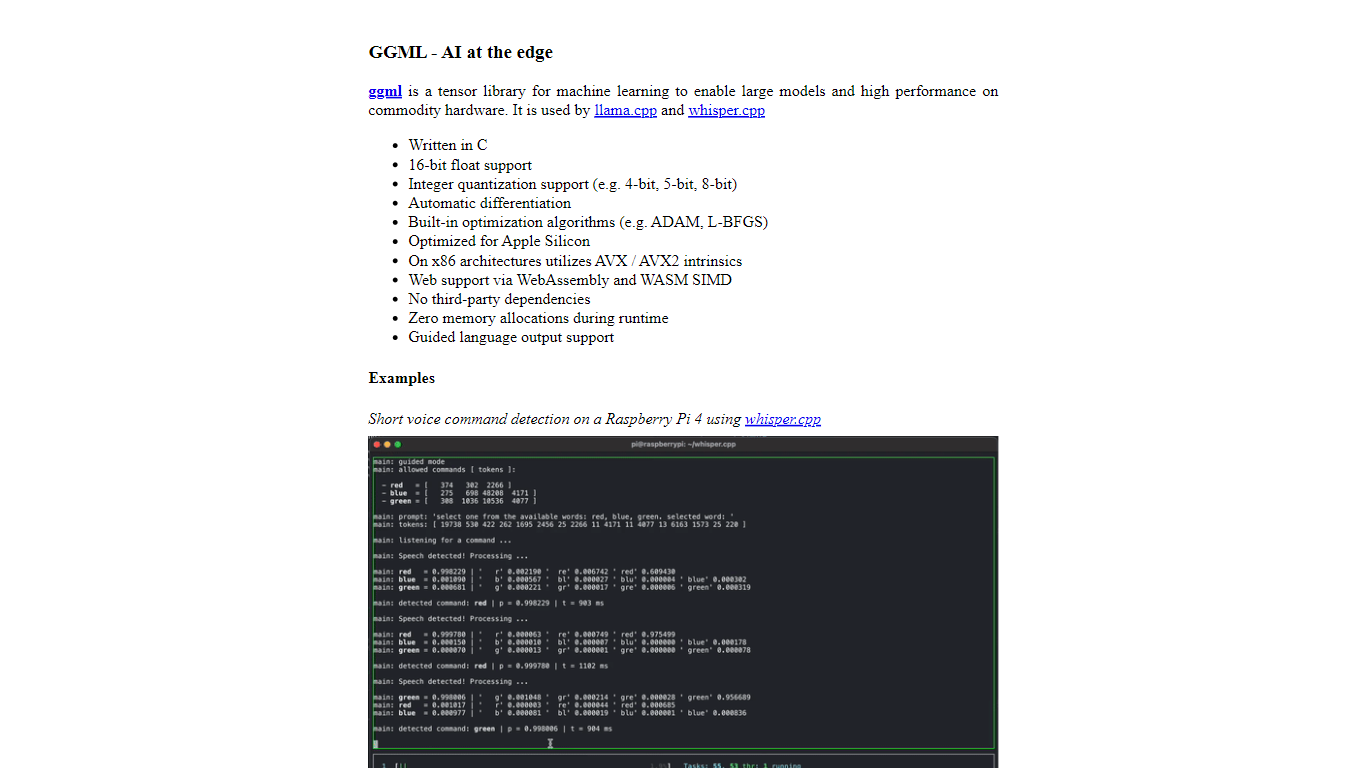
ggml runs large language and speech models on everyday CPUs and GPUs through a compact C tensor library built for on-device inference. ML engineers and app developers adopt it via llama.cpp and whisper.cpp when they want LLaMA or Whisper workloads without cloud-only dependencies.
Frameworks like PyTorch optimize for training clusters and heavy runtimes. ggml keeps the core library minimal with zero runtime memory allocations, no third-party dependencies, and integer quantization so llama.cpp can serve Meta LLaMA weights on laptops and Apple Silicon.
The ggml.ai company was founded in 2023 by Georgi Gerganov to support the library and was acquired by Hugging Face in 2026. The core ggml project stays MIT licensed with open development on GitHub.
Helicone
What is Helicone?
Helicone is an open-source AI gateway and observability platform for production LLM apps. Point the OpenAI SDK at https://ai-gateway.helicone.ai and you can call 100+ models from OpenAI, Anthropic, Google, and other providers while Helicone logs latency, token usage, cost, and errors automatically.
Most model routers charge a markup and bolt observability on later. Helicone combines routing with monitoring: automatic provider failover, cross-provider caching, granular rate limits, session tracking, and a unified dashboard for debugging prompts. The credits product advertises 0% markup on model usage, so you pay provider rates plus standard payment processing rather than a platform surcharge.
Helicone's Hobby plan includes 10,000 monitored requests per month with a 7-day retention window, while Pro and Team tiers add longer retention, higher ingestion limits, prompts, datasets, and gateway features like caching and automatic fallbacks. The company is open source with self-host and managed cloud options, and the homepage notes Helicone joined Mintlify in 2026.
ggml.ai Upvotes
Helicone Upvotes
ggml.ai Top Features
Powers llama.cpp for Meta LLaMA inference and whisper.cpp for OpenAI Whisper speech models
Written in C with zero runtime memory allocations during inference
Integer quantization support for smaller models on commodity hardware
No third-party dependencies in the core tensor library
Cross-platform low-level implementation with broad hardware support
MIT licensed open-core library with public development on GitHub
Helicone Top Features
OpenAI-compatible gateway endpoint at ai-gateway.helicone.ai for 100+ LLM providers
Automatic provider failover, load balancing, and intelligent cheapest-route selection
Built-in observability with sessions, user analytics, custom properties, and cost tracking
Hobby plan includes 10,000 requests per month with 7-day log retention
Cross-provider caching and granular rate limits by user, team, or cost
0% markup Helicone Credits billing across OpenAI, Anthropic, Google, and other providers
Open-source codebase with self-hosted and managed cloud deployment options
ggml.ai Category
- Large Language Model (LLM)
Helicone Category
- Large Language Model (LLM)
ggml.ai Pricing Type
- Free
Helicone Pricing Type
- Freemium