GLM-130B vs Stellaris AI
When comparing GLM-130B vs Stellaris AI, which AI Large Language Model (LLM) tool shines brighter? We look at pricing, alternatives, upvotes, features, reviews, and more.
In a comparison between GLM-130B and Stellaris AI, which one comes out on top?
When we put GLM-130B and Stellaris AI side by side, both being AI-powered large language model (llm) tools, The community has spoken, GLM-130B leads with more upvotes. GLM-130B has received 7 upvotes from aitools.fyi users, while Stellaris AI has received 6 upvotes.
Feeling rebellious? Cast your vote and shake things up!
GLM-130B

What is GLM-130B?
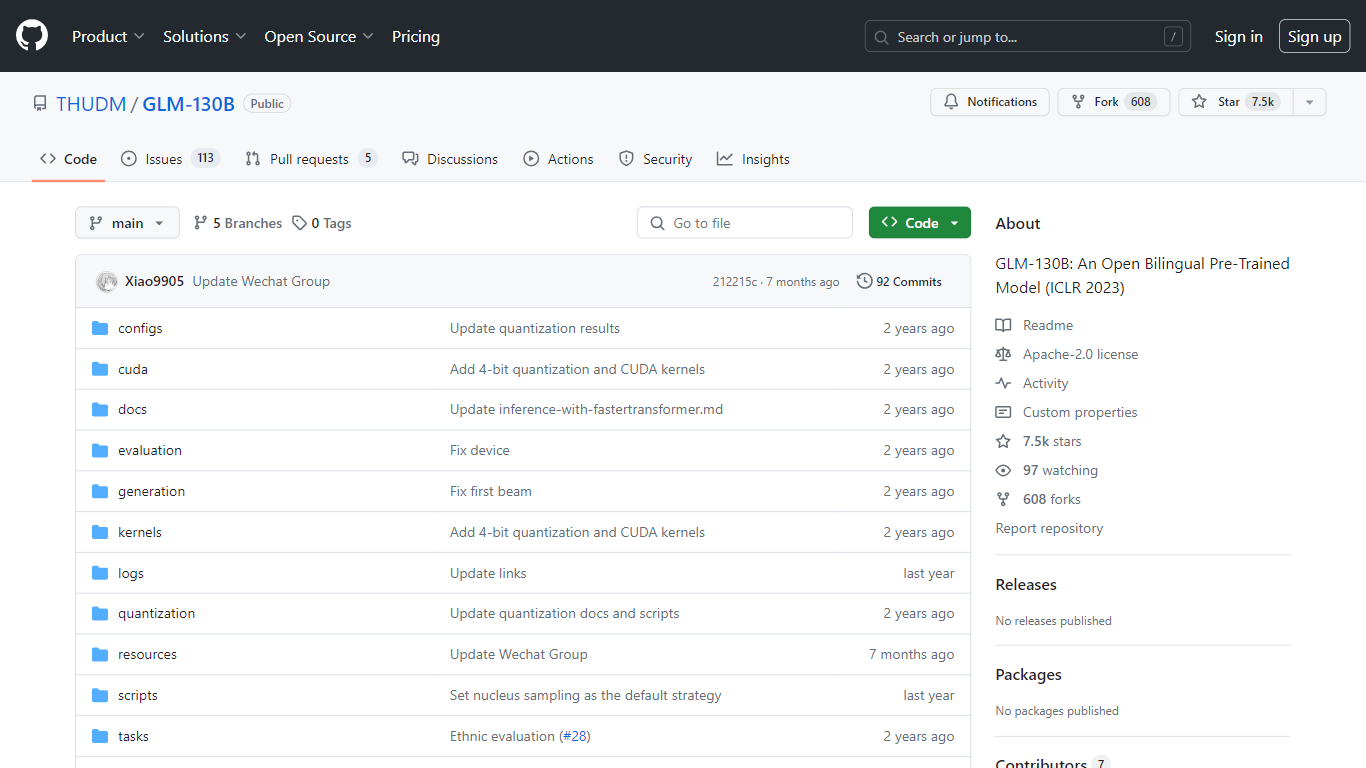
GLM-130B puts a 130-billion-parameter bilingual language model in the open research stack THUDM built around the General Language Model (GLM) pre-training recipe. The weights target English and Chinese text, and the GitHub repo ships inference code, evaluation tasks, and checkpoints accepted at ICLR 2023. You can run left-to-right generation or blank infilling with [MASK] and [gMASK] tokens on hardware that fits a single multi-GPU server rather than a proprietary API.
Where most 100B+ models stay behind closed doors, GLM-130B publishes model weights, training notes, and YAML configs for 30+ benchmarks. Its INT4 quantization path is tuned so four RTX 3090 (24GB) cards can host inference with almost no accuracy drop, a much lower bar than the eight A100 (40GB) setup used for full FP16 runs. The training objective mixes autoregressive blank infilling on 95% of tokens with multi-task instruction data from T0++ and DeepStruct, which is a different bet than standard causal GPT-style pre-training.
Researchers studying bilingual zero-shot transfer, large-model quantization, or reproducible LLM benchmarks will get the most from GLM-130B. The repo focuses on evaluation and inference tooling rather than a hosted chat product, though THUDM later spun dialogue work into ChatGLM. Expect to bring your own GPUs, storage for a 260GB checkpoint, and patience for the weight download form.
Stellaris AI
What is Stellaris AI?
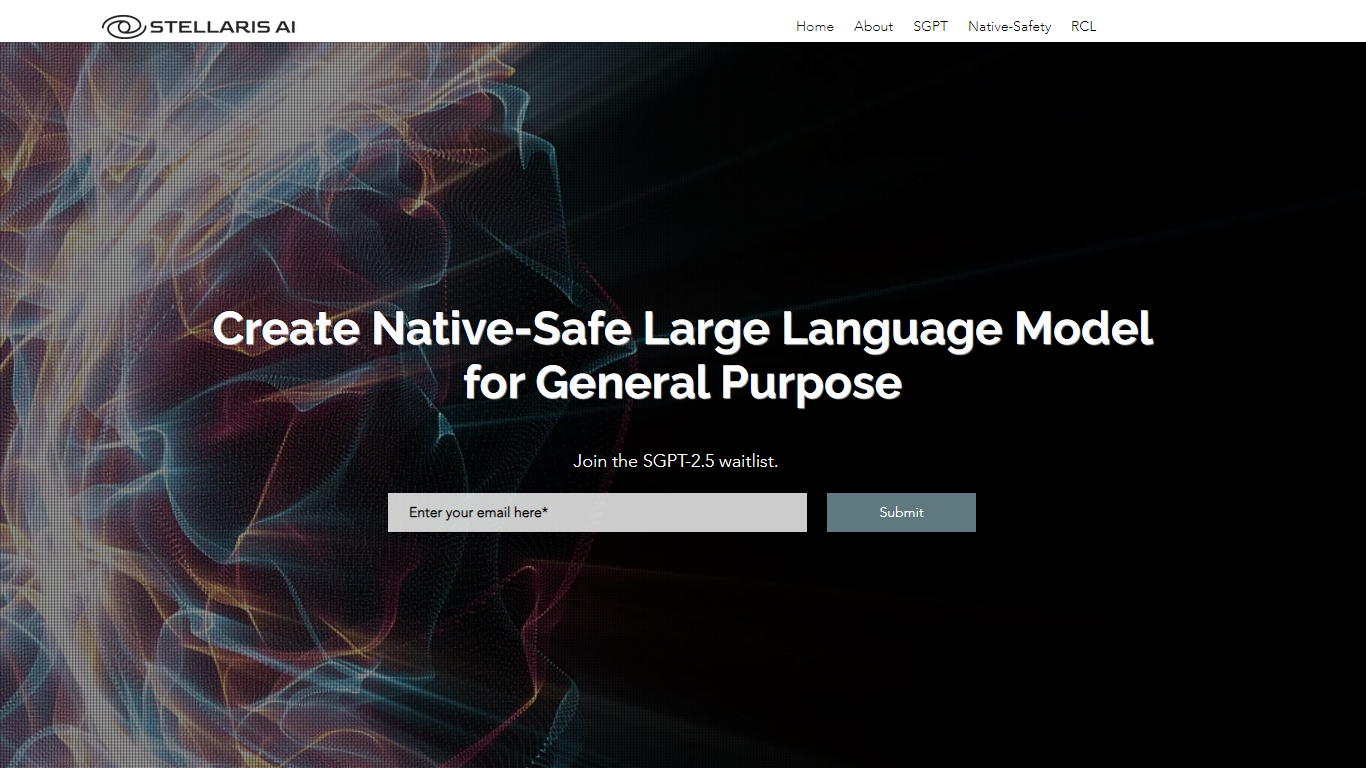
Stellaris AI builds large language models marketed around native safety and human-like reasoning for real-world tasks. Its flagship SGPT line targets text and code generation, knowledge Q&A, logical reasoning, and analytics at a scale the company describes as hundreds of billions of parameters. The public site centers on a waitlist for SGPT-4.5 rather than a self-serve chat product you can open today.
Where many LLM labs bolt safety filters on after training, Stellaris AI frames safety as part of the model stack through strict source referencing and harm minimization in the architecture. It also highlights Real-time Context Learning (RCL) for adapting answers with live knowledge, a combination aimed at teams that want cited outputs instead of unchecked generation.
Researchers, enterprise AI teams, and early adopters join the SGPT-4.5 waitlist for first access. The company cites 10+ years of research and three core product pillars: Stellaris GPT, Native Safety, and RCL.
GLM-130B Upvotes
Stellaris AI Upvotes
GLM-130B Top Features
130 billion parameters trained on 400+ billion tokens split evenly between English and Chinese
Full FP16 inference on one server with 8 A100 (40GB) or 8 V100 (32GB) GPUs; INT4 quantization drops requirements to 4 RTX 3090 (24GB) cards
NVIDIA FasterTransformer integration reaches up to 2.5x faster decode than Megatron on A100 hardware
Repository ships YAML evaluation configs for 30+ NLP tasks with reproducible benchmark scripts
Two mask tokens support workflows: [MASK] for short blank filling and [gMASK] for left-to-right long generation
Model checkpoint ships as a 260GB archive split across 60 downloadable chunks after form-based access approval
Stellaris AI Top Features
SGPT models described at 100B+ parameters for text, code, and reasoning tasks
Native Safety framework with strict source referencing and harm minimization
Real-time Context Learning (RCL) for live knowledge integration
Three product pillars: Stellaris GPT, Native Safety, and RCL
SGPT-4.5 waitlist open for early access signups on the homepage
GLM-130B Category
- Large Language Model (LLM)
Stellaris AI Category
- Large Language Model (LLM)
GLM-130B Pricing Type
- Free
Stellaris AI Pricing Type
- Freemium