Hex vs Latitude
Compare Hex vs Latitude and see which AI Analytics tool is better when we compare features, reviews, pricing, alternatives, upvotes, etc.
Which one is better? Hex or Latitude?
When we compare Hex with Latitude, which are both AI-powered analytics tools, The upvote count reveals a draw, with both tools earning the same number of upvotes. You can help us determine the winner by casting your vote and tipping the scales in favor of one of the tools.
Feeling rebellious? Cast your vote and shake things up!
Hex

What is Hex?
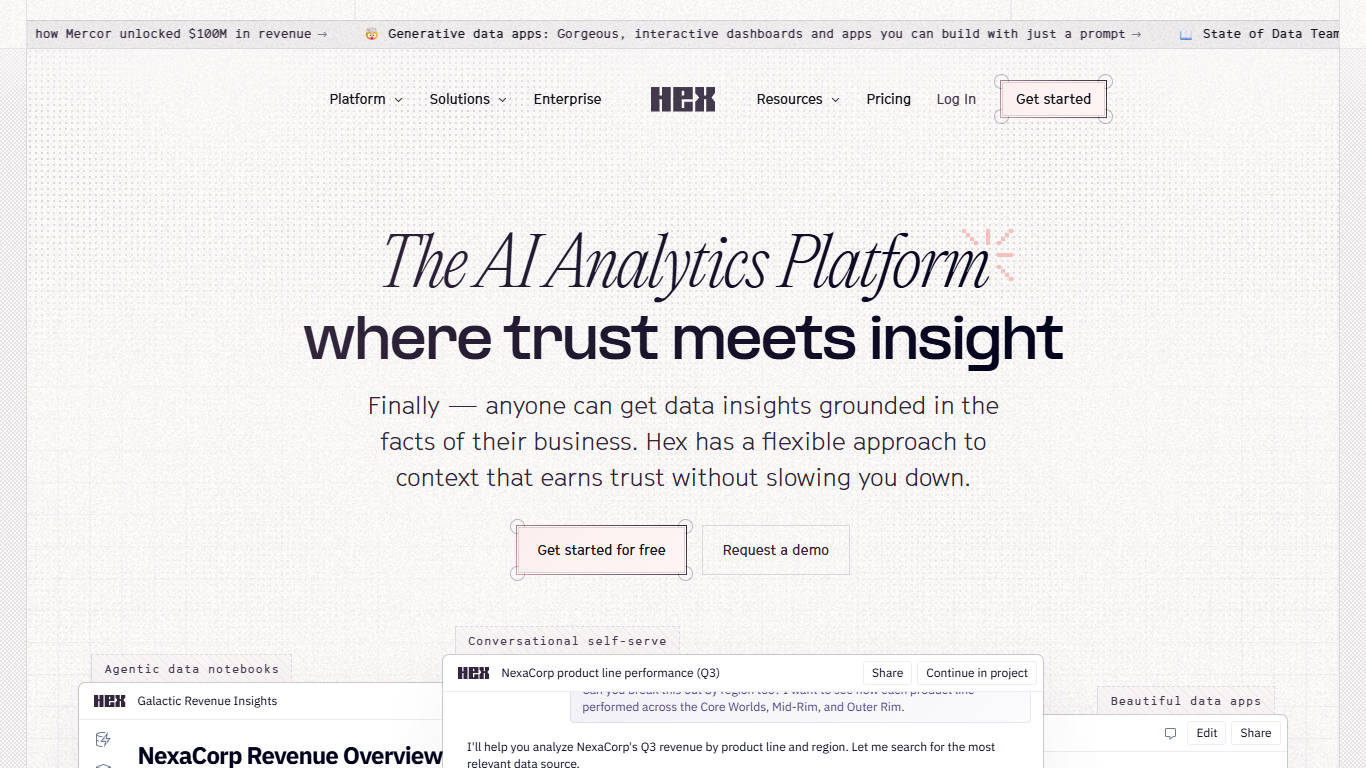
Hex is an analytics workspace that combines agentic notebooks, conversational self-serve, and publishable data apps. Data practitioners write SQL and Python in notebooks with an AI agent that builds queries and charts, while business users ask plain-language questions through Threads in Hex, Slack, or MCP. Every answer draws from the same shared context layer of semantic models, business rules, and endorsed tables.
Traditional BI tools split deep analysis from reporting, which means separate notebooks, dashboards, and Slack threads with no shared logic. Hex keeps code-based notebooks, conversational Threads, and interactive data apps on one context engine, so a model built by a data scientist can become a self-serve app without redefining metrics. Context Studio adds observability into agent conversations, warnings, and topic trends across Hex, Slack, MCP, and CLI.
Data teams at companies like Notion, Figma, Ramp, and Anthropic use Hex to replace a stack of notebooks, BI tools, and ad-hoc requests. Analysts run complex workflows in notebooks, publish governed apps for stakeholders, and let business users self-serve through Slack without filing tickets.
Latitude
What is Latitude?
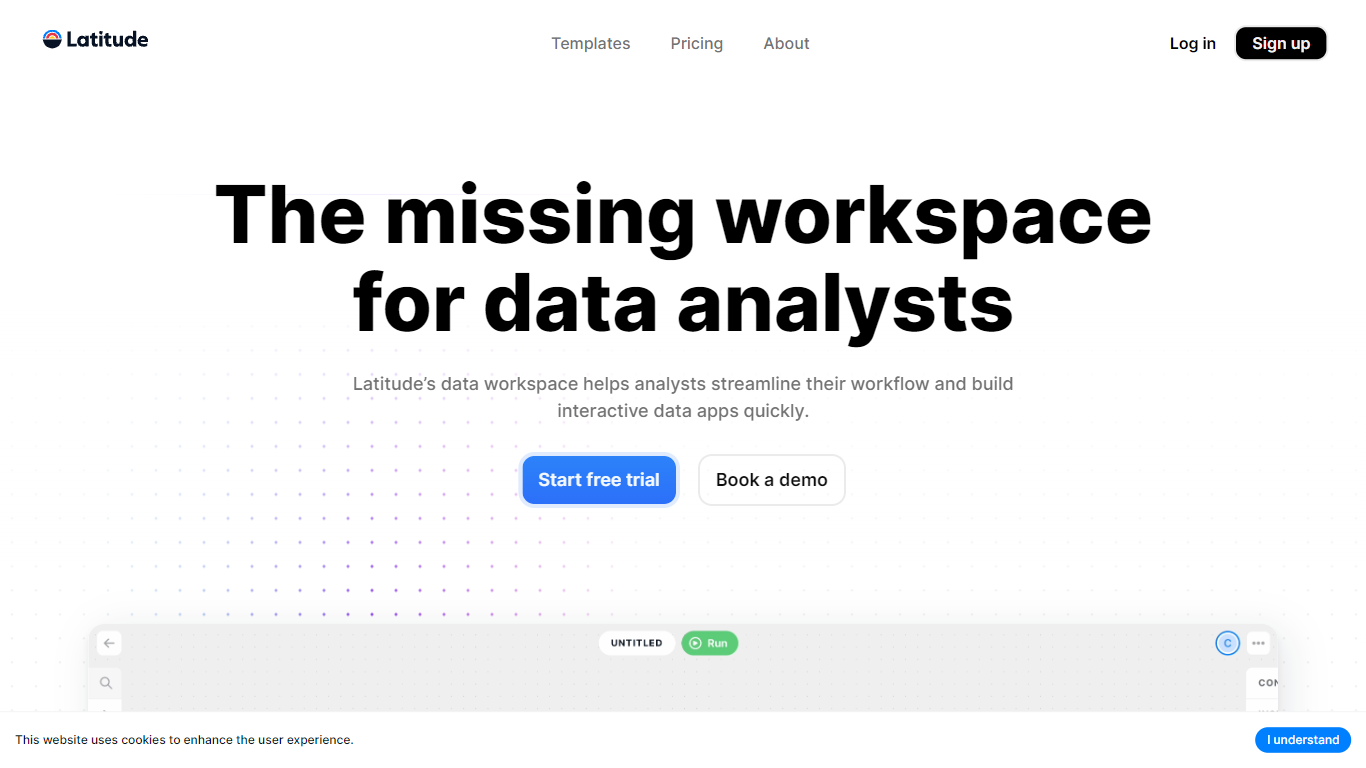
Latitude traces AI agents in production, clusters failures into issues, and can dispatch Claude Code or Cursor with sample traces when a signal escalates. Teams get semantic session search, conversation intelligence, and OpenTelemetry-compatible ingestion without adopting a proprietary trace format.
Generic log tools leave you triaging individual traces by hand. Latitude groups similar failures into issues with trends, affected users, and example spans, then turns validated production traces into versioned datasets for evals. Its newer agent dispatch flow sends coding agents the full context plus a deep link so they can open a pull request with a minimal fix instead of handing engineers another ticket.
The product targets teams shipping agent products who need analytics beyond raw telemetry. Setup is advertised at under five minutes via the Latitude SDK or an existing OTEL pipeline. Paid tiers add longer retention, SOC 2 and ISO 27001 reports, and enterprise deployment options with SAML SSO and European data residency.
Hex Upvotes
Latitude Upvotes
Hex Top Features
Notebook Agent writes SQL queries, builds charts, and chains analyses in a single workspace
Threads let business users ask plain-language questions in Hex, Slack, or via MCP without writing code
Context Studio tracks agent conversations, warnings, and topics across Hex, Slack, MCP, and CLI
Publish notebooks as interactive data apps with filters, drill-down, and embedded Threads
Semantic model workbench connects to dbt metadata, warehouse tables, and business rules
Team plan at $75 per Editor per month includes Threads agent, semantic model agent, and scheduled runs
Latitude Top Features
Dispatch Claude Code or Cursor with traces when a signal escalates and open a PR
Semantic search across 100% of agent traces with combined metadata filters
OpenTelemetry-compatible SDK or pipeline ingestion with no proprietary format
Automatic issue clustering with trends, examples, and affected users per pattern
Starter plan includes 20K credits per month and unlimited seats at $0
Latitude MCP server lets coding agents manage projects from the editor
Golden datasets auto-built from validated production traces for regression evals
Hex Category
- Analytics
Latitude Category
- Analytics
Hex Pricing Type
- Freemium
Latitude Pricing Type
- Freemium