
Last updated 08-22-2026
Category:
Reviews:
Join thousands of AI enthusiasts in the World of AI!
Hex
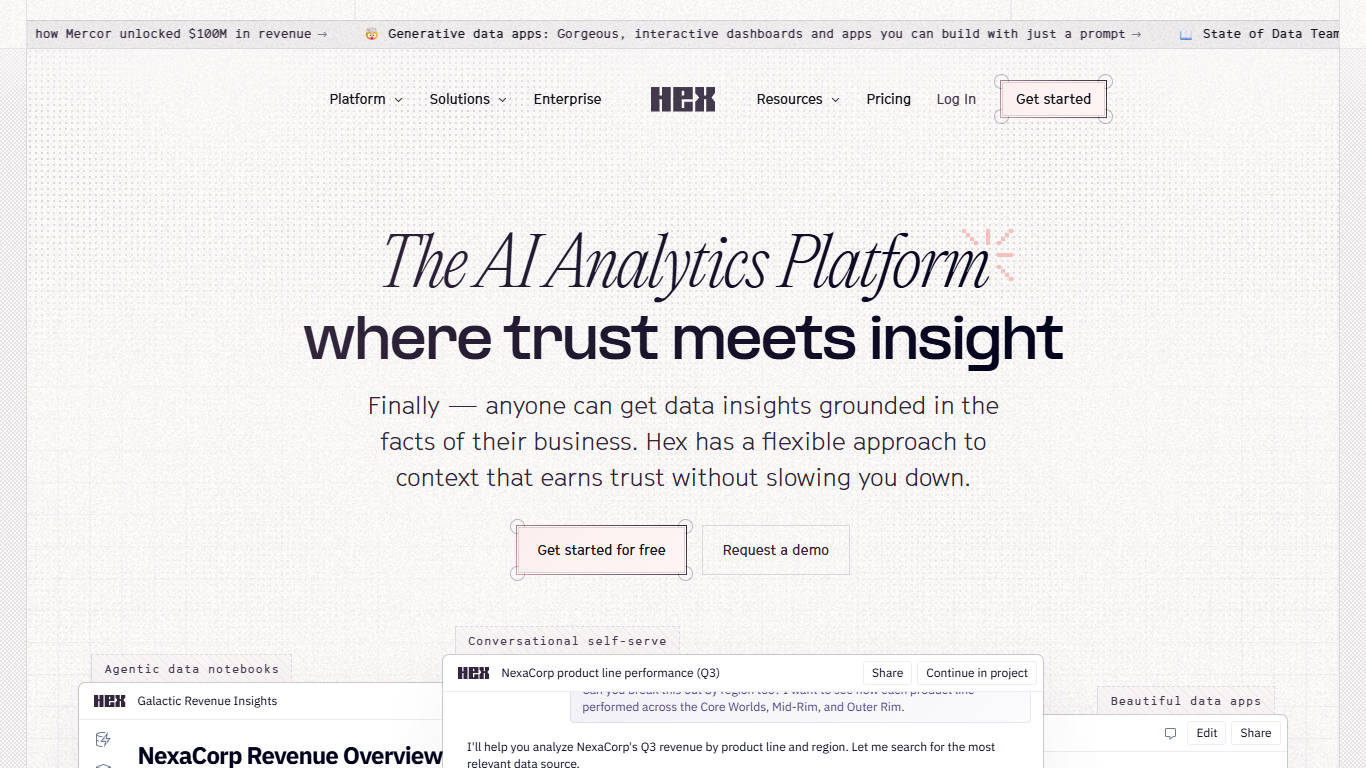
Hex is an analytics workspace that combines agentic notebooks, conversational self-serve, and publishable data apps. Data practitioners write SQL and Python in notebooks with an AI agent that builds queries and charts, while business users ask plain-language questions through Threads in Hex, Slack, or MCP. Every answer draws from the same shared context layer of semantic models, business rules, and endorsed tables.
Traditional BI tools split deep analysis from reporting, which means separate notebooks, dashboards, and Slack threads with no shared logic. Hex keeps code-based notebooks, conversational Threads, and interactive data apps on one context engine, so a model built by a data scientist can become a self-serve app without redefining metrics. Context Studio adds observability into agent conversations, warnings, and topic trends across Hex, Slack, MCP, and CLI.
Data teams at companies like Notion, Figma, Ramp, and Anthropic use Hex to replace a stack of notebooks, BI tools, and ad-hoc requests. Analysts run complex workflows in notebooks, publish governed apps for stakeholders, and let business users self-serve through Slack without filing tickets.
Notebook Agent writes SQL queries, builds charts, and chains analyses in a single workspace
Threads let business users ask plain-language questions in Hex, Slack, or via MCP without writing code
Context Studio tracks agent conversations, warnings, and topics across Hex, Slack, MCP, and CLI
Publish notebooks as interactive data apps with filters, drill-down, and embedded Threads
Semantic model workbench connects to dbt metadata, warehouse tables, and business rules
Team plan at $75 per Editor per month includes Threads agent, semantic model agent, and scheduled runs
Notebooks, conversational Threads, and data apps share one governed context layer
Slack and MCP integrations let business users query data where they already work
Deep dbt, warehouse, and Git integrations fit existing data stack workflows
Context Studio observability tracks agent warnings and conversation topics
Free Community plan available for individual projects
Team plan at $75 per Editor per month required for Threads and semantic model agents
Advanced compute profiles beyond Medium cost extra, up to $4.06 per hour for GPU
Enterprise features like SSO, audit logs, and HIPAA require custom pricing
Primarily web-based with no dedicated mobile app
What is Hex?
Hex is an AI analytics platform that combines agentic notebooks, conversational self-serve, and publishable data apps in one workspace. A shared context engine of semantic models, business rules, and endorsed tables ensures every answer is consistent whether it comes from an analyst or a business user.
How much does Hex cost?
Hex offers a free Community plan for hobbyists. The Professional plan is $36 per Editor per month with Notebook Agent and up to 5 published apps. The Team plan is $75 per Editor per month with Threads agent, semantic model agent, and unlimited published apps. Enterprise pricing is custom.
Can business users use Hex without SQL?
Yes. Hex Threads lets anyone ask questions in plain language through Hex, Slack, or MCP and get answers backed by semantic models and business rules. When a question needs deeper work, a data practitioner can continue in the same notebook workflow without switching tools.
How does Hex ensure accurate AI answers?
Hex grounds every agent answer in a shared context layer of database metadata, semantic models, business rules, and endorsed tables. Context Studio provides observability into agent conversations, warnings, and topic trends so data teams can audit and improve context over time.
What data warehouses does Hex connect to?
Hex has built-in connections to Snowflake, BigQuery, Databricks, Postgres, MySQL, Trino, Athena, and other popular warehouses and databases. It also integrates with dbt for metadata and docs, plus GitHub and GitLab for version control of projects.
How is Hex different from Tableau or Looker?
Hex does not separate deep analytical work from reporting. A complex model built in a notebook can become an interactive data app with one click, and business users can ask follow-up questions in Threads using the same logic. Traditional BI tools typically require separate notebooks and dashboard tools.