OpenRead vs Semantic Scholar
When comparing OpenRead vs Semantic Scholar, which AI Research tool shines brighter? We look at pricing, alternatives, upvotes, features, reviews, and more.
Between OpenRead and Semantic Scholar, which one is superior?
When we put OpenRead and Semantic Scholar side by side, both being AI-powered research tools, Semantic Scholar stands out as the clear frontrunner in terms of upvotes. Semantic Scholar has received 18 upvotes from aitools.fyi users, while OpenRead has received 8 upvotes.
Think we got it wrong? Cast your vote and show us who's boss!
OpenRead
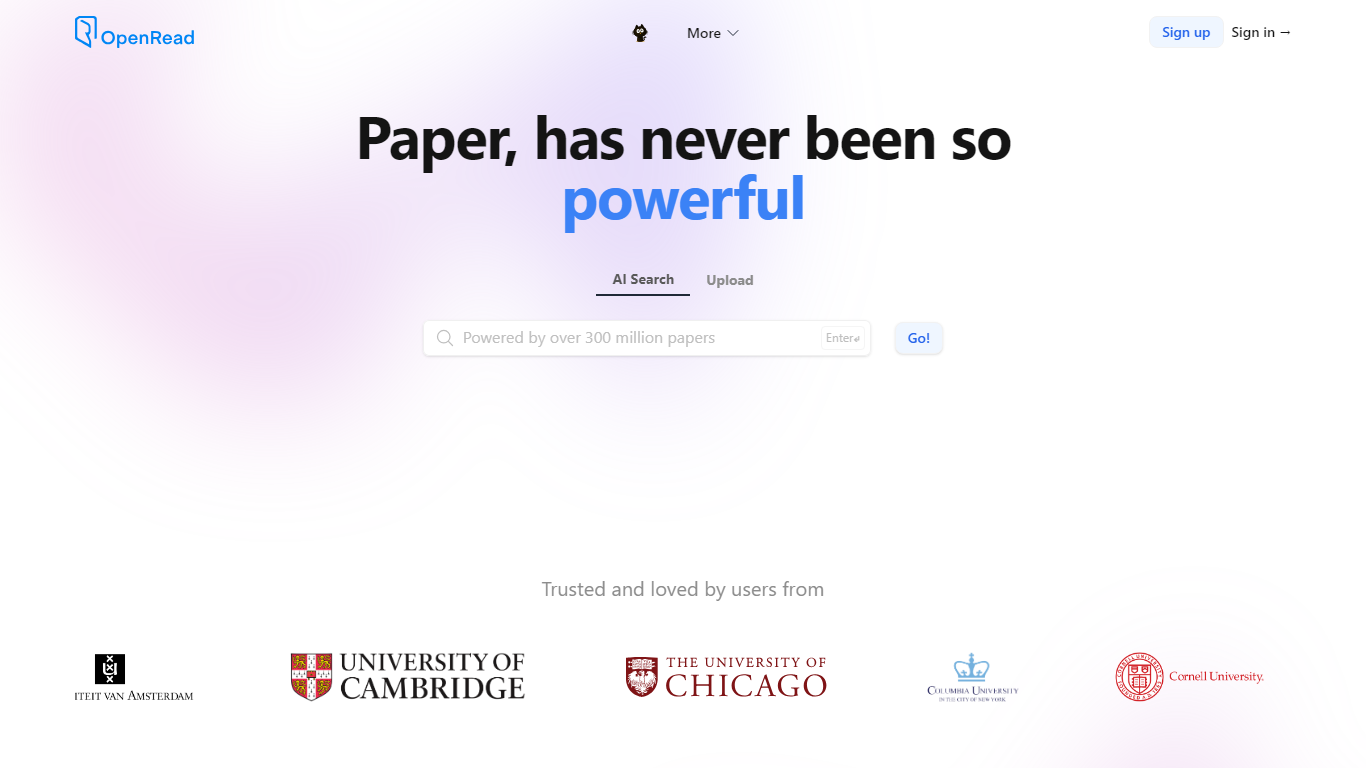

What is OpenRead?
OpenRead is an advanced academic platform committed to enhancing the research experience by removing traditional barriers to knowledge access. Trusted by a dedicated user base, OpenRead utilizes AI-driven search capabilities to aid researchers and students alike in their quest for academic material.
Using the power of semantic search, OpenRead allows users to input natural language queries to swiftly find and match over 300 million papers with the meaning behind their questions. The AI Summary feature further revolutionizes learning efficiency by condensing search results into succinct paragraphs, saving users up to 70% of the time typically spent on new concepts.
The platform's extensive database spans more than 400 categories across over a thousand journals, offering a breadth of knowledge in numerous disciplines. With innovative tools like Paper Espresso and Paper Q&A, users can quickly gauge a paper's relevance and delve into specific content with ease, while the Related Paper Graph feature visually maps the connections between research documents.
OpenRead emphasizes a seamless integration of reading and note-taking, enabling users to consolidate their insights alongside corresponding papers. This functionality fosters a cohesive research experience and the construction of a personal knowledge bank within a single ecosystem.
As part of its commitment to knowledge accessibility, OpenRead invites researchers and institutions to join its university alliance, aspiring to remove paywalls and ease the exchange between academic notes and writing tools.
Semantic Scholar
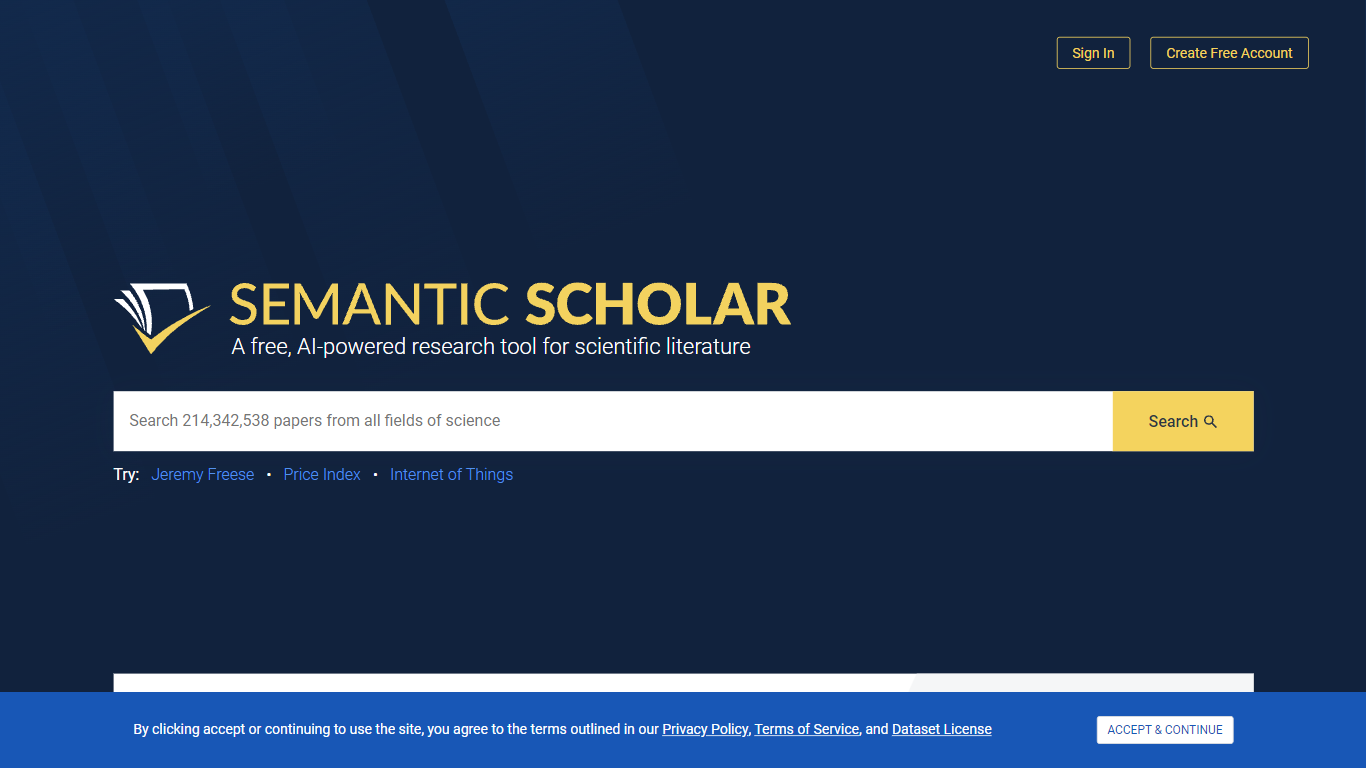
What is Semantic Scholar?
Semantic Scholar searches more than 236 million academic papers across every scientific field and surfaces citations, authors, and related work from one free interface. Built by the Allen Institute for AI (Ai2), it extracts meaning from papers so you can scan abstracts, follow citation chains, and open PDFs without jumping between databases.
Google Scholar indexes broadly but leaves connection-finding to you. Semantic Scholar adds AI-classified paper metadata, a Semantic Reader beta for in-browser annotation, and a public Academic Graph API with 214 million papers and 2.49 billion citations for developers. The S2AG and S2ORC datasets are also published as open JSON archives for NLP research.
Graduate students, faculty, librarians, and research engineers use it for literature reviews, citation tracking, and building scholarly apps. The API is free with optional keys for higher rate limits, and the platform partners with 50+ publishers to keep the index current.
OpenRead Upvotes
Semantic Scholar Upvotes
OpenRead Top Features
Semantic Search: Utilize natural language queries for swift and accurate paper matching.
AI Summary: Receive concise summaries to accelerate learning and concept acquisition.
Paper Espresso: Quickly understand a paper's key points and relevance to your research.
Paper Q&A: Engage in a deep guided exploration within a specific paper to enhance understanding.
Notes Taking: Seamlessly integrate and organize your research notes in one central location.
Semantic Scholar Top Features
Search 236,851,843 papers indexed across all fields of science from one homepage
Semantic Reader beta adds in-browser annotations and contextual overlays on select papers
Academic Graph API covers 214 million papers, 2.49 billion citations, and 79 million authors
S2AG and S2ORC datasets ship as free JSON archives for NLP and text mining projects
Paper recommendations surface related studies based on citation and content similarity
Partners with 50+ publishers and scholarly societies to ingest new academic content
OpenRead Category
- Research
Semantic Scholar Category
- Research
OpenRead Pricing Type
- Freemium
Semantic Scholar Pricing Type
- Free