PSEUDO.AI vs TimeComplexity.ai
In the face-off between PSEUDO.AI vs TimeComplexity.ai, which AI Developer tool takes the crown? We scrutinize features, alternatives, upvotes, reviews, pricing, and more.
In a face-off between PSEUDO.AI and TimeComplexity.ai, which one takes the crown?
If we were to analyze PSEUDO.AI and TimeComplexity.ai, both of which are AI-powered developer tools, what would we find? PSEUDO.AI is the clear winner in terms of upvotes. PSEUDO.AI has received 7 upvotes from aitools.fyi users, while TimeComplexity.ai has received 6 upvotes.
Disagree with the result? Upvote your favorite tool and help it win!
PSEUDO.AI

What is PSEUDO.AI?
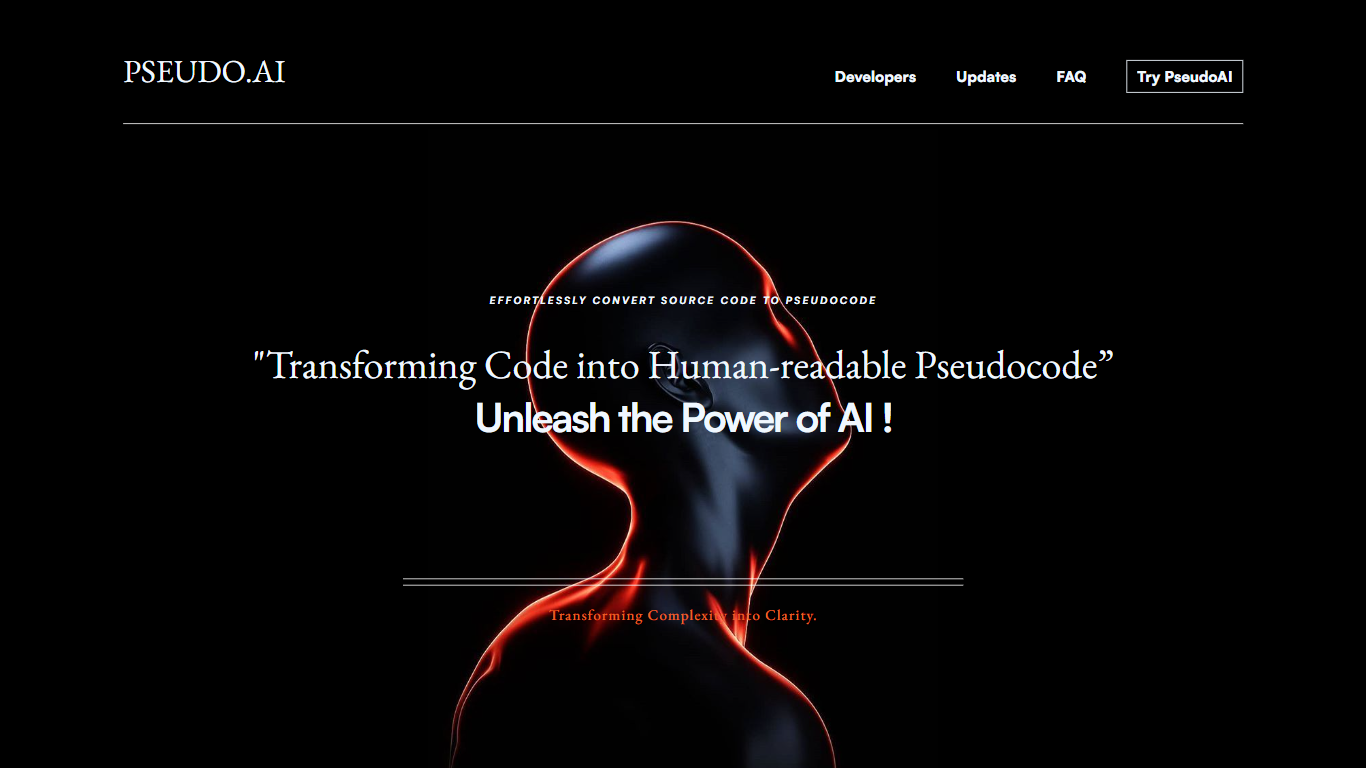
PSEUDO.AI turns source code into human-readable pseudocode in your browser. You enter a prompt or code snippet, pick a language, and the app returns plain-language steps that read like structured pseudocode rather than raw syntax. It runs on the web at pseudoai.vercel.app with no install, and targets teams who need to explain implementation details to people who do not read code daily.
Most code explainers summarize what a snippet does in prose. PSEUDO.AI keeps the output closer to pseudocode structure, which makes handoffs to designers, product owners, or junior developers easier to scan. The trade-off is focus: it is built for pseudocode conversion, not debugging, testing, or repo-wide documentation. That narrow scope is the point when the goal is shared comprehension, not a full IDE workflow.
Software developers use it to translate tricky logic before code reviews or stakeholder meetings. Computer science students and instructors lean on it when a textbook example needs a readable walkthrough. Product managers and mentors who sit in technical discussions but do not write production code get a format they can follow without parsing braces and semicolons.
TimeComplexity.ai
What is TimeComplexity.ai?
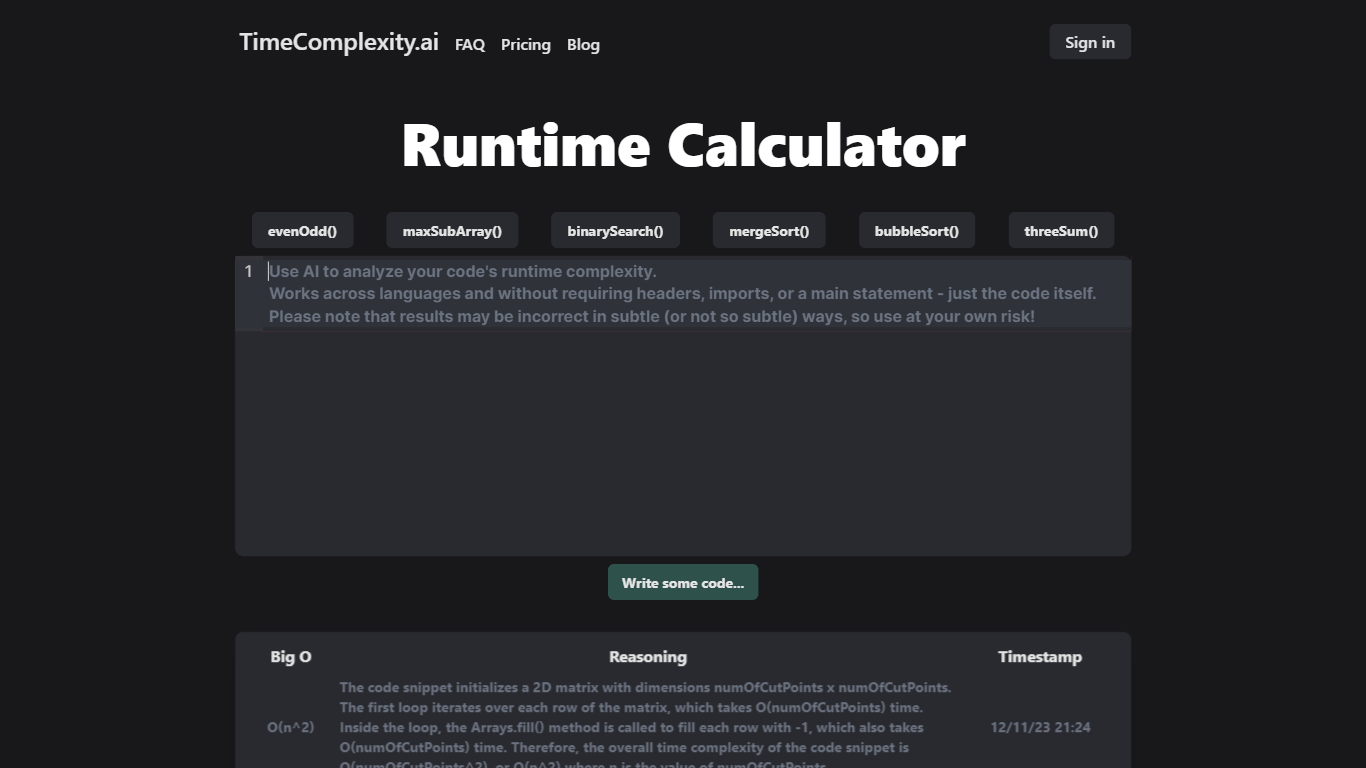
Paste a function into TimeComplexity.ai and it returns Big O runtime complexity with plain-language reasoning. You drop in an algorithm snippet, and the site responds with notation like O(n log n) plus an explanation of why that bound fits the loops and recursion it sees.
Static analyzers usually need a full file with imports and a main block. TimeComplexity.ai accepts partial snippets in Python, JavaScript, Java, C++, Go, and other languages without headers or setup code. That makes it useful for interview prep and quick checks on isolated functions pulled from a larger codebase.
Developers, CS students, and interview candidates use TimeComplexity.ai to sanity-check algorithm bounds before submitting homework or reviewing pull requests. Anonymous users get 20 queries per day, signed-in users get 50, and the $5 per month Pro plan removes the daily cap.
PSEUDO.AI Upvotes
TimeComplexity.ai Upvotes
PSEUDO.AI Top Features
Choose from 12 languages on the converter page, including C, C++, C#, Java, Python 3, JavaScript, Node.js, PHP, Kotlin, Swift, and SQL.
Runs entirely in the browser at pseudoai.vercel.app with no downloads required, per the homepage FAQ.
Uses an OpenAI-trained GPT model to generate pseudocode from your code input, according to the site FAQ.
Three-step workflow on the converter: enter a prompt or topic, pick a language, then click GO and copy the output.
Homepage FAQ lists Java, Python, C++, and JavaScript among supported languages, with a broader list on the live converter.
TimeComplexity.ai Top Features
Returns Big O notation plus written reasoning for each pasted code snippet
Accepts partial code without headers, imports, or a main function across common languages
Uses GPT-3.5 Turbo with a formatted prompt, per the site FAQ
Anonymous users receive 20 queries per day; signed-in users receive 50 free queries daily
Pro plan at $5 per month unlocks unlimited queries with query history and deletion
Each analysis gets a shareable ID so you can link results with teammates
PSEUDO.AI Category
- Developer
TimeComplexity.ai Category
- Developer
PSEUDO.AI Pricing Type
- Free
TimeComplexity.ai Pricing Type
- Freemium