Readdy vs StyleDrop
In the battle of Readdy vs StyleDrop, which AI Design tool comes out on top? We compare reviews, pricing, alternatives, upvotes, features, and more.
Between Readdy and StyleDrop, which one is superior?
Upon comparing Readdy with StyleDrop, which are both AI-powered design tools, Neither tool takes the lead, as they both have the same upvote count. You can help us determine the winner by casting your vote and tipping the scales in favor of one of the tools.
Don't agree with the result? Cast your vote and be a part of the decision-making process!
Readdy

What is Readdy?
Readdy is a no-code AI website builder that turns a text prompt, template, screenshot, or reference URL into a full multi-page site in minutes. You describe what you want, and it generates layouts, copy, images, and navigation with responsive design baked in from the start.
What sets it apart from a typical page builder is the end-to-end stack. Readdy covers generation, a visual editor with Selector Mode, hosting, custom domains, SEO controls, form storage, and integrations like Stripe, Shopify, Calendly, and Supabase without wiring up separate tools.
It fits solo creators, small businesses, and web agencies that need to ship business sites, portfolios, blogs, landing pages, or storefronts fast. Agency tiers add white-label delivery, lead finding, outreach campaigns, and client management under your own brand.
StyleDrop
What is StyleDrop?
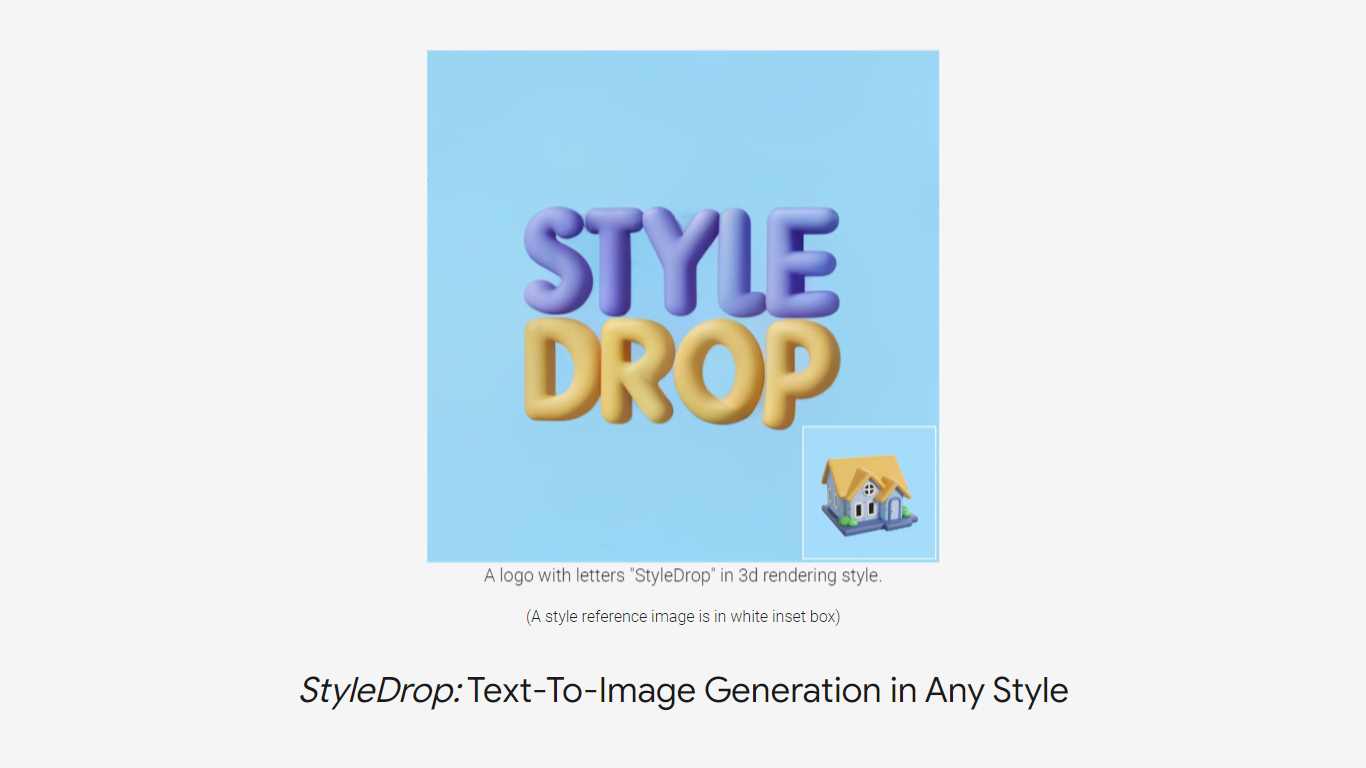
StyleDrop generates text-to-image outputs that match a specific visual style from as few as one reference image. This Google Research method fine-tunes less than 1% of the Muse vision transformer parameters through adapter tuning, then appends a natural-language style descriptor (like "in melting golden 3D rendering style") to your content prompt at generation time. It captures color schemes, shading, design patterns, and both local and global visual effects.
DreamBooth and Textual Inversion need multiple images and heavy fine-tuning to lock in a look. StyleDrop targets style alone: one reference image is enough, and the paper reports it outperforms those methods on Muse, Imagen, and Stable Diffusion backbones for style fidelity. Google also adapted the technique into a custom style model on Vertex AI for brand prototyping.
Graphic designers, art directors, and researchers studying controllable image generation are the natural audience. The project page hosts demos and comparisons, but StyleDrop itself is a research release rather than a standalone consumer app with signup or pricing.
Readdy Upvotes
StyleDrop Upvotes
Readdy Top Features
Generates complete websites from a text prompt, screenshot, reference URL, or 500+ industry templates
Selector Mode lets you click any element to edit text, colors, spacing, or AI-generated backgrounds in real time
One-click publish with hosting, SSL, custom domains, sitemap.xml, and Google Search Console verification
Built-in form backend stores submissions in Supabase with no external database setup
Connects Stripe, Shopify, Calendly, Mailchimp, and Google Analytics from the same dashboard
Agency plans add white-label portals, AI lead finder, batch demo sites, and cold email outreach campaigns
StyleDrop Top Features
Learns a new visual style by fine-tuning less than 1% of Muse model parameters
Works from a single reference image specifying color, shading, and design patterns
Iterative training with human or automated feedback improves style fidelity over rounds
Outperforms DreamBooth and Textual Inversion on style-tuning benchmarks in the paper
Combines with DreamBooth to render a custom subject in a custom style
Adapted into a Vertex AI custom style model for brand asset prototyping
Readdy Category
- Design
StyleDrop Category
- Design
Readdy Pricing Type
- Freemium
StyleDrop Pricing Type
- Free