Rectify (formerly Replicate So) vs PSEUDO.AI
In the clash of Rectify (formerly Replicate So) vs PSEUDO.AI, which AI Developer tool emerges victorious? We assess reviews, pricing, alternatives, features, upvotes, and more.
When we put Rectify (formerly Replicate So) and PSEUDO.AI head to head, which one emerges as the victor?
Let's take a closer look at Rectify (formerly Replicate So) and PSEUDO.AI, both of which are AI-driven developer tools, and see what sets them apart. PSEUDO.AI is the clear winner in terms of upvotes. PSEUDO.AI has received 7 upvotes from aitools.fyi users, while Rectify (formerly Replicate So) has received 6 upvotes.
Not your cup of tea? Upvote your preferred tool and stir things up!
Rectify (formerly Replicate So)
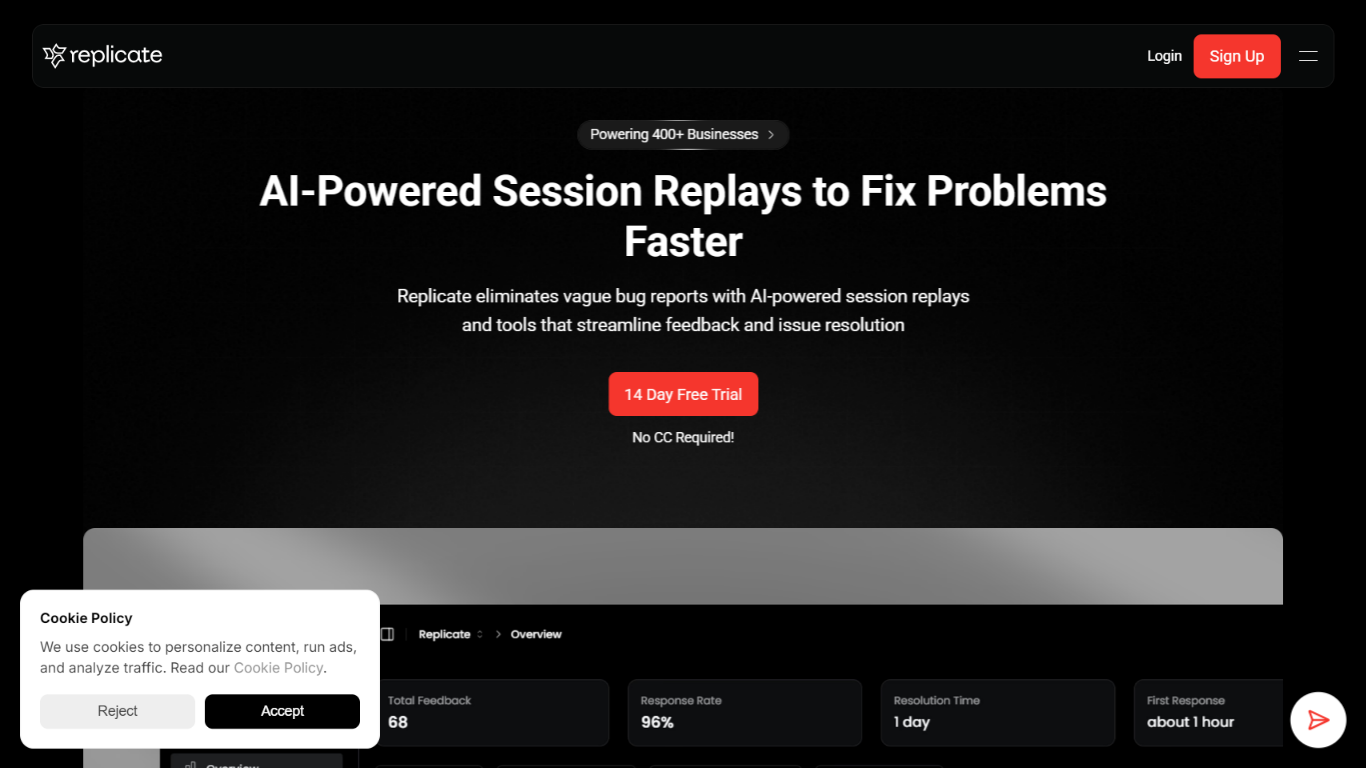

What is Rectify (formerly Replicate So)?
Rectify gives SaaS founders one developer-focused workspace to catch bugs, replay user sessions, monitor uptime, and run support without switching between a dozen tools. The product rebranded from Replicate and now centers on Quanta, an operations agent you steer through conversation rather than dashboards.
Most bug trackers make you configure filters and query builders before you see anything useful. Rectify flips that: you ask Quanta to surface rage-click sessions, draft changelogs from commits, or triage inbox patterns in plain English. The Chrome extension fits teams shipping with Cursor, Lovable, Bolt, Replit, or v0, capturing annotated screenshots, Loom clips, console logs, and network data with each report.
The stack covers monitoring across HTTP, HTTPS, TCP, DNS, and ICMP, on-demand GitHub code scans with file-level findings, roadmaps, changelogs, workflows, and an MCP server that links Claude or Cursor to your scan and feedback data. The site lists 100+ integrations and powers more than 1,000 products.
Pricing uses bring-your-own-key AI: connect OpenAI, Claude, Gemini, Deepseek, or Open Router with zero markup. Paid plans from $29 per month include a 14-day trial with no credit card, and an Idea tier stays free for solo builders.
PSEUDO.AI

What is PSEUDO.AI?
PSEUDO.AI turns source code into human-readable pseudocode in your browser. You enter a prompt or code snippet, pick a language, and the app returns plain-language steps that read like structured pseudocode rather than raw syntax. It runs on the web at pseudoai.vercel.app with no install, and targets teams who need to explain implementation details to people who do not read code daily.
Most code explainers summarize what a snippet does in prose. PSEUDO.AI keeps the output closer to pseudocode structure, which makes handoffs to designers, product owners, or junior developers easier to scan. The trade-off is focus: it is built for pseudocode conversion, not debugging, testing, or repo-wide documentation. That narrow scope is the point when the goal is shared comprehension, not a full IDE workflow.
Software developers use it to translate tricky logic before code reviews or stakeholder meetings. Computer science students and instructors lean on it when a textbook example needs a readable walkthrough. Product managers and mentors who sit in technical discussions but do not write production code get a format they can follow without parsing braces and semicolons.
Rectify (formerly Replicate So) Upvotes
PSEUDO.AI Upvotes
Rectify (formerly Replicate So) Top Features
Ask Quanta to find rage-click sessions and drop-offs in plain English
Bug reports ship with Loom clips, screenshots, console logs, and network data
Scan any GitHub repo on demand for bugs, vulnerabilities, and code smells
Monitors across HTTP, HTTPS, TCP, DNS, and ICMP with multi-channel alerts
Chrome extension records sessions, PRD prompts, and reusable code snippets
MCP server connects Claude, Cursor, and other IDEs to scan and feedback data
Workflows automate actions across feedback, roadmap, monitoring, and changelog events
PSEUDO.AI Top Features
Choose from 12 languages on the converter page, including C, C++, C#, Java, Python 3, JavaScript, Node.js, PHP, Kotlin, Swift, and SQL.
Runs entirely in the browser at pseudoai.vercel.app with no downloads required, per the homepage FAQ.
Uses an OpenAI-trained GPT model to generate pseudocode from your code input, according to the site FAQ.
Three-step workflow on the converter: enter a prompt or topic, pick a language, then click GO and copy the output.
Homepage FAQ lists Java, Python, C++, and JavaScript among supported languages, with a broader list on the live converter.
Rectify (formerly Replicate So) Category
- Developer
PSEUDO.AI Category
- Developer
Rectify (formerly Replicate So) Pricing Type
- Freemium
PSEUDO.AI Pricing Type
- Free