Switch Transformers vs ggml.ai
Compare Switch Transformers vs ggml.ai and see which AI Large Language Model (LLM) tool is better when we compare features, reviews, pricing, alternatives, upvotes, etc.
Which one is better? Switch Transformers or ggml.ai?
When we compare Switch Transformers with ggml.ai, which are both AI-powered large language model (llm) tools, The upvote count shows a clear preference for ggml.ai. ggml.ai has received 7 upvotes from aitools.fyi users, while Switch Transformers has received 6 upvotes.
Not your cup of tea? Upvote your preferred tool and stir things up!
Switch Transformers
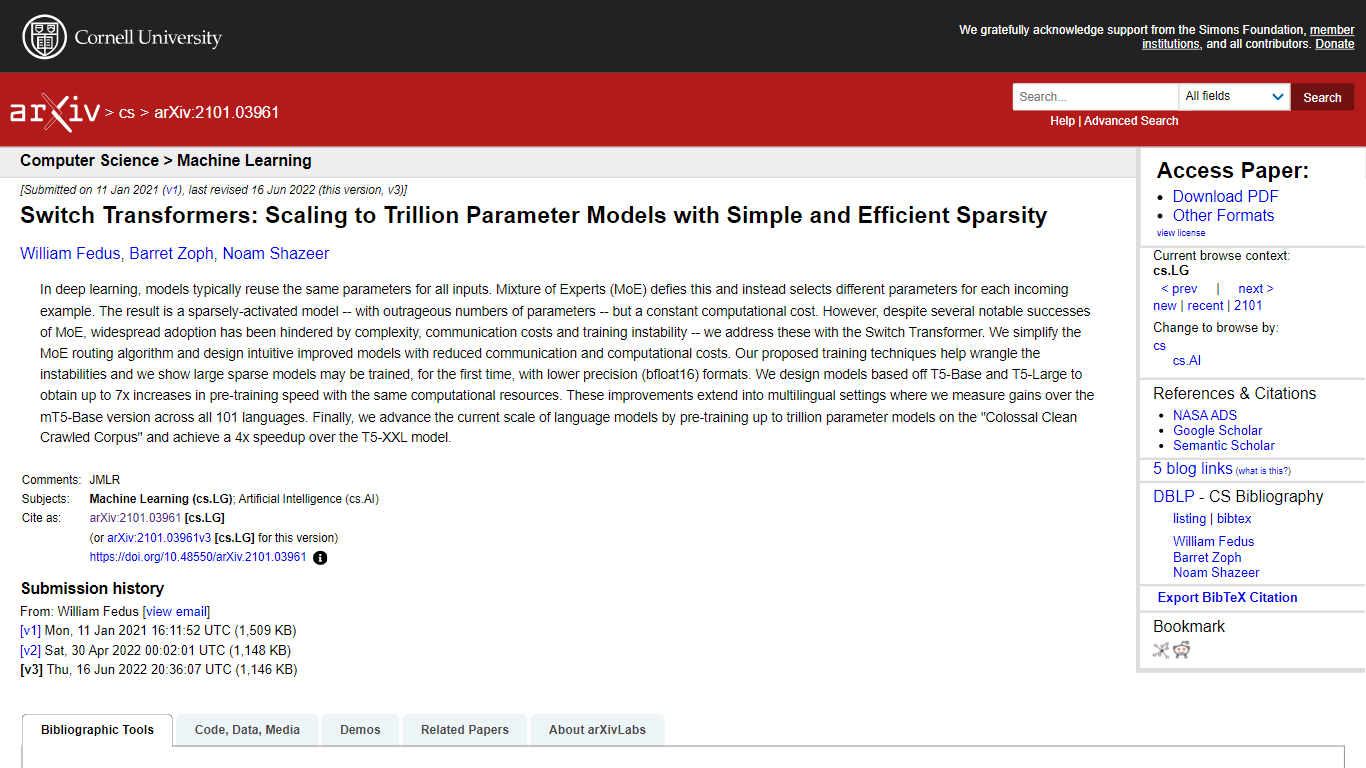

What is Switch Transformers?
Switch Transformers introduce a sparse Mixture of Experts architecture that routes each input to a single expert, reducing communication overhead while scaling to trillion-parameter language models with constant compute cost. The paper from Google researchers William Fedus, Barret Zoph, and Noam Shazeer simplifies MoE routing, improves training stability, and reports up to 7x faster pre-training than dense T5 models on the same compute budget.
The approach builds on the T5 architecture and supports multilingual training across 101 languages. Switch Transformers also enable training with bfloat16 precision for faster, more stable large-scale runs. The work targets researchers and engineers who need to scale NLP models without proportional increases in hardware cost.
Published on arXiv as a research paper, Switch Transformers documents methods for efficient sparse activation rather than a commercial SaaS product. The paper and PDF are freely available for download and citation.
ggml.ai
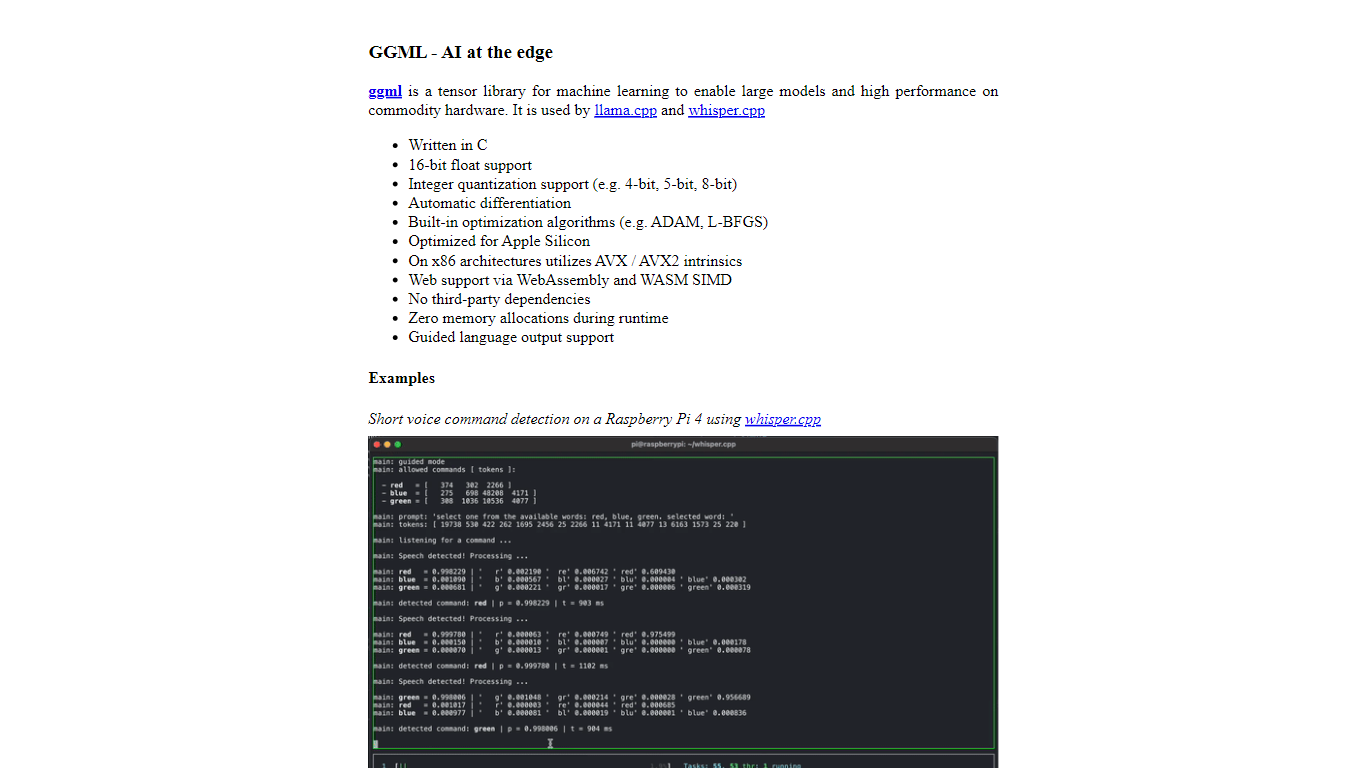
What is ggml.ai?
ggml runs large language and speech models on everyday CPUs and GPUs through a compact C tensor library built for on-device inference. ML engineers and app developers adopt it via llama.cpp and whisper.cpp when they want LLaMA or Whisper workloads without cloud-only dependencies.
Frameworks like PyTorch optimize for training clusters and heavy runtimes. ggml keeps the core library minimal with zero runtime memory allocations, no third-party dependencies, and integer quantization so llama.cpp can serve Meta LLaMA weights on laptops and Apple Silicon.
The ggml.ai company was founded in 2023 by Georgi Gerganov to support the library and was acquired by Hugging Face in 2026. The core ggml project stays MIT licensed with open development on GitHub.
Switch Transformers Upvotes
ggml.ai Upvotes
Switch Transformers Top Features
Sparse activation routes each input to one expert for constant compute
Simplified MoE routing reduces communication between model parts
Scales to trillion-parameter models on the T5 architecture
Supports multilingual training across 101 languages
Enables faster pre-training with bfloat16 precision
ggml.ai Top Features
Powers llama.cpp for Meta LLaMA inference and whisper.cpp for OpenAI Whisper speech models
Written in C with zero runtime memory allocations during inference
Integer quantization support for smaller models on commodity hardware
No third-party dependencies in the core tensor library
Cross-platform low-level implementation with broad hardware support
MIT licensed open-core library with public development on GitHub
Switch Transformers Category
- Large Language Model (LLM)
ggml.ai Category
- Large Language Model (LLM)
Switch Transformers Pricing Type
- Free
ggml.ai Pricing Type
- Free