UniLM vs Gemini AI
In the contest of UniLM vs Gemini AI, which AI Large Language Model (LLM) tool is the champion? We evaluate pricing, alternatives, upvotes, features, reviews, and more.
If you had to choose between UniLM and Gemini AI, which one would you go for?
When we examine UniLM and Gemini AI, both of which are AI-enabled large language model (llm) tools, what unique characteristics do we discover? Interestingly, both tools have managed to secure the same number of upvotes. Every vote counts! Cast yours and contribute to the decision of the winner.
You don't agree with the result? Cast your vote to help us decide!
UniLM

What is UniLM?
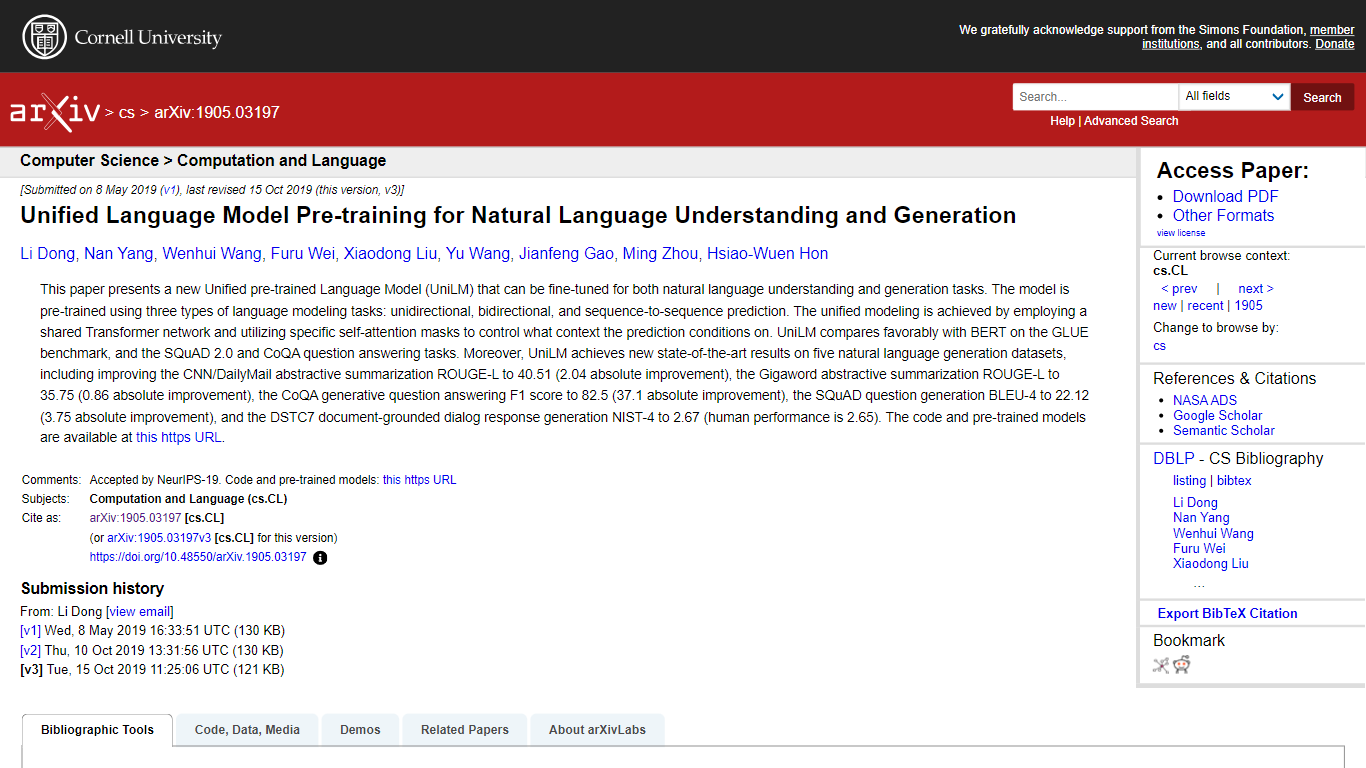
UniLM is a pre-trained language model from Microsoft Research that handles both natural language understanding and text generation from one shared Transformer. You fine-tune a single checkpoint for reading tasks like question answering and writing tasks like summarization or dialogue, without maintaining separate encoder-only and decoder-only models. Code and pretrained weights ship through the microsoft/unilm GitHub repo under an MIT license.
BERT-style models excel at reading but need a separate decoder stack for generation. UniLM trains one Transformer with three attention-mask modes: unidirectional, bidirectional, and sequence-to-sequence. That design let the same weights compete with BERT on GLUE and SQuAD while setting summarization and question-generation benchmarks in 2019, a split that most contemporaries treated as two problems.
ML researchers and NLP engineers use UniLM when they want published benchmarks, training scripts, and checkpoint files for both understanding and generation in one codebase. The repository now spans later releases like UniLMv2 (Pseudo-Masked Language Model, ICML 2020), but v1 remains the reference for the original unified masking approach described in the NeurIPS 2019 paper.
Gemini AI
What is Gemini AI?
Gemini is Google's flagship family of multimodal AI models, developed by Google DeepMind and available through the Gemini app at gemini.google.com. The models handle text, images, audio, and video in a single conversation, and the consumer app positions Gemini as a personal assistant for writing, planning, brainstorming, and research.
Google ships Gemini across several tiers, from the free Gemini app to paid Google AI Plus, Pro, and Ultra subscriptions. Developers access the same underlying models through the Gemini API in Google AI Studio, with separate free and pay-as-you-go pricing for production workloads.
The model line has expanded well beyond the original Ultra, Pro, and Nano sizes announced in 2023. Current releases include Gemini 3.5 Flash, Gemini 3.1 Pro, and specialized variants for image generation, video, audio, and on-device use.
UniLM Upvotes
Gemini AI Upvotes
UniLM Top Features
Three pre-training objectives (unidirectional, bidirectional, sequence-to-sequence) share one Transformer backbone
CNN/DailyMail abstractive summarization ROUGE-L of 40.51, a 2.04-point gain over prior work
CoQA generative question answering F1 score of 82.5 on the published benchmark
SQuAD question generation BLEU-4 of 22.12 with beam search decoding
Pre-trained checkpoints and PyTorch training scripts in the microsoft/unilm repository (22.2k GitHub stars)
MIT license with UniLM v1 and UniLMv2 code paths in the same open-source repo
Gemini AI Top Features
Chat with Gemini 3.5 Flash and Gemini 3.1 Pro for writing, coding, and complex reasoning tasks
Generate and edit images with Nano Banana directly inside the Gemini app
Create and edit videos conversationally with Gemini Omni
Run Deep Research to compile reports from web sources and uploaded documents
Switch between voice and text with Gemini Live, including camera input for visual questions
Build custom Gems for repeatable workflows and specialized assistant behavior
Use Canvas to draft documents, code, and plans alongside the chat interface
UniLM Category
- Large Language Model (LLM)
Gemini AI Category
- Large Language Model (LLM)
UniLM Pricing Type
- Free
Gemini AI Pricing Type
- Freemium