Vidu vs Phenaki
In the battle of Vidu vs Phenaki, which AI Video Generation tool comes out on top? We compare reviews, pricing, alternatives, upvotes, features, and more.
Between Vidu and Phenaki, which one is superior?
Upon comparing Vidu with Phenaki, which are both AI-powered video generation tools, In the race for upvotes, Vidu takes the trophy. Vidu has been upvoted 79 times by aitools.fyi users, and Phenaki has been upvoted 6 times.
Not your cup of tea? Upvote your preferred tool and stir things up!
Vidu


What is Vidu?
Vidu turns text prompts, still images, and reference photos into finished video clips up to 1080p. Independent creators and production teams use it to skip a traditional post pipeline and go from idea to export in the browser. The core modes are text-to-video, image-to-video, and reference-to-video.
Reference-to-video is where Vidu stands out. Upload up to seven images to keep characters, objects, and scenes consistent across a clip, or save assets in My References for reuse on later projects. The Vidu Q3 model adds native audio in the same generation pass, so dialogue, voiceover, sound effects, and music land with the picture instead of in a separate editing step.
Creators working in anime, advertising, social content, and short-form film use Vidu for everything from template-based viral clips to 16-second narrative shots with frame-level camera control. Studios and marketers also use image-to-video to animate product shots or swap ad backgrounds while keeping subjects on-model.
New accounts receive starter credits, with more available through daily logins, subscriptions, and platform events.
Phenaki
What is Phenaki?
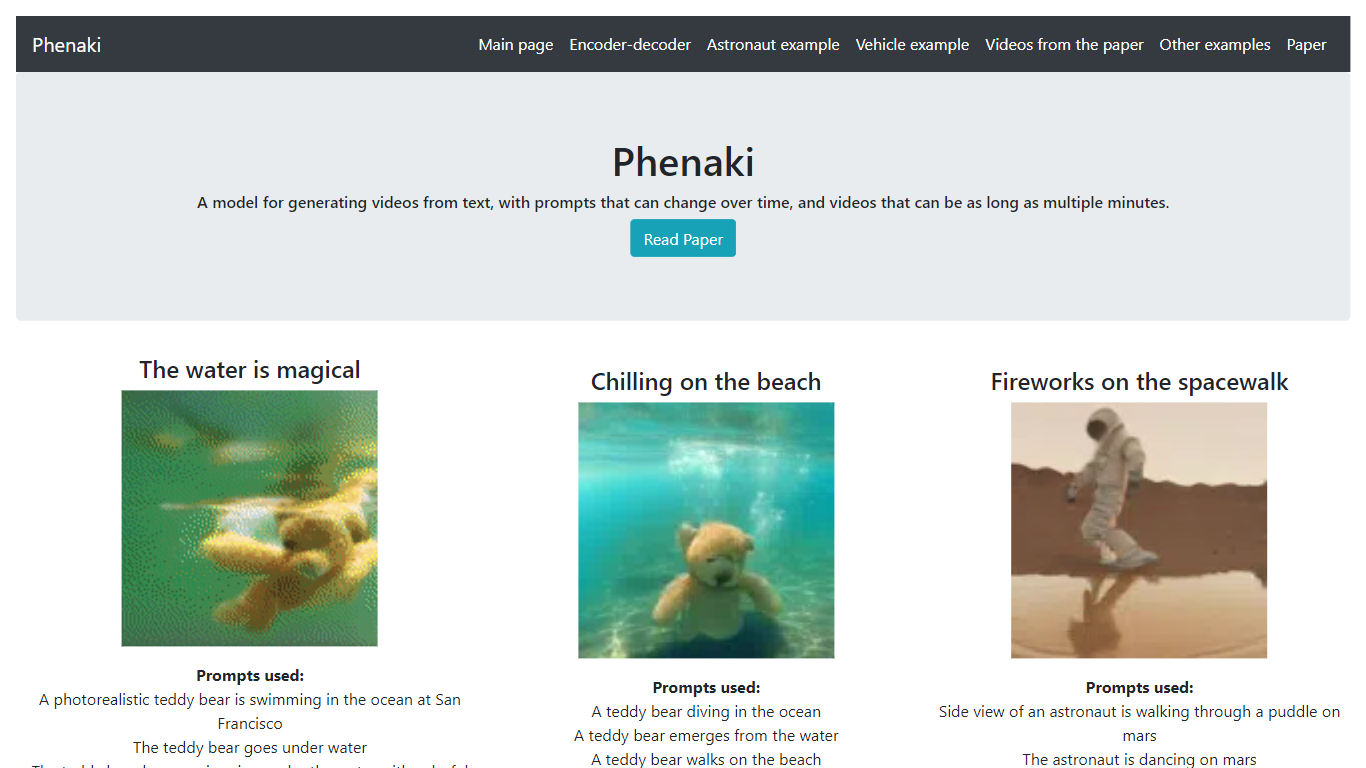
Phenaki is a Google Research text-to-video model that generates open-domain clips from sequences of prompts, so the story can change as new text arrives over time. Its C-ViViT encoder compresses footage into discrete tokens with causal time attention, which lets the system handle variable clip lengths instead of fixed two-second bursts. A masked transformer turns text tokens into video tokens, then the decoder rebuilds pixels for demos that run past two minutes when prompts are chained.
Consumer video generators usually ask for one prompt per clip. Phenaki's paper and demo site focus on time-varying prompt chains, image-conditioned continuation from a first frame, and joint training on image-text pairs plus smaller video-text sets to stretch beyond limited video datasets. You browse sample stories on the project page rather than signing up for a hosted editor.
Researchers, ML engineers, and creative technologists study Phenaki for long-form narrative synthesis and tokenizer design. The phenaki.github.io site hosts interactive astronaut examples, image-plus-prompt continuations, and published two to two-and-a-half minute sample stories with prompt lists documented beside each clip.
Vidu Upvotes
Phenaki Upvotes
Vidu Top Features
Generates a full video in about 10 seconds flat
Upload up to 7 reference images and the output stays consistent across all of them
Set the first and last frame, and Vidu fills in the motion between them
Vidu Q3 bakes dialogue, sound effects, and music directly into the video in one pass
Unlimited free video generation in Off-Peak Mode with no credits required
Phenaki Top Features
Generates videos from sequences of text prompts that can change over time within one story
Published demo clips include a 2:28 minute motorcycle story and a 2-minute futuristic city narrative
C-ViViT tokenizer compresses video with causal time attention for variable-length generation
Interactive site lets you combine context words to render astronaut videos from trained examples
Supports image-conditioned generation where the first frame plus a prompt drives the next motion
Joint training on image-text pairs and video-text examples improves open-domain generalization
Research paper linked on OpenReview documents the MaskGIT text-to-video transformer pipeline
Vidu Category
- Video Generation
Phenaki Category
- Video Generation
Vidu Pricing Type
- Freemium
Phenaki Pricing Type
- Free