
Last updated 07-30-2026
Category:
Reviews:
Join thousands of AI enthusiasts in the World of AI!
Phenaki
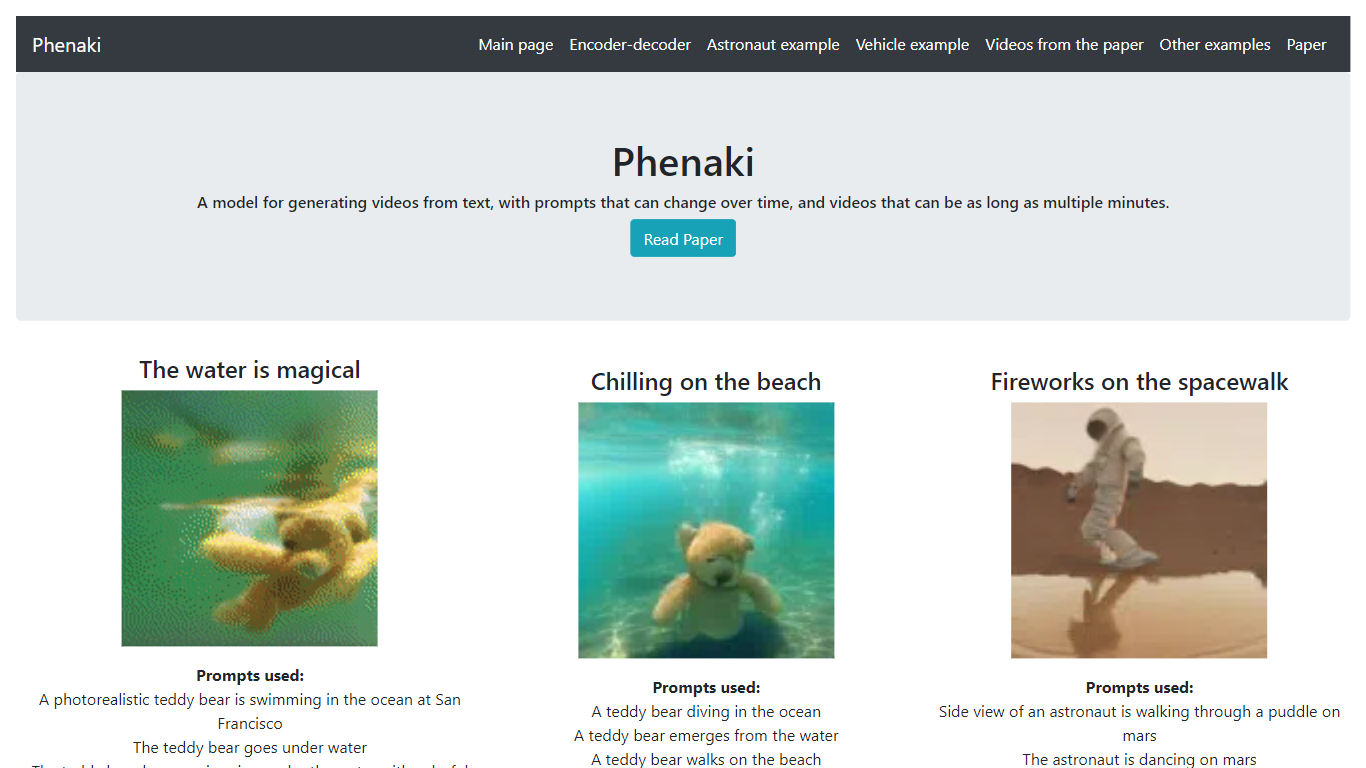
Phenaki is a Google Research text-to-video model that generates open-domain clips from sequences of prompts, so the story can change as new text arrives over time. Its C-ViViT encoder compresses footage into discrete tokens with causal time attention, which lets the system handle variable clip lengths instead of fixed two-second bursts. A masked transformer turns text tokens into video tokens, then the decoder rebuilds pixels for demos that run past two minutes when prompts are chained.
Consumer video generators usually ask for one prompt per clip. Phenaki's paper and demo site focus on time-varying prompt chains, image-conditioned continuation from a first frame, and joint training on image-text pairs plus smaller video-text sets to stretch beyond limited video datasets. You browse sample stories on the project page rather than signing up for a hosted editor.
Researchers, ML engineers, and creative technologists study Phenaki for long-form narrative synthesis and tokenizer design. The phenaki.github.io site hosts interactive astronaut examples, image-plus-prompt continuations, and published two to two-and-a-half minute sample stories with prompt lists documented beside each clip.
Generates videos from sequences of text prompts that can change over time within one story
Published demo clips include a 2:28 minute motorcycle story and a 2-minute futuristic city narrative
C-ViViT tokenizer compresses video with causal time attention for variable-length generation
Interactive site lets you combine context words to render astronaut videos from trained examples
Supports image-conditioned generation where the first frame plus a prompt drives the next motion
Joint training on image-text pairs and video-text examples improves open-domain generalization
Research paper linked on OpenReview documents the MaskGIT text-to-video transformer pipeline
Supports prompt sequences that evolve mid-video, which most single-prompt generators do not demonstrate.
Published samples include multi-minute coherent stories with documented prompt chains.
Image-conditioned mode lets a still frame seed the next generated motion.
Free research site with interactive examples and paper references.
No public API or signup flow to render custom videos from your own prompts.
Stored phenaki.video domain is dead; the live demo lives on phenaki.github.io.
Samples reflect research-era quality and may lag behind latest commercial video models.
Is Phenaki free to use?
Yes. The Phenaki project site at phenaki.github.io is a free Google Research demo that publishes sample videos and interactive examples. There is no signup, payment, or hosted generation API for public users on the page.
What does Phenaki generate?
Phenaki generates open-domain videos from text, including stories built from multiple prompts that change over time. The model targets realistic motion rather than single-prompt clip generators with fixed durations.
How long can Phenaki videos be?
Phenaki demo stories on the project site reach about two to two-and-a-half minutes when a long prompt sequence is fed through the model and optional super-resolution pass, such as the published motorcycle and city narratives.
Can Phenaki use multiple text prompts?
Yes. Phenaki is designed for time-varying prompts, meaning you can supply a sequence of sentences and the model continues the video as each new line arrives, which is how the multi-minute sample stories are built.
Is Phenaki a public video app?
No. Phenaki is a research demonstration with pre-rendered and interactive examples on phenaki.github.io, not a consumer SaaS where visitors upload prompts and receive fresh renders on demand.
Who developed Phenaki?
Phenaki was developed by Google Research authors including Ruben Villegas and colleagues, with the paper titled Variable Length Video Generation From Open Domain Textual Description published on OpenReview.