VisualBERT vs ggml.ai
Explore the showdown between VisualBERT vs ggml.ai and find out which AI Large Language Model (LLM) tool wins. We analyze upvotes, features, reviews, pricing, alternatives, and more.
In a face-off between VisualBERT and ggml.ai, which one takes the crown?
When we contrast VisualBERT with ggml.ai, both of which are exceptional AI-operated large language model (llm) tools, and place them side by side, we can spot several crucial similarities and divergences. There's no clear winner in terms of upvotes, as both tools have received the same number. Your vote matters! Help us decide the winner among aitools.fyi users by casting your vote.
Think we got it wrong? Cast your vote and show us who's boss!
VisualBERT

What is VisualBERT?
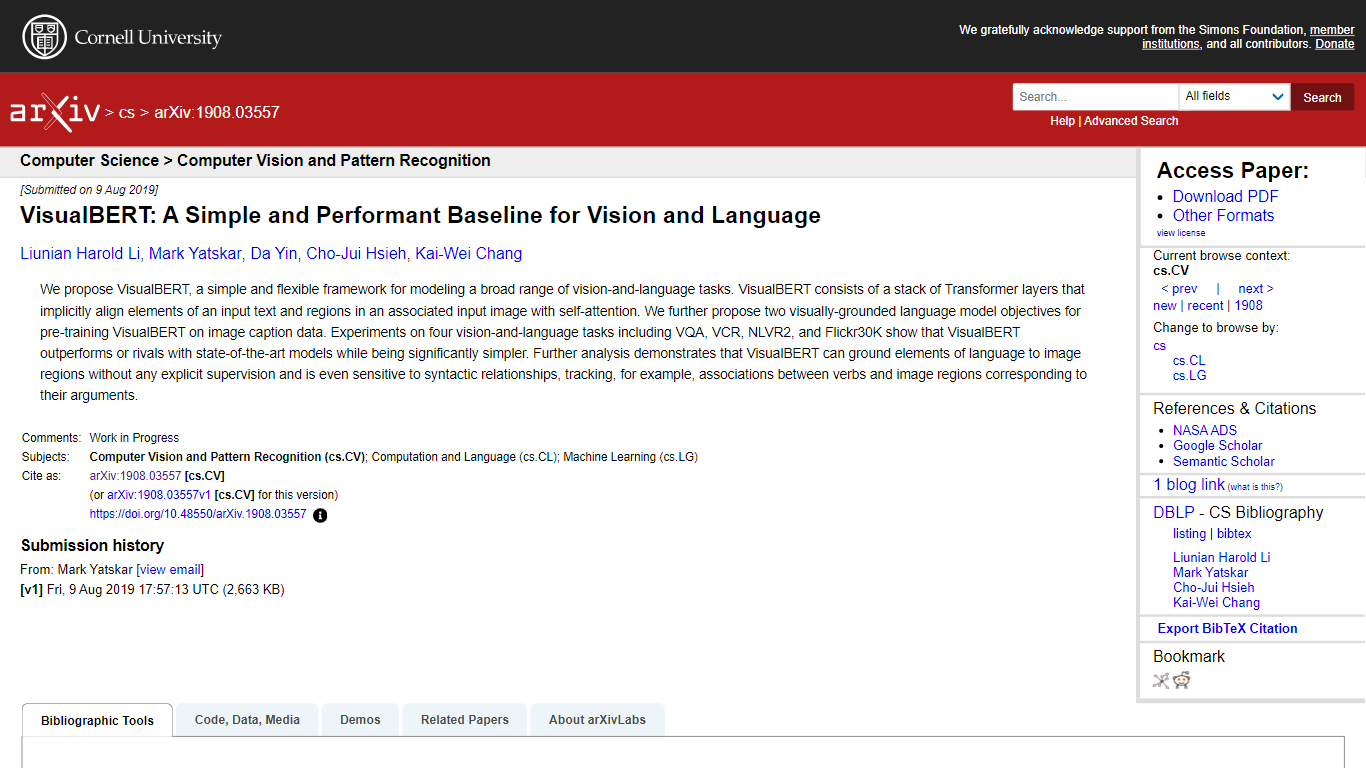
VisualBERT represents a cutting-edge approach in the field of AI, combining vision and language processing. This model leverages Transformer layers to encapsulate rich representations from both textual and visual inputs. It is pre-trained using image caption data with visually grounded language model objectives, enhancing its ability to comprehend and align elements in images with their linguistic descriptors.
VisualBERT demonstrates noteworthy competencies in several vision-and-language tasks such as VQA (Visual Question Answering), VCR (Visual Commonsense Reasoning), NLVR2 (Natural Language Visual Reasoning for Real), and Flickr30K. Its performance is either on par or superior to other state-of-the-art models, yet maintains simplicity. One of VisualBERT's significant feats is its unsupervised grounding capability, which means it can associate words and phrases with corresponding image regions without direct instructional input, even discerning between syntactic relationships within the language component.
ggml.ai
What is ggml.ai?
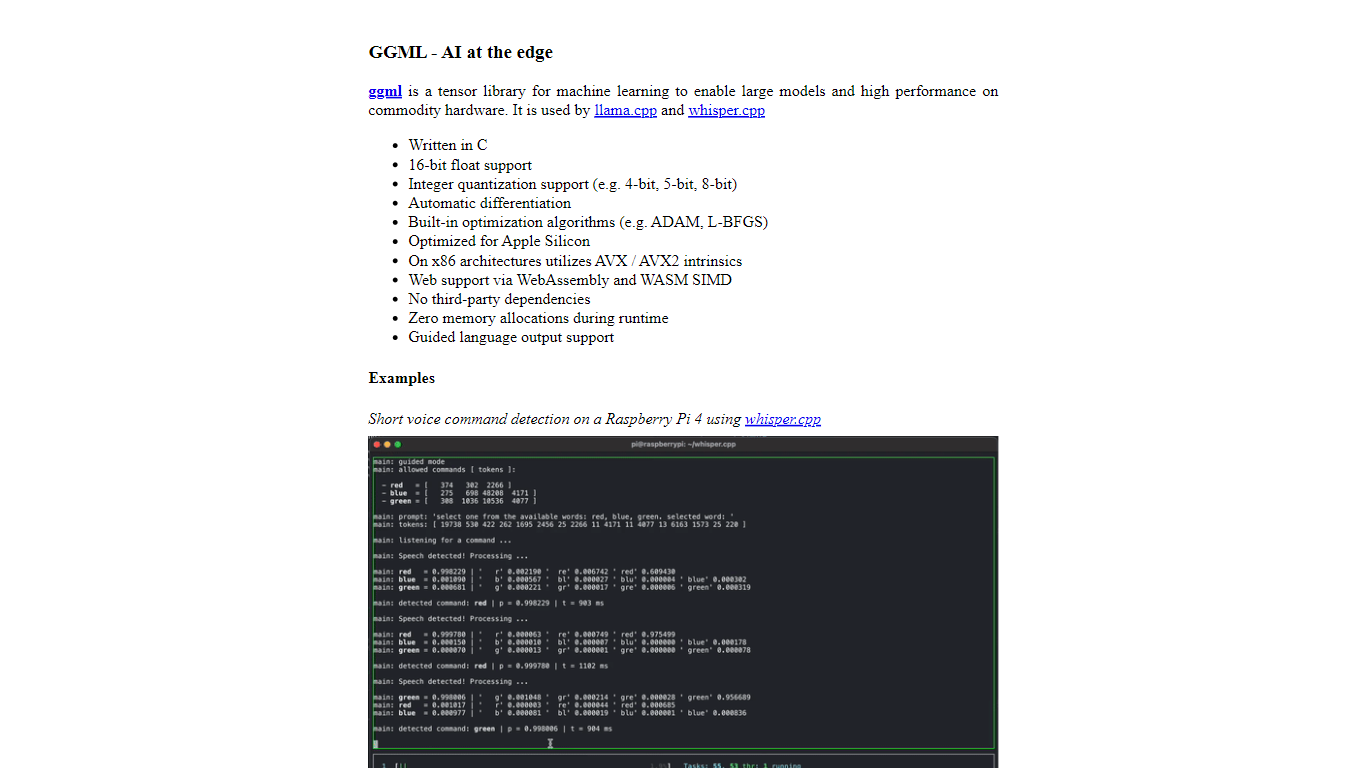
ggml.ai is at the forefront of AI technology, bringing powerful machine learning capabilities directly to the edge with its innovative tensor library. Built for large model support and high performance on common hardware platforms, ggml.ai enables developers to implement advanced AI algorithms without the need for specialized equipment. The platform, written in the efficient C programming language, offers 16-bit float and integer quantization support, along with automatic differentiation and various built-in optimization algorithms like ADAM and L-BFGS. It boasts optimized performance for Apple Silicon and leverages AVX/AVX2 intrinsics on x86 architectures. Web-based applications can also exploit its capabilities via WebAssembly and WASM SIMD support. With its zero runtime memory allocations and absence of third-party dependencies, ggml.ai presents a minimal and efficient solution for on-device inference.
Projects like whisper.cpp and llama.cpp demonstrate the high-performance inference capabilities of ggml.ai, with whisper.cpp providing speech-to-text solutions and llama.cpp focusing on efficient inference of Meta's LLaMA large language model. Moreover, the company welcomes contributions to its codebase and supports an open-core development model through the MIT license. As ggml.ai continues to expand, it seeks talented full-time developers with a shared vision for on-device inference to join their team.
Designed to push the envelope of AI at the edge, ggml.ai is a testament to the spirit of play and innovation in the AI community.
VisualBERT Upvotes
ggml.ai Upvotes
VisualBERT Top Features
Transformer Layer Architecture: Utilizes stacked Transformer layers for implicit text and image region alignment.
Visually-Grounded Pre-training Objectives: Employs image caption data to pre-train the model, enhancing contextual understanding.
Performance on Vision-and-Language Tasks: Proven effectiveness in VQA, VCR, NLVR2, and Flickr30K tasks.
Unsupervised Grounding Capability: Grounds linguistic elements to image regions without explicit supervision.
Sensitivity to Syntactic Relationships: Identifies associations between language elements and image components, such as verbs to image regions.
ggml.ai Top Features
Written in C: Ensures high performance and compatibility across a range of platforms.
Optimization for Apple Silicon: Delivers efficient processing and lower latency on Apple devices.
Support for WebAssembly and WASM SIMD: Facilitates web applications to utilize machine learning capabilities.
No Third-Party Dependencies: Makes for an uncluttered codebase and convenient deployment.
Guided Language Output Support: Enhances human-computer interaction with more intuitive AI-generated responses.
VisualBERT Category
- Large Language Model (LLM)
ggml.ai Category
- Large Language Model (LLM)
VisualBERT Pricing Type
- Freemium
ggml.ai Pricing Type
- Freemium