wav2vec 2.0 vs Gemini AI
In the face-off between wav2vec 2.0 vs Gemini AI, which AI Large Language Model (LLM) tool takes the crown? We scrutinize features, alternatives, upvotes, reviews, pricing, and more.
In a face-off between wav2vec 2.0 and Gemini AI, which one takes the crown?
If we were to analyze wav2vec 2.0 and Gemini AI, both of which are AI-powered large language model (llm) tools, what would we find? Interestingly, both tools have managed to secure the same number of upvotes. You can help us determine the winner by casting your vote and tipping the scales in favor of one of the tools.
Don't agree with the result? Cast your vote and be a part of the decision-making process!
wav2vec 2.0
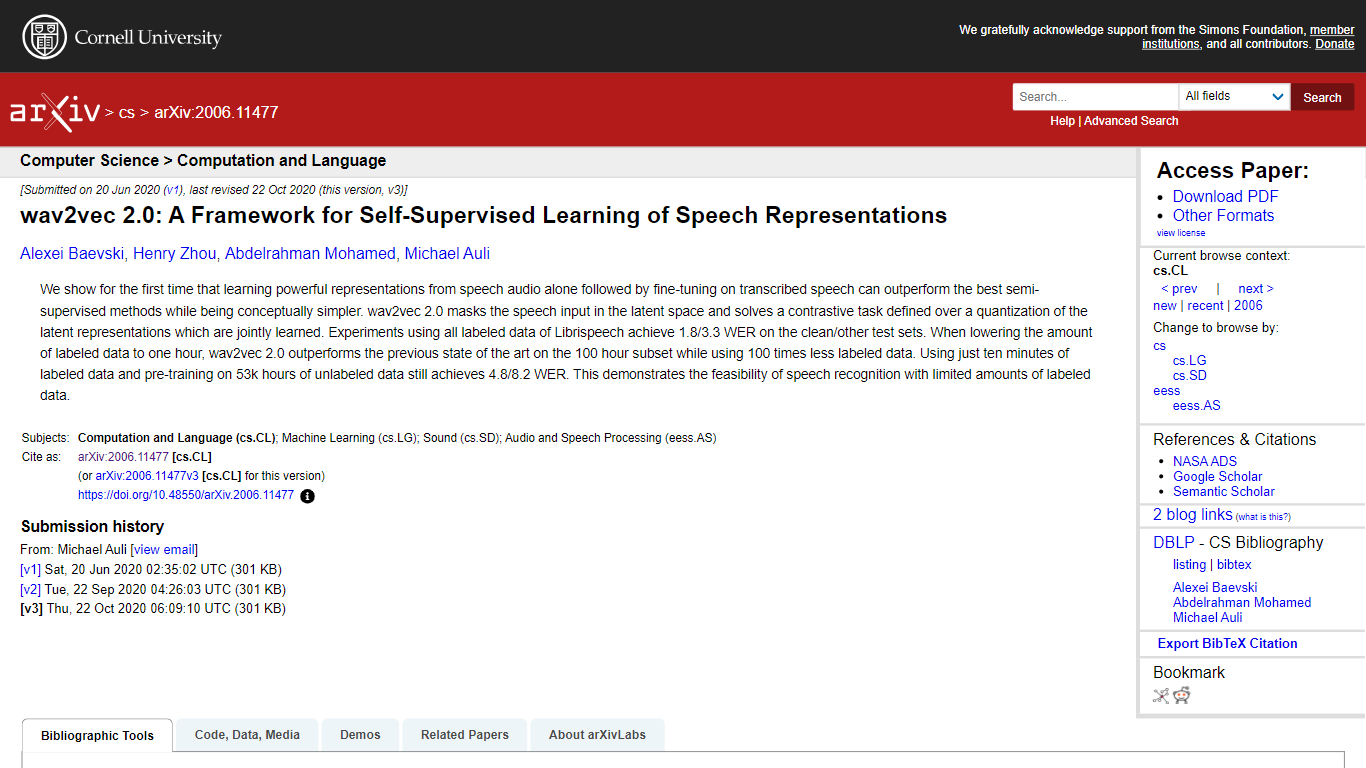

What is wav2vec 2.0?
wav2vec 2.0 is a self-supervised learning framework that learns speech representations directly from raw audio. It masks portions of the speech input in a latent space and solves a contrastive task over quantized latent representations, which are learned jointly with the model. This approach allows the model to leverage large amounts of unlabeled speech data effectively. After pre-training, wav2vec 2.0 can be fine-tuned on small amounts of labeled speech data to achieve state-of-the-art speech recognition performance. The model has demonstrated strong results even when fine-tuned with just minutes of labeled audio, making it highly efficient for low-resource scenarios.
The framework simplifies speech recognition by removing the need for complex semi-supervised pipelines, relying instead on a single end-to-end model. It achieves impressive word error rates on standard benchmarks like Librispeech and TIMIT, outperforming previous methods that require much more labeled data. The quantization of latent speech representations enables the model to learn discrete speech units, which improves robustness and generalization.
wav2vec 2.0 targets researchers and developers working on speech recognition, especially those interested in leveraging unlabeled audio data to reduce annotation costs. Its ability to perform well with limited labeled data opens opportunities for building speech systems in low-resource languages or domains. The model architecture is based on convolutional feature encoders and Transformer networks, allowing it to capture both local and global speech patterns.
Technically, wav2vec 2.0 combines contrastive learning with a masking strategy applied in the latent space, which differs from previous approaches that mask input audio directly. This design choice improves the quality of learned representations. The model is trained on large unlabeled datasets, such as 53,000 hours of speech, and fine-tuned on smaller labeled subsets. This two-stage training process balances scalability and accuracy.
Overall, wav2vec 2.0 represents a significant advance in self-supervised speech representation learning. It reduces reliance on labeled data, simplifies training pipelines, and achieves competitive or superior performance compared to fully supervised or semi-supervised methods. The release of code and pretrained models supports adoption and further research in speech technology.
Gemini AI
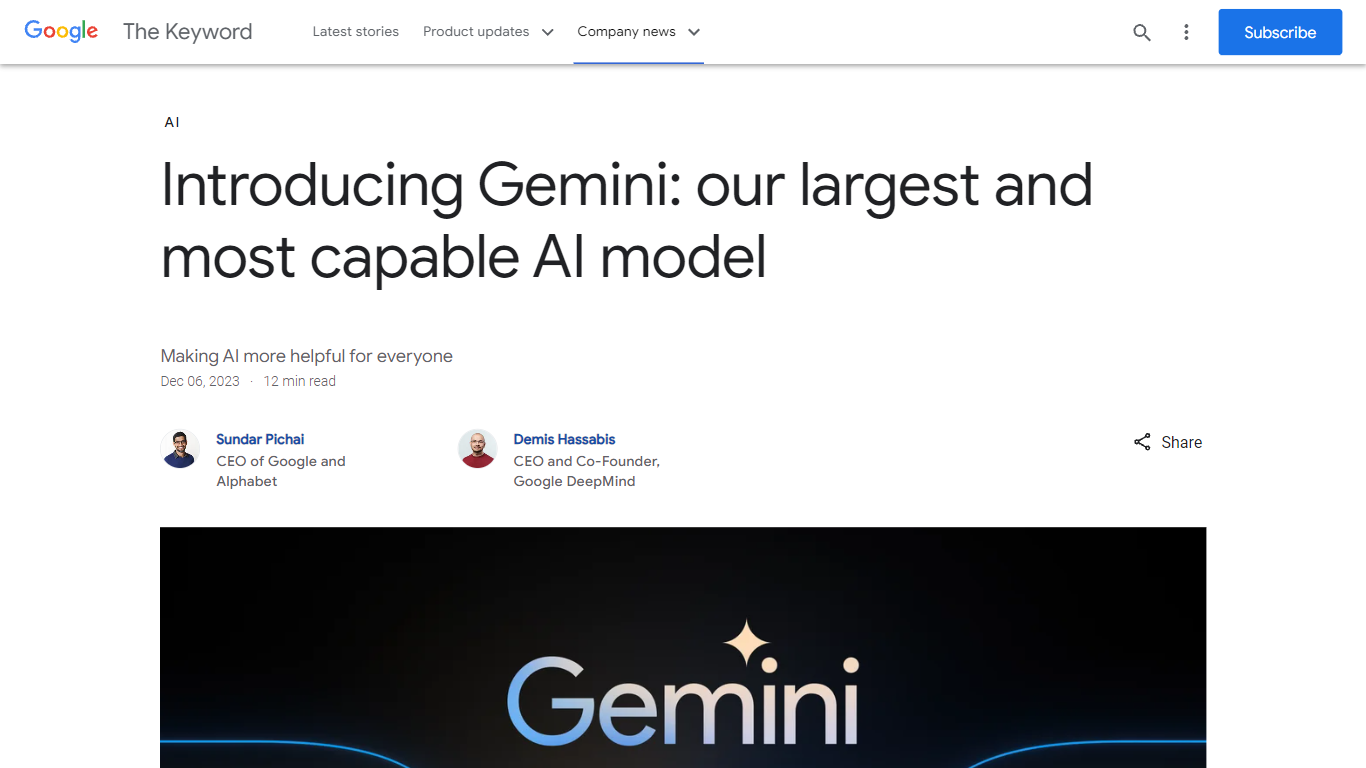
What is Gemini AI?
Gemini is Google's flagship family of multimodal AI models, developed by Google DeepMind and available through the Gemini app at gemini.google.com. The models handle text, images, audio, and video in a single conversation, and the consumer app positions Gemini as a personal assistant for writing, planning, brainstorming, and research.
Google ships Gemini across several tiers, from the free Gemini app to paid Google AI Plus, Pro, and Ultra subscriptions. Developers access the same underlying models through the Gemini API in Google AI Studio, with separate free and pay-as-you-go pricing for production workloads.
The model line has expanded well beyond the original Ultra, Pro, and Nano sizes announced in 2023. Current releases include Gemini 3.5 Flash, Gemini 3.1 Pro, and specialized variants for image generation, video, audio, and on-device use.
wav2vec 2.0 Upvotes
Gemini AI Upvotes
wav2vec 2.0 Top Features
Self-supervised pretraining on raw audio 🎧 enables learning from unlabeled speech data
Latent space masking 🎭 improves model focus on context and robustness
Contrastive task over quantized representations 🔄 helps learn discrete speech units
Fine-tuning with minimal labeled data 📝 achieves strong speech recognition accuracy
Transformer-based architecture 🔗 captures long-range speech dependencies effectively
Gemini AI Top Features
Chat with Gemini 3.5 Flash and Gemini 3.1 Pro for writing, coding, and complex reasoning tasks
Generate and edit images with Nano Banana directly inside the Gemini app
Create and edit videos conversationally with Gemini Omni
Run Deep Research to compile reports from web sources and uploaded documents
Switch between voice and text with Gemini Live, including camera input for visual questions
Build custom Gems for repeatable workflows and specialized assistant behavior
Use Canvas to draft documents, code, and plans alongside the chat interface
wav2vec 2.0 Category
- Large Language Model (LLM)
Gemini AI Category
- Large Language Model (LLM)
wav2vec 2.0 Pricing Type
- Freemium
Gemini AI Pricing Type
- Freemium