
Last updated 08-11-2026
Category:
Overall Rating:
5.0 🏆
Reviews:
Join thousands of AI enthusiasts in the World of AI!
Gladia
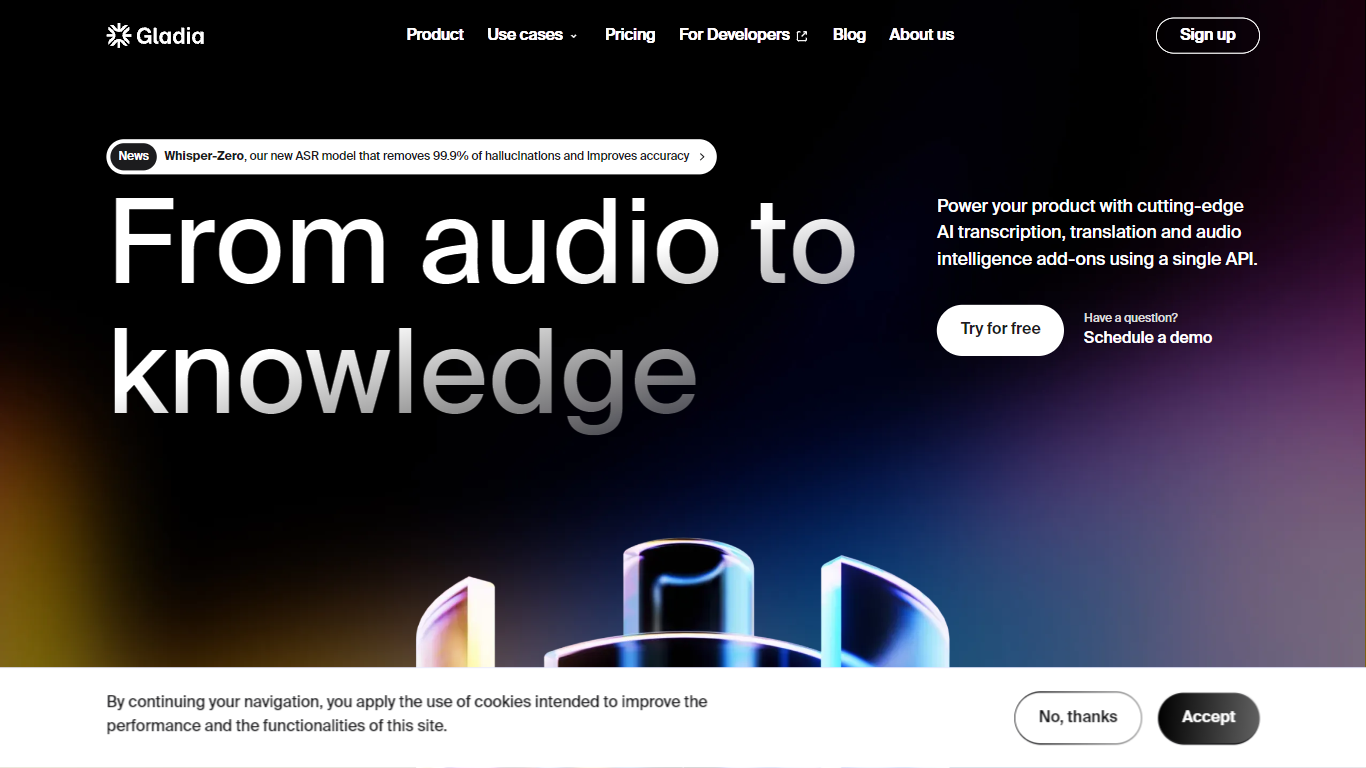
Gladia is a speech-to-text API for developers building voice products. Its single API handles async and real-time transcription, speaker diarization, sentiment analysis, and Audio-to-LLM enrichment. Solaria-3 and Solaria-1 models cover 100+ languages with native code-switching when speakers mix languages mid-sentence. Over 300,000 developers and 2,000+ enterprise teams use Gladia for meeting assistants, contact centers, voice agents, and media workflows.
Most STT APIs charge extra for diarization, sentiment, or multilingual support. Gladia bundles speaker labels, named entity recognition, and translation into the core transcription call at no add-on cost. Its EU headquarters and default model-training opt-out on paid plans give procurement teams a compliance story Deepgram and AssemblyAI often sell as upgrades. Self-hosted Whisper comparisons on Gladia's site cite roughly 20% less DevOps overhead for teams that switch.
Product teams plug Gladia into Pipecat, LiveKit, Twilio, or Retell with Python and Node.js SDKs. Contact centers transcribe call recordings for QA and compliance. Meeting assistant builders get sub-300ms real-time latency and a 99.95% uptime SLA on production traffic. Media teams generate time-stamped subtitles from pre-recorded audio through the async endpoint.
Solaria-3 hits 9.6% WER on real English audio and leads on European business benchmarks
Real-time STT streams with sub-300ms latency for live voice agents and dictation apps
100+ languages with automatic detection and native mid-sentence code-switching
Speaker diarization included on every plan, with 3x fewer errors than competing vendors on Gladia benchmarks
Async transcription from $0.61/hour on Starter and down to $0.20/hour on Growth plans
Audio-to-LLM pipeline returns summaries, action items, and entity extraction in one API call
SOC 2 Type II, HIPAA, GDPR, and ISO 27001 certifications with EU data residency options
Speaker diarization, sentiment, and translation ship inside the core API with no per-feature add-ons
Solaria-3 leads Gladia's open benchmarks on conversational English and European business audio
Python and Node.js SDKs plus native integrations with Pipecat, LiveKit, Twilio, and Retell
50 euro signup credit with no expiry lets teams test async and real-time before committing
EU-headquartered with model-training opt-out and data residency built into paid plans
Starter tier limits you to 30 real-time and 25 async concurrent requests
No uptime SLA on the pay-as-you-go Starter plan
Enterprise pricing is custom only, with no self-serve quote for high-volume teams
Is Gladia free to try?
Yes. Gladia gives new signups 50 euros in free transcription credits with no expiry. That covers roughly 80+ hours of async transcription or 60+ hours of real-time at Starter rates. After credits run out, you top up through a prepaid wallet or upgrade to Growth or Enterprise.
How much does Gladia speech-to-text cost?
Gladia charges by the hour of audio processed. Starter plans price async transcription at $0.61 per hour and real-time at $0.75 per hour. Growth plans drop async to $0.20 per hour and real-time to $0.25 per hour when you commit upfront.
Does Gladia support real-time transcription?
Yes. Gladia's real-time STT API streams transcripts with sub-300ms latency through WebSocket connections. Starter plans include 30 concurrent real-time requests, with flexible limits on Growth and unlimited concurrency on Enterprise.
How many languages does Gladia support?
Gladia transcribes 100+ languages on both async and real-time endpoints. Solaria-1 covers the broadest set, while Solaria-3 optimizes accuracy for English, French, German, Spanish, and Italian. Automatic language detection runs without manual configuration.
Does Gladia include speaker diarization?
Yes. Gladia includes speaker diarization on every paid plan at no extra charge. Its pyannote-based diarization ranks first on Gladia's open benchmarks, with roughly 3x fewer speaker-label errors than competing STT providers.
Is Gladia compliant for regulated industries?
Yes. Gladia holds SOC 2 Type II, HIPAA, GDPR, and ISO 27001 certifications. Enterprise customers can choose EU data residency, zero data retention, and on-premise deployment for both Solaria models.