
Last updated 09-02-2026
Category:
Reviews:
Join thousands of AI enthusiasts in the World of AI!
Latenode
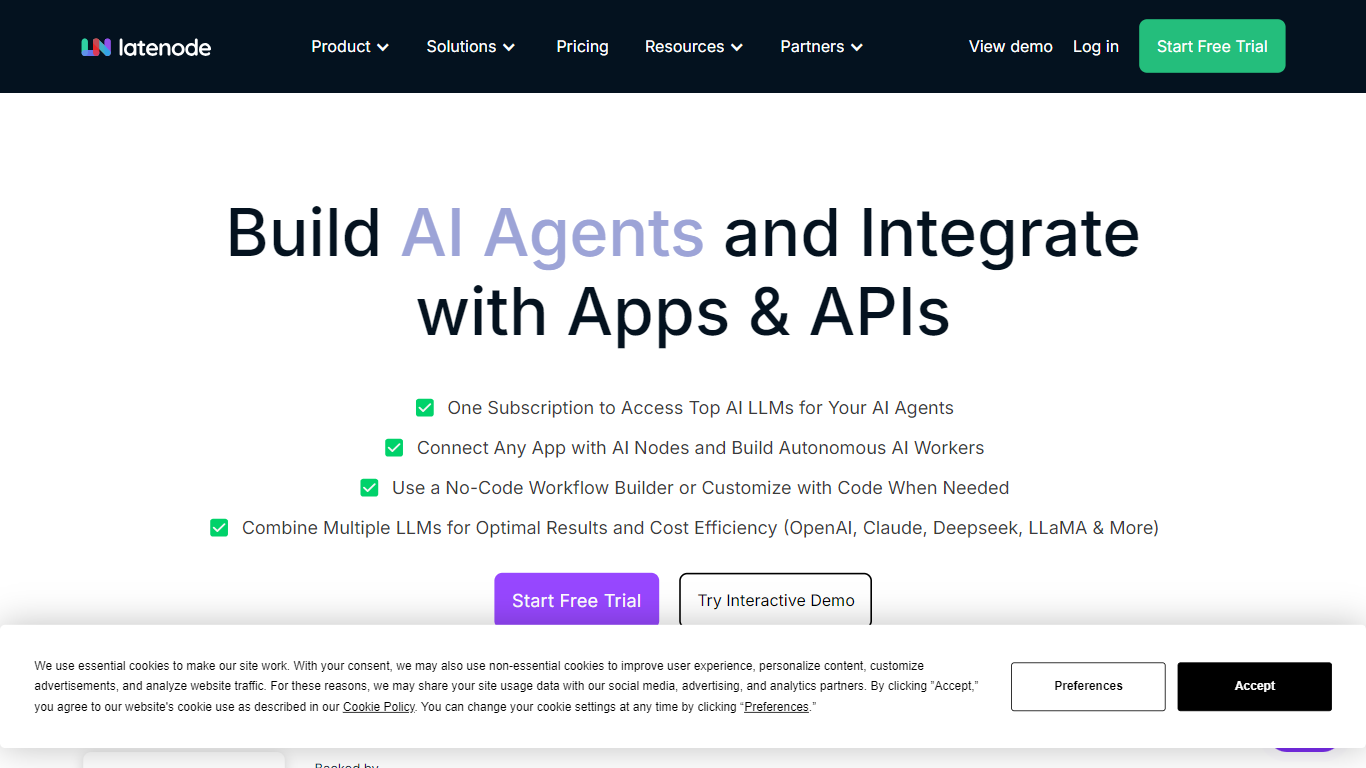
Describe a task in plain language and Latenode's AI assistant builds nodes, connections, and JavaScript on a visual canvas for you. It connects 5,500+ integrations across 1,200+ apps, includes 335+ LLM models without separate API keys, and runs triggers, actions, and agents from one workspace.
Where Zapier and Make charge per task or operation, Latenode bills by CPU runtime, so a workflow with many branches does not multiply the bill the way step-based tools do. Its pricing page estimates 100,000 one-second runs at $10.80 per month after the free allowance, while the homepage comparison table puts Zapier near $733 at the same volume. You still get drag-and-drop building, but any node can flip to full JavaScript with NPM packages when visual steps fall short.
RevOps, marketing, and operations teams use Latenode for lead routing, CRM sync, and invoice extraction. Developers get headless Chromium automation, MCP server access for Cursor and Claude, built-in RAG storage, and webhooks without standing up separate infrastructure.
Teams that want hands-off delivery can use the managed service from $199 per month with partner-built workflows, though the self-serve free tier requires no credit card and includes 10,000 CPU seconds monthly.
5,500+ integrations across 1,200+ apps with managed OAuth and no separate API keys for 335+ LLMs
CPU-second billing with 10,000 free seconds monthly and tiered rates from $0.00012 down to $0.00005 per second
Full JavaScript editor with 1M+ NPM packages in any workflow node
Headless Chromium browser automation for sites that lack a public API
MCP server connects Cursor, Claude, and Codex to saved app connections and scenarios
Built-in database, RAG storage, and webhook triggers included on Free and Pay as you go plans
Free plan includes 5 active workflows, all apps, AI agents, and browser automation with no credit card
Free tier includes 10,000 CPU seconds monthly with no credit card required.
CPU-second billing avoids per-operation charges on complex multi-step workflows.
335+ LLM models and 5,500+ integrations accessible without managing separate API keys.
Full JavaScript and 1M+ NPM packages in nodes go beyond strict no-code automation tools.
MCP server lets Cursor, Claude, and Codex build and run scenarios without opening the editor.
Headless browser automation covers sites that lack public APIs.
CPU-second pricing takes more effort to estimate than flat task-based plans.
Free plan limits you to 5 active workflows and 1 parallel worker.
Managed service starts at $199 per month plus setup from $1,000.
Optional Plug-n-Play nodes for paid external providers bill separate PnP tokens at $1 each.
Does Latenode have a free plan?
Yes. Latenode's Free plan costs $0 per month and includes 10,000 CPU seconds every month, up to 5 active workflows, and access to all apps, AI agents, RAG, headless browser automation, and the built-in database. No credit card is required to create an account.
How does Latenode pricing work after the free tier?
After the monthly 10,000 free CPU seconds, Latenode uses pay-as-you-go billing with no base fee. Usage is charged by workflow runtime in tiered brackets, starting at $0.00012 per CPU second for the 10,001 to 100,000 range and dropping to $0.00005 per second above 5,000,000 seconds. You can set a monthly spending cap before paid usage starts.
How many integrations does Latenode support?
Latenode lists 5,500+ integrations across 1,200+ apps and LLMs on its integrations page. Popular connectors include Slack, HubSpot, Salesforce, Shopify, Notion, Stripe, and ChatGPT. OAuth is handled automatically, and custom HTTP or JavaScript nodes cover apps outside the library.
Can I write code in Latenode workflows?
Yes. Latenode lets you write full JavaScript in any node with access to 1M+ NPM packages alongside its visual drag-and-drop builder. The platform also includes an AI Code Copilot to generate, explain, and debug code inside scenarios.
Does Latenode require separate API keys for AI models?
No. Latenode includes access to 335+ LLM models in one subscription without managing separate API keys for GPT, Claude, Gemini, and other models on its AI models page. Optional Plug-n-Play nodes that call paid external providers use separate PnP tokens billed at $1 per token.
What security certifications does Latenode offer?
Latenode publishes GDPR Ready and SOC2 Ready reports on its homepage and lists encryption at rest and in transit, granular access control, and auditability under its Secure by design section. Its security documentation is available at latenode.com/docs/security.
How is Latenode different from Zapier or Make?
Latenode charges by CPU runtime instead of per operation or task, includes 335+ LLMs without separate API billing, and supports full JavaScript in any node. Its homepage comparison estimates 100,000 operations at about $10.80 per month on Latenode versus roughly $733 on Zapier and $203 on Make.