
Last updated 08-21-2026
Category:
Reviews:
Join thousands of AI enthusiasts in the World of AI!
OpenFlags
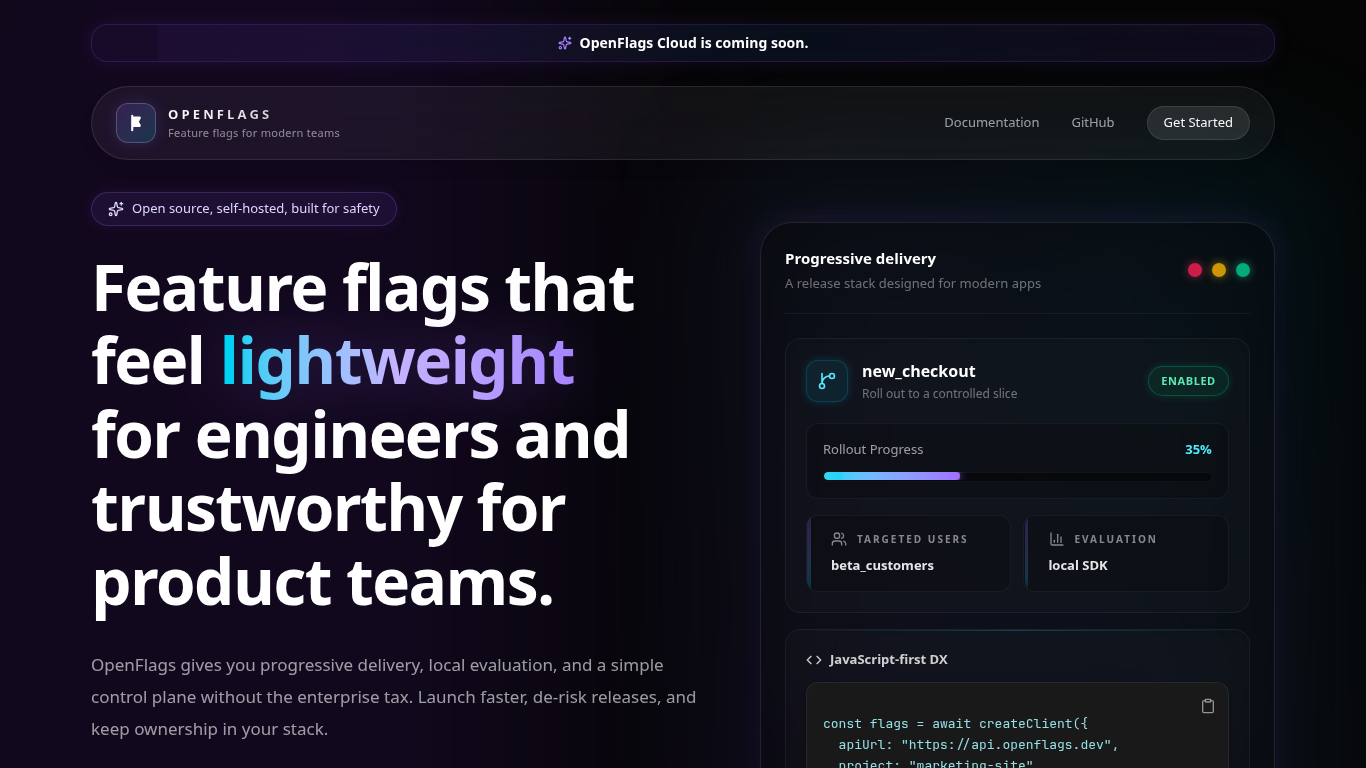
OpenFlags is an open-source, self-hosted feature flag platform built for modern JavaScript teams. It gives engineers percentage rollouts, local flag evaluation, and a lightweight control plane without the overhead of enterprise flag vendors. Product teams get safer launches; developers keep full ownership of the stack.
The architecture centers on local SDK evaluation, so feature checks run inside your app instead of adding a network hop on every request. The homepage cites 0ms local latency for flag evaluation. Rollouts support granular targeting by user segments, and kill switches let you turn features off without redeploying.
OpenFlags ships as a Bun monorepo with a server API, React dashboard, TypeScript SDKs, and documentation site. It targets teams running React, Next.js, Vite, Node.js, and Bun who want progressive delivery without migrating to a heavy hosted platform. Deploy templates are available on Railway and Zeabur; a hosted OpenFlags Cloud is listed as coming soon.
Flags evaluate locally in your app with 0ms latency cited on the homepage for each check
Percentage rollouts and user segment targeting for gradual feature releases
Type-safe JavaScript SDKs for React, Next.js, Vite, Node.js, and Bun
Quickstart integration uses the @openflagsdev/js package with a createClient API
Kill switches to disable features instantly without redeploying your application
Fully open source with a transparent monorepo you can audit and self-host.
Local SDK evaluation avoids per-check network calls to a flag service.
One-click deploy templates on Railway and Zeabur lower the setup barrier.
Hosted OpenFlags Cloud is not available yet; self-hosting is required today.
SDK coverage is JavaScript-focused with no documented support for other language stacks.
No pricing page or enterprise support tier is listed on the site.
Is OpenFlags free to use?
Yes. OpenFlags is open source and self-hosted, so you can run the full platform on your own infrastructure at no license cost. The project is available on GitHub under the huextrat/openflags repository.
Does OpenFlags require a hosted service?
No. OpenFlags is designed to be self-hosted by default, with a Bun-powered server, React dashboard, and SDKs you run in your own environment. OpenFlags Cloud, a hosted option, is listed as coming soon on the homepage.
What frameworks does OpenFlags support?
OpenFlags provides JavaScript-first SDKs built for React, Next.js, Vite, Node.js, and Bun applications. The quickstart docs show integration via the @openflagsdev/js package with a createClient API.
How does OpenFlags keep flag checks fast?
OpenFlags evaluates flags locally inside your application using its SDK layer, so feature checks do not require an extra network request on every evaluation. The homepage highlights 0ms local latency for flag decisions.
What is included in the OpenFlags monorepo?
The OpenFlags monorepo includes a Bun-powered server for flag storage and targeting, a React dashboard for managing projects and rollouts, TypeScript SDK packages for in-app evaluation, and a documentation site for onboarding.
Can I deploy OpenFlags with one-click templates?
Yes. OpenFlags offers one-click deploy templates on Railway and Zeabur from the homepage, in addition to running the monorepo locally with bun install and bun run dev:server.