
Last updated 08-22-2026
Category:
Reviews:
Join thousands of AI enthusiasts in the World of AI!
Palabra.ai
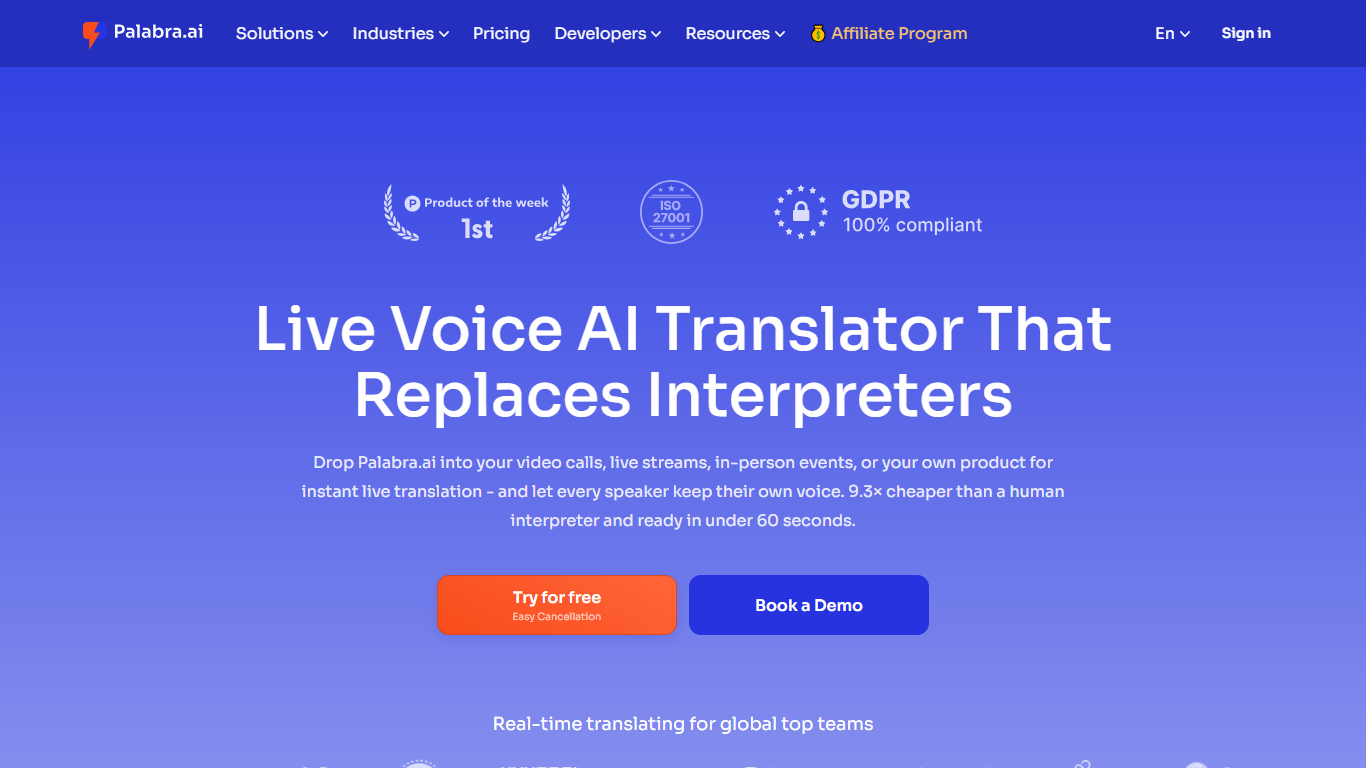
Palabra.ai translates live speech in video calls, streams, and in-person events across 60+ languages with under one second of latency. Drop it into Zoom, Google Meet, Microsoft Teams, or your own product via API, and listeners hear the speaker in their language while the original voice stays recognizable.
The platform runs on Palabra's proprietary language model, which handles automatic speech recognition, translation, and text-to-speech in one pipeline. That full-stack control lets the team tune accuracy, add custom languages on request, and deploy regional servers for teams that need minimal delay.
Event organizers, international sales teams, broadcasters, and developers building multilingual apps use Palabra when human interpreters are too slow or too expensive to scale. Ready-made tools cover meetings, webinars, live streams, and conference floors, while the streaming API exposes the same engine through WebRTC, WebSockets, and SDKs for Python, JavaScript, and Java.
Sub-second latency across 60+ languages in live sessions
Auto voice cloning so translated speech keeps each speaker's tone
Plugs into Zoom, Google Meet, and Microsoft Teams without extra plugins
One streaming API handles ASR, translation, and TTS over WebRTC or WebSockets
Custom glossaries keep industry terms consistent mid-conversation
Starter plan includes 3 hours of translation capacity per month at $60
Encrypted sessions with zero stored conversation data by default
Sub-second latency makes live conversations feel natural instead of turn-based.
Works with major meeting platforms and streaming protocols without custom plugins.
Voice cloning and custom glossaries help translated speech sound like the original speaker.
Free trial and self-serve plans are available without a sales call for smaller teams.
The company does not store conversation data by default, with private deployment options for enterprise.
Meeting plans are priced around included hours, so heavy users pay overage fees beyond the monthly cap.
Pricing varies by use case, with separate plan tables for events and live streaming.
Speaker diarization and emotion transfer are listed as coming soon rather than generally available.
No dedicated mobile app is advertised; the product is positioned for desktop calls, events, and API integrations.
Does Palabra.ai have a free trial?
Yes. Palabra.ai offers a free trial through its registration page, with easy cancellation noted on the homepage. Paid plans start at $60 per month for meetings and presentations once trial capacity is used.
Which video platforms does Palabra.ai support?
Palabra.ai works with Google Meet, Zoom, and Microsoft Teams for live meeting translation. Its Broadcaster product also integrates with streaming tools like OBS and vMix using SRT and RTMP protocols.
How fast is Palabra.ai's live translation?
Palabra.ai delivers simultaneous two-way speech translation with less than one second of latency. The homepage and API pages both cite sub-second response times for real-time conversations.
Can developers integrate Palabra.ai into their own app?
Yes. Palabra.ai provides a speech-to-speech translation API with WebRTC and WebSocket streaming, plus SDKs for Python, JavaScript, and Java. Developers can add real-time multilingual voice to custom products without building an ASR or TTS stack.
Does Palabra.ai store conversation recordings?
No. Palabra.ai encrypts conversations in transit and does not store conversation data on its servers. Enterprise customers can also deploy the API in private cloud or on-premises environments.
Can audiences read captions instead of hearing translated audio?
Yes. Palabra.ai supports real-time captions and transcripts alongside translated audio. Listeners can choose to read live text or hear the translated voice during meetings, events, and streams.
How many languages does Palabra.ai support?
Palabra.ai supports more than 60 languages, including English, Spanish, French, German, Chinese, Japanese, Korean, Arabic, and Portuguese. The platform can also add custom languages on request for enterprise deployments.