
Last updated 07-26-2026
Category:
Reviews:
Join thousands of AI enthusiasts in the World of AI!
Project Aria
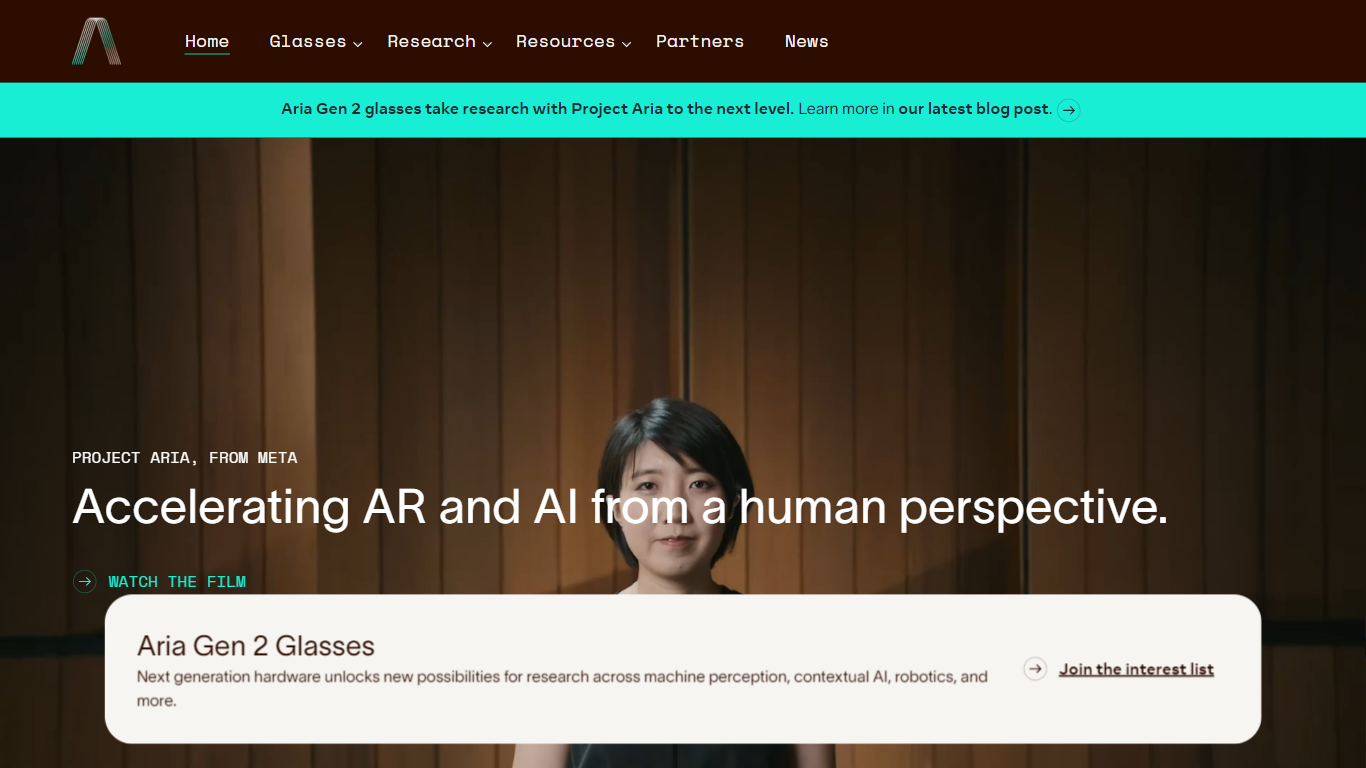
Project Aria is Meta's research initiative advancing augmented reality (AR) and artificial intelligence (AI) through egocentric data collection and analysis. It provides researchers with Aria Gen 2 glasses, a wearable device equipped with an enhanced sensor suite including multiple SLAM cameras, eye tracking, PPG sensors, contact microphones, and on-device compute capabilities. These glasses enable always-on sensing and human-in-the-loop features, expanding research in contextual AI, robotics, and machine perception.
The program supports a diverse community of over 200 academic and corporate partners, offering access to the Aria Research Kit which includes hardware, software tools, and services. Researchers can collect, stream, and analyze multimodal sensor data to create datasets and build models that improve scene understanding and AI contextual awareness.
Project Aria emphasizes open science by sharing extensive public datasets such as city-scale egocentric data, synthetic environments, and detailed object catalogs. It also provides open-source tools like EgoBlur for privacy-preserving data processing and SceneScript for scene geometry inference. These resources accelerate research and foster collaboration across computer vision and robotics fields.
The Aria Gen 2 glasses improve upon the first generation with longer battery life (6-8 hours), foldable design, programmable applications, and cloud streaming support. The device integrates advanced sensors like four SLAM cameras, RGB and eye-tracking cameras, inertial measurement units, microphones, GNSS, PPG sensors, and contact microphones, enabling rich data capture and on-device processing.
Meta offers a rolling application process for the Aria Research Kit, making this technology accessible to independent researchers and institutions. The program also maintains comprehensive documentation, research papers, and active community engagement through challenges and partnerships.
Overall, Project Aria bridges the gap between research and real-world AR applications by providing state-of-the-art hardware, open datasets, and a collaborative ecosystem. It enables researchers to explore human-centered machine perception and develop innovations that inform future AR and AI products.
🎥 Multimodal Sensor Suite: Capture rich data with SLAM, RGB, eye-tracking, PPG, and contact microphones for comprehensive environment understanding.
🕶️ Wearable Always-On Glasses: Long battery life and foldable design enable extended real-world data collection in natural settings.
⚙️ On-Device Compute: Run applications and machine perception algorithms directly on the glasses for real-time insights.
☁️ Cloud Streaming Support: Stream sensor data locally or to the cloud for flexible research workflows and remote analysis.
📂 Open Resources: Access extensive public datasets, open-source tools, and models to accelerate AI and AR research.
Provides a unique wearable platform with advanced sensors for egocentric data capture.
Supports a broad research community with open datasets and tools.
Enables always-on sensing with improved battery life and on-device processing.
Offers programmable glasses and cloud streaming for flexible experimentation.
Maintains active partnerships and open science initiatives to foster collaboration.
Access to the Aria Research Kit requires application and approval, limiting immediate availability.
Hardware is specialized for research and not intended for consumer use.
Some advanced features may require technical expertise to utilize effectively.
How can I apply for the Aria Research Kit?
You can apply through a rolling application process on the Project Aria website, demonstrating a clear research use case and understanding of the tools.
What sensors are included in the Aria Gen 2 glasses?
The glasses include four SLAM cameras, one RGB camera, two eye-tracking cameras, inertial measurement units, microphones, GNSS, PPG sensors, and a contact microphone.
Can I run applications directly on the Aria Gen 2 glasses?
Yes, Aria Gen 2 supports programmable applications that can be installed and run on-device for real-time machine perception.
Are there public datasets available from Project Aria?
Yes, Project Aria offers extensive open datasets including city-scale egocentric data, synthetic environments, and object catalogs accessible via the Dataset Explorer.
What tools are provided to work with Aria data?
Open-source tools like EgoBlur, SceneScript, and Aria Studio help with data processing, privacy, visualization, and scene understanding.
Is the Aria Research Kit intended for consumer use?
No, the kit is designed specifically for research purposes and is not a consumer product.
How long does the Aria Gen 2 battery last?
The battery life ranges from 6 to 8 hours, supporting extended data collection sessions.