
Last updated 07-02-2026
Category:
Reviews:
Join thousands of AI enthusiasts in the World of AI!
Rails Guard
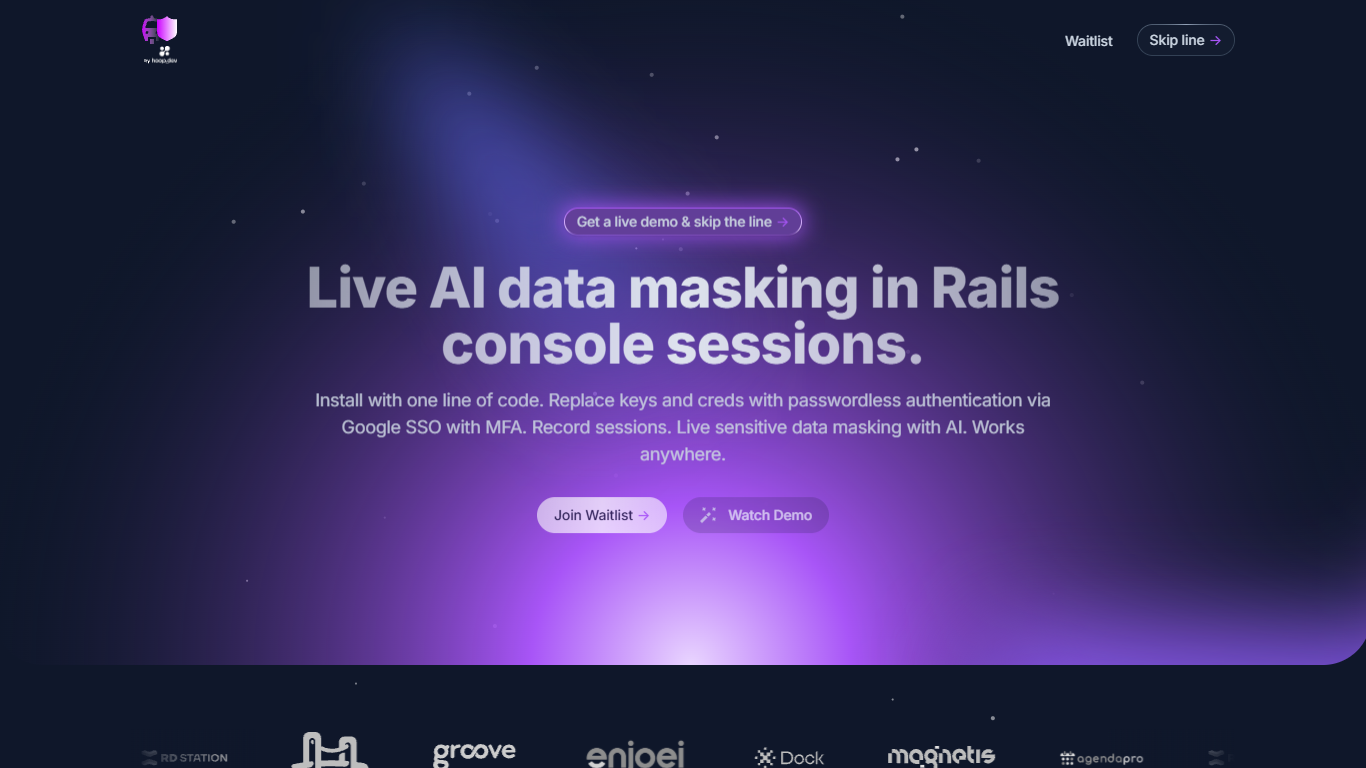
Rails Guard is a security layer for Ruby on Rails console access, built by Hoop.dev. It wraps production console sessions with guardrails so engineers can debug live apps without exposing customer data or sharing long-lived credentials.
The setup is a one-line change: prefix your Rails startup with the Hoop agent to inject Rails Guard and open its web portal. From there, teams get passwordless access through Google SSO with MFA, group-based console profiles, and automated onboarding and off-boarding.
Live data masking redacts sensitive values in console output as they appear, which helps teams stay compliant with HIPAA, SOC 1/2, PCI, and GDPR requirements. Every session is recorded for audit trails, and repeated Ruby scripts can be turned into repeatable no-code UIs in about 10 seconds.
Activate Rails Guard by prefixing your Rails startup with the Hoop agent
Masks PII and sensitive values in console output as sessions run
Google SSO with MFA replaces static keys for remote console access
Records who ran what, when, and where across every console session
Grants just-in-time console access from Slack for 10 minutes up to 12 hours
Turns repeated Ruby scripts into repeatable no-code UIs in about 10 seconds
Installs with a one-line codebase change and keeps the familiar Rails console interface.
Live output masking reduces the risk of exposing customer PII during production debugging.
Session recording and Slack-based approvals give security teams clear audit trails.
Supports compliance workflows for HIPAA, SOC 1/2, PCI, and GDPR from a single layer.
Public access is waitlist-only, so teams cannot self-serve signup today.
No pricing page is published on the Rails Guard site.
Focused on Rails console workflows, so it is not a general-purpose secrets manager.
How do you install Rails Guard?
Rails Guard installs with a one-line change to your Rails codebase. You prefix the application startup with the Hoop agent, deploy the change, and the Rails Guard web portal becomes available for your team.
What authentication does Rails Guard use?
Rails Guard uses passwordless authentication through Google SSO with MFA. It replaces static keys and credentials for remote access to the Rails console and supports group-based console profiles.
Does Rails Guard mask sensitive data in console output?
Yes. Rails Guard applies live data masking that redacts sensitive information from Rails console session output in real time. The site describes this as a plug-and-play PII filter that requires zero setup or data catalog.
Does Rails Guard record console sessions?
Yes. Rails Guard records console sessions so teams can audit who performed each action, when it happened, and where it ran. Session content search and automatic audits are listed as part of the platform.
Does Rails Guard integrate with Slack?
Yes. Rails Guard supports Slack-based access reviews, including just-in-time grants from 10 minutes to 12 hours, single-command approvals, single-file execution grants, and trusted script grants for verified scripts.
Is Rails Guard publicly available?
Rails Guard is currently on a waitlist. The sign-in page offers early access before public release, and the signup page offers guided onboarding to skip the line.
What compliance standards does Rails Guard support?
Rails Guard is designed to help automate security controls for HIPAA, SOC 1/2, PCI, GDPR, and other certification requirements. Customer testimonials on the site also reference GDPR, SOC2, and PCI data needs.