
Last updated 08-22-2026
Category:
Reviews:
Join thousands of AI enthusiasts in the World of AI!
Stainless
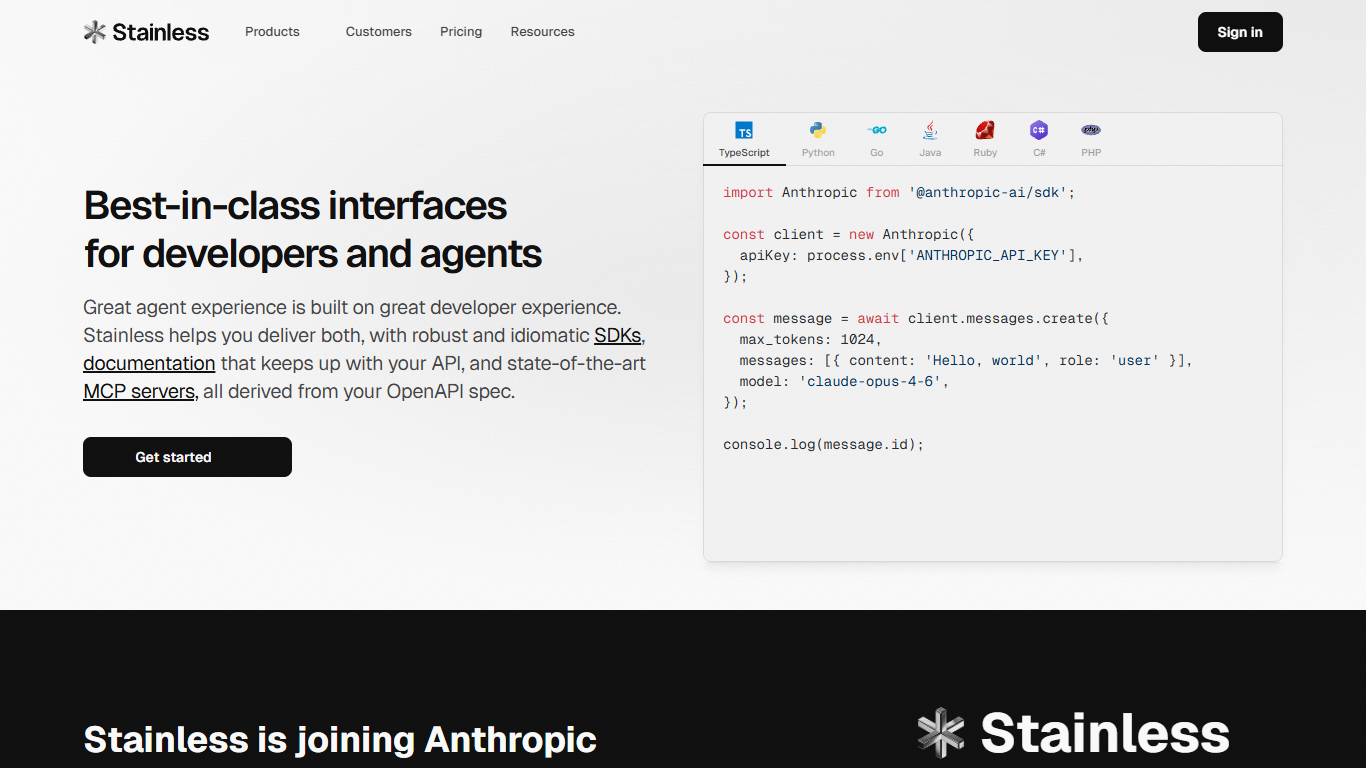
Stainless turns your OpenAPI spec into idiomatic SDKs, API documentation, and MCP servers for coding agents. Point it at your API definition and it generates client libraries in TypeScript, Python, Go, Java, Kotlin, Ruby, Terraform, C#, and PHP, plus docs sites and agent-facing MCP servers that stay in sync as your spec changes.
Where most API tooling stops at code stubs, Stainless targets libraries that feel hand-written. The team built Stripe's code generation stack, and the output ships with rich types, auto-pagination, and retries baked in. Its MCP servers use SDK code mode instead of exposing one tool per endpoint, which Stainless says cuts tool calls by 3x and saves over 100k tokens on complex agent tasks compared with traditional MCP designs.
Stainless fits API platform teams, developer relations engineers, and companies shipping public or partner APIs who want SDKs, docs, and agent integrations without maintaining each surface by hand. Customers have included Anthropic, Cloudflare, OpenAI, and Nvidia. In May 2026 Stainless announced it is joining Anthropic and winding down new hosted signups, though existing customers retain rights to SDKs they already generated.
Generates SDKs in 9 languages from a single OpenAPI spec, including TypeScript, Python, Go, and Java
SDK code mode MCP servers expose search_docs and execute tools instead of one tool per endpoint
Stainless Docs Platform is built on Astro with hybrid AI search, llms.txt, and copy-as-markdown
Free plan includes up to 5 generators, 5 seats, and APIs with 25 endpoints or fewer
Docs sites support self-hosted deployment on Vercel, Fly.io, or Cloudflare with sub-100ms TTFB on Stainless hosting
SDK output mirrors hand-written libraries with types, pagination, and retries included
Single OpenAPI spec feeds SDKs, docs, and MCP servers so nothing drifts out of sync
MCP code mode reduces token overhead versus endpoint-per-tool MCP designs
Docs platform runs on Astro with hybrid search, llms.txt, and framework-agnostic components
Trusted by major API companies including Anthropic, Cloudflare, OpenAI, and Nvidia
New signups and SDK generator projects were closed after the Anthropic acquisition announcement
Paid Starter and Pro plan prices are not listed publicly on the pricing page
Requires a well-maintained OpenAPI spec as the single source of truth for all outputs
Self-hosted docs need familiarity with Astro to customize beyond CSS theming
What does Stainless generate from an OpenAPI spec?
Stainless generates idiomatic SDKs, API documentation sites, and MCP servers from your OpenAPI spec. SDKs ship for TypeScript, Python, Go, Java, Kotlin, Ruby, Terraform, C#, and PHP, and all outputs stay in sync when the spec changes.
Is there a free plan for Stainless?
Yes, Stainless offers a Free plan at $0 per month with up to 5 generators, 5 seats, and support for APIs with 25 endpoints or fewer. A generator counts as one SDK, Docs site, or MCP server.
How does Stainless MCP differ from traditional MCP servers?
Stainless MCP servers use SDK code mode with two tools, search_docs and execute, instead of listing one tool per API endpoint. Stainless reports 94 to 97 percent task accuracy, 3x fewer tool calls, and over 100k tokens saved on complex agent tasks.
What languages do Stainless SDKs support?
Stainless generates SDKs for TypeScript, Python, Go, Java, Kotlin, Ruby, Terraform, C#, and PHP from the same OpenAPI spec. Output includes rich types, auto-pagination, and retries based on patterns from Stripe's code generation.
Can Stainless docs be self-hosted?
Yes, Stainless docs sites are Astro repos you fully own. You can host on Stainless infrastructure with Cloudflare edge caching and automatic SSL, or deploy as static or SSR sites on Vercel, Fly.io, or Cloudflare.
Who built Stainless?
Stainless was founded in 2022 by Alex Rattray and team members who built Stripe's code generation and Markdoc documentation tooling. The company announced it is joining Anthropic in May 2026 to focus on Claude Platform API capabilities.