
Last updated 07-30-2026
Category:
Reviews:
Join thousands of AI enthusiasts in the World of AI!
TurboDoc
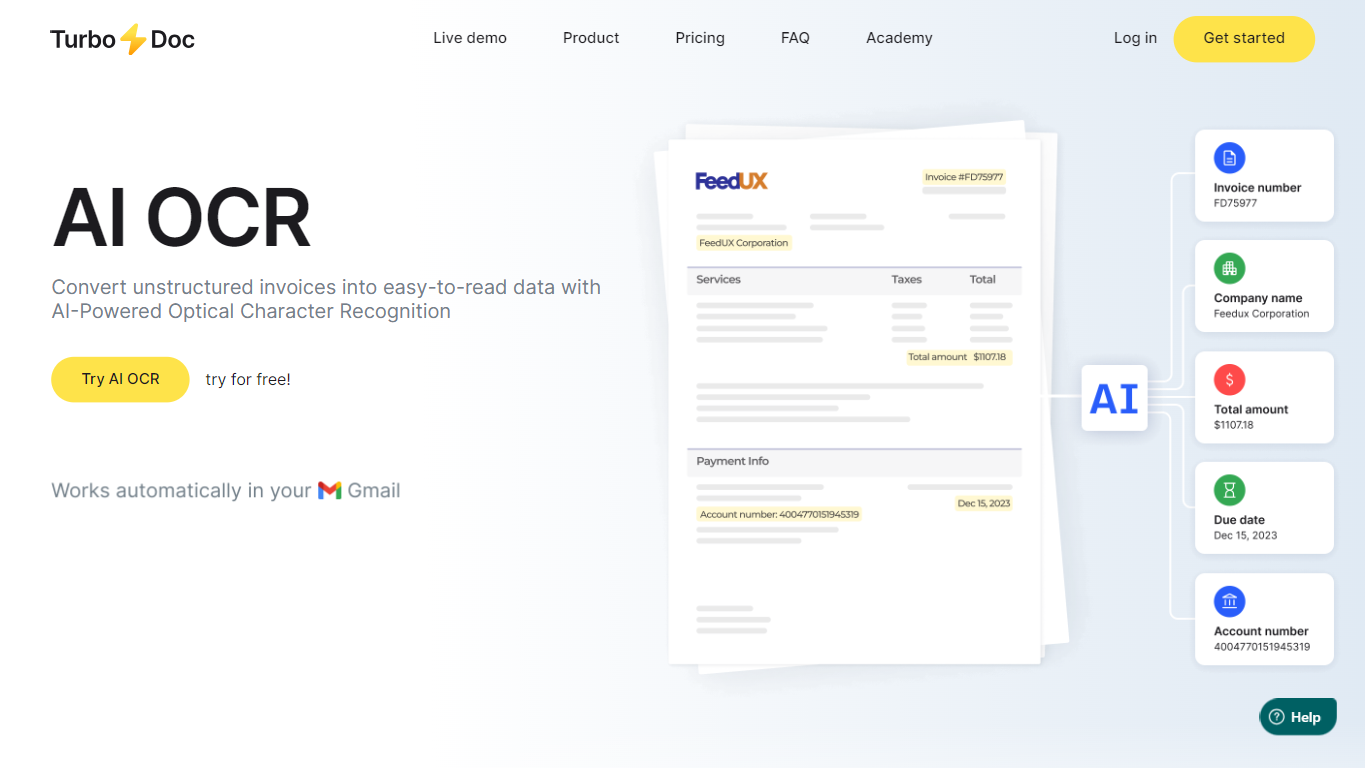
TurboDoc pulls structured data out of invoices, receipts, and bank statements so finance teams stop retyping vendor names, totals, and due dates. Upload files directly or connect Gmail or Outlook and let new documents flow into a searchable dashboard without manual sorting. It targets accounts payable and bookkeeping workflows where messy PDFs and scans pile up every week. Stored originals stay tied to extracted fields you can review and edit row by row.
Most OCR tools stop at turning a page into text. TurboDoc is built around payable document fields like invoice numbers, routing details, and payment dates, then keeps them in a table you can export to CSV or XLS. The Gmail and Outlook hooks mean capture starts in the inbox, which is closer to how small teams actually receive bills than a bulk upload queue. Accounting software integrations and a public API are listed as coming soon, so this is a mailbox-first extraction layer rather than a full ERP replacement.
Bookkeepers, AP clerks, and small business owners use it to clear invoice backlogs and catch missing payments before they become late fees. The dashboard view-and-edit mode lets you open the source file beside corrected fields, which helps when a scan is skewed or a vendor uses an unusual layout. Export paths into spreadsheets support month-end reconciliation without rebuilding the same report from scratch.
Connect Gmail or Outlook and TurboDoc captures invoices from up to 10 mailbox accounts on the Business plan
Accepts PDF, JPEG, PNG, WEBP, HEIC, and TIFF uploads up to 10 MB per file
Reports an average extraction time of 1.2 seconds per page with 96% accuracy
Exports extracted fields to CSV, XLS, PDF, or Word for accounting workflows
Supports invoice OCR in English, Spanish, German, French, Italian, Dutch, Portuguese, and Catalan
AES256 encryption with customer data stored on US servers
Mailbox automation through Gmail or Outlook removes manual uploads for incoming bills
Side-by-side dashboard editing pairs each extracted row with its original document
Eight-language OCR covers common European invoice layouts without extra setup
Tiered plans from 50 to 1,000 monthly documents suit solo bookkeepers and growing AP teams
Native accounting software and API integrations are still on a waitlist, not live connectors
Simple plan caps bank statement parsing at 10 documents per month
No permanent free tier; every plan card routes through a paid trial signup
How much does TurboDoc cost per month?
TurboDoc lists three paid tiers on its homepage: Simple at $6 per month for 50 invoices, Pro at $30 per month for 300 invoices, and Business at $100 per month for 1,000 invoices. Each plan includes a free trial signup option before you commit to a subscription.
Can TurboDoc pull invoices from email automatically?
Yes. TurboDoc connects to Gmail or Outlook and captures incoming invoices and receipts from linked mailboxes. The Simple plan supports one connected account, Pro supports three, and Business supports ten.
What file formats does TurboDoc accept?
TurboDoc accepts PDF, JPEG, PNG, WEBP, HEIC, and TIFF files through its upload demo and connected mailboxes. Uploaded files must be between 1 KB and 10 MB.
Which languages does TurboDoc support for invoice OCR?
TurboDoc processes invoices in English, Spanish, German, French, Italian, Dutch, Portuguese, and Catalan. The vendor asks teams working in other languages to contact support for help.
Can TurboDoc handle low-quality invoice scans?
TurboDoc uses image processing algorithms to read documents with varying scan quality, though it recommends clear, legible files for the best field accuracy. The dashboard edit mode lets you correct any misread values against the original file.
Does TurboDoc integrate with accounting software?
TurboDoc exports structured data to CSV and XLS today, but direct accounting software, ERP, and CRM integrations are marked as coming soon on its site. A TurboDoc API repository on GitHub documents planned developer access.
Is TurboDoc customer data encrypted?
TurboDoc states it uses AES256 enterprise-level encryption and stores data on servers in the United States. The privacy policy says information is not stored or shared without user consent.