
Last updated 07-23-2026
Category:
Reviews:
Join thousands of AI enthusiasts in the World of AI!
Tusk
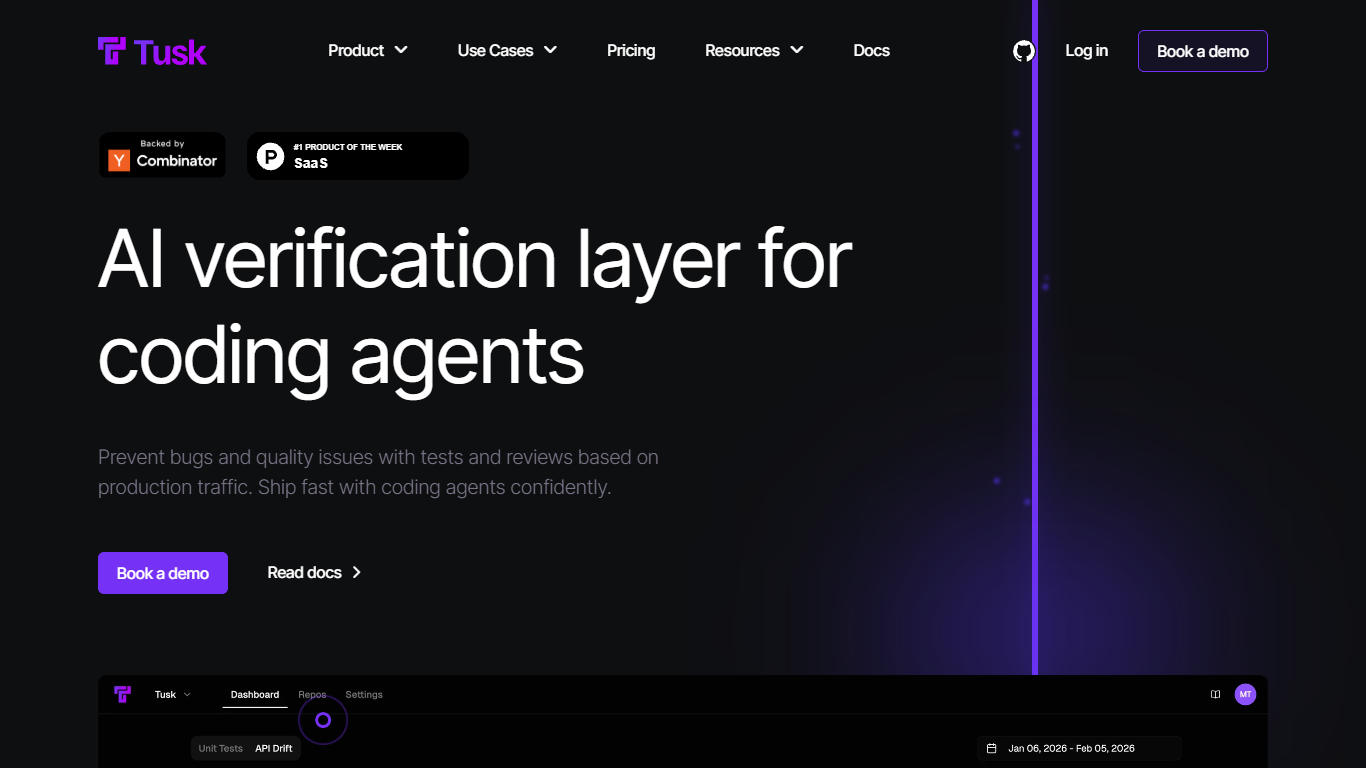
Tusk was a verification layer for coding agents that generated unit tests, API tests, and pull request code reviews grounded in production traffic. Engineering teams used it to catch regressions, raise coverage, and ship faster without sacrificing quality. The product was backed by Y Combinator and trusted by teams at companies like DeepLearning.AI, Hamming, and Promptfoo.
Tusk combined autonomous test generation with self-healing suites that updated on every commit. Its Tusk Drift module recorded real API traffic to build integration tests, while CoverBot ran scheduled pipelines to backfill unit tests on untested code. Tusk Review added PR-level code review with production trace context and documentation that learned from past resolutions.
Note: Tusk officially sunset its product on June 10, 2026. The GitHub App has been removed and the company recommends migrating to Cognition's Devin for test automation and code review.
Generates unit and API tests from pull requests with a single CLI setup command
Self-iterates on failing tests without back-and-forth with a copilot
Self-healing suites that update on every commit to match current business logic
Tusk Drift records production API traffic to build integration tests
CoverBot opens daily or weekly PRs to backfill unit tests on untested code
Tusk Review catches bugs in PRs and updates code review docs from past resolutions
Runs tests locally or in CI with GitHub and GitLab integrations
SOC 2 Type II certified with multi-tenant architecture that isolated customer source code.
Supported GitHub and GitLab with integrations for Linear and Jira on Team plans.
Self-healing test suites and autonomous iteration reduced manual test maintenance.
Tusk Drift used real production API traffic to generate more realistic integration tests.
Product discontinued on June 10, 2026 and is no longer available for new users.
Did not generate end-to-end tests, focusing only on unit and integration coverage.
Enterprise plan required a 200-seat minimum with custom pricing via sales.
Paid plans required booking a demo with no self-serve checkout option.
Is Tusk still available?
No. Tusk officially sunset its product on June 10, 2026, per a company announcement on usetusk.ai. The Tusk GitHub App has been removed from organizations, and the company recommends migrating to Cognition's Devin for test automation and code review.
What did Tusk do?
Tusk generated unit tests, API integration tests, and pull request code reviews for software teams. It used production traffic via Tusk Drift to ground tests in real usage patterns and ran autonomously in CI pipelines connected to GitHub or GitLab.
How much did Tusk cost?
Tusk offered a Free plan at $0 with a 14-day Team trial, a Team plan at $50 per month per active developer, and a Custom Enterprise plan with a 200-seat minimum. All paid plans required booking a demo rather than self-serve checkout.
What test frameworks did Tusk support?
Tusk supported popular frameworks including Jest, Vitest, Mocha, RSpec, pytest, and JUnit. It gathered context from existing tests and documentation in the repo to generate compatible test cases.
Did Tusk generate end-to-end tests?
No. Tusk focused on unit and integration tests at the pull request level. The company stated that E2E tests are brittle and time-consuming to maintain, so it did not offer E2E test generation.
How secure was Tusk?
Tusk was SOC 2 Type II certified and used multi-tenant architecture so customer source code was not accessible to other customers. Tusk and its LLM providers did not use customer source code to train models.