
Last updated 08-22-2026
Category:
Reviews:
Join thousands of AI enthusiasts in the World of AI!
Unsloth
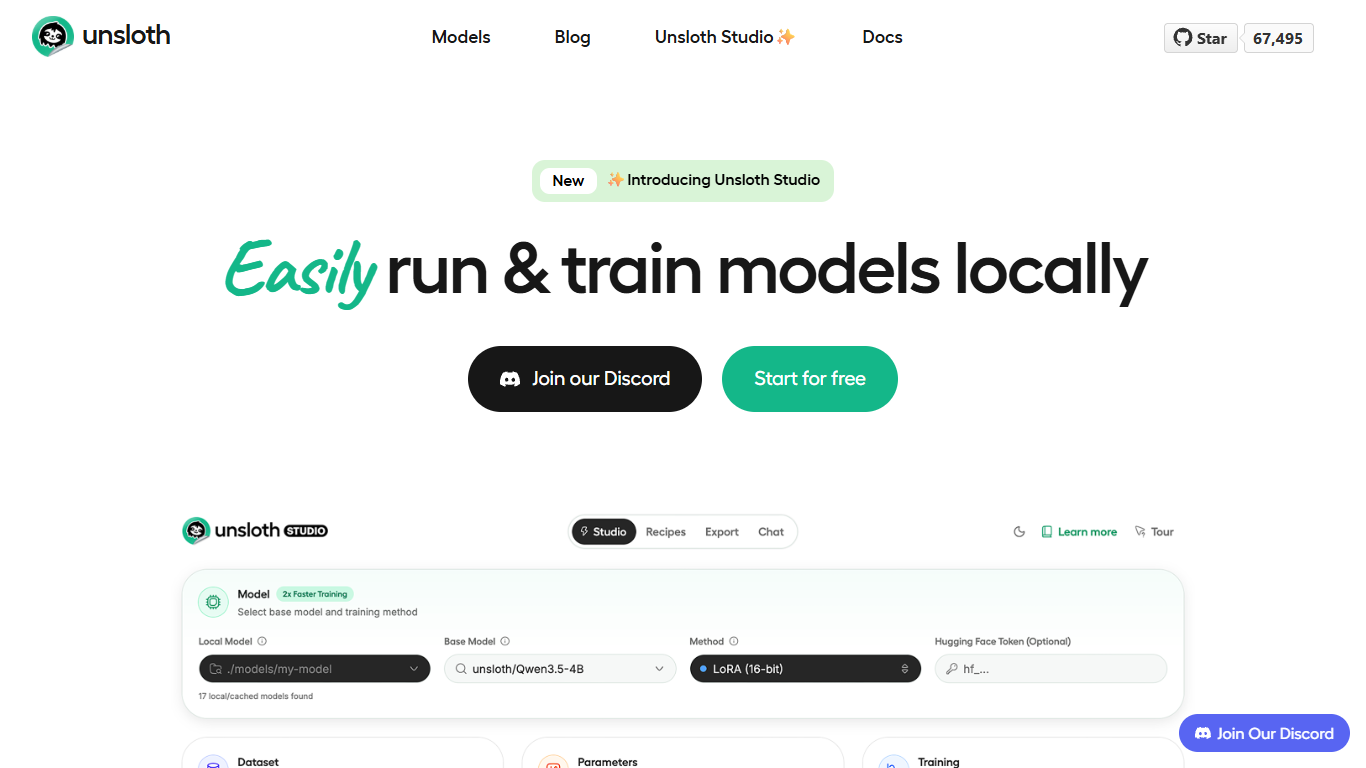
Unsloth lets you train, run, and export large language models on your own hardware through an open-source Python library and a local Desktop app. You chat with GGUF and safetensor models, build datasets from documents, generate images and video, and ship trained weights to tools like Ollama or vLLM without leaving your machine. It fits ML engineers, researchers, and hobbyists who want faster LoRA training without giving up model choice.
The core library rewrites training kernels in Triton and claims roughly 2x faster fine-tuning with about 70% less VRAM than standard setups, with support for 500+ text, vision, audio, and embedding models. Unsloth Desktop adds no-code workflows: Data Recipes turn PDFs, CSVs, and JSON into training data, while real-time observability tracks loss and GPU use during runs.
You can run everything offline on Mac, Windows, or Linux. Desktop includes self-healing tool calling, Bash and Python code execution, private web search inside model traces, and an OpenAI-compatible API endpoint for tools like Claude Code or Codex. The open-source package stays on Apache 2.0; Desktop UI components use AGPL-3.0.
Train 500+ text, vision, audio, and embedding models with custom Triton kernels
Unsloth Desktop runs GGUF and safetensor models 100% offline on Mac, Windows, and Linux
Generate images with MiniMax-H3, FLUX, and Z-Image plus video with Wan and LTX locally
Connect Claude Code and Codex to local models via the unsloth start command
Self-healing tool calling with Bash, Python execution, and private web search in chat
Export fine-tuned weights to GGUF, safetensors, Ollama, vLLM, or LM Studio
Open-source core library with 67,000+ GitHub stars and active community channels.
Claims 2x faster fine-tuning with about 70% less VRAM than standard training stacks.
Unsloth Desktop bundles local inference, no-code training, and export in one offline app.
Supports 500+ model families including text, vision, TTS, and embedding models.
Pro and Enterprise tiers require contacting sales with no public pricing listed.
AMD Desktop training support is not available yet despite chat working today.
Desktop is still in beta with ongoing fixes and feature rollouts expected.
Is Unsloth free to use?
Yes. Unsloth offers a free open-source version on GitHub with support for Mistral, Gemma, and Llama models, plus 4-bit and 16-bit LoRA fine-tuning. Unsloth Pro and Enterprise tiers with faster multi-GPU training require contacting the team for pricing.
What platforms does Unsloth Desktop support?
Unsloth Desktop runs locally on Mac, Windows, Linux, and WSL. Training works on NVIDIA RTX 30/40/50, Blackwell, DGX Spark/Station, and Intel GPUs. Mac supports training, MLX, and GGUF inference. AMD chat works today; full Desktop training support is listed as coming soon.
Does Unsloth collect user data?
Unsloth states it does not collect usage telemetry. Unsloth Desktop runs fully offline and locally. The company only collects minimal hardware information such as GPU type for compatibility checks.
Can I use Unsloth without fine-tuning a model?
Yes. You can download and run any GGUF or supported model in Unsloth Desktop without training. The UI also supports chatting, comparing models side by side, and exporting existing weights.
Does Unsloth support an OpenAI-compatible API?
Yes. Unsloth Desktop exposes an OpenAI-compatible API endpoint so tools like Claude Code and Codex can call local Qwen, Gemma, and other models with Unsloth inference features such as tool calling and web search.
What license does Unsloth use?
Unsloth uses dual licensing. The core Unsloth package remains Apache 2.0, while optional components including the Unsloth Desktop UI are licensed under AGPL-3.0.