Last updated 08-22-2026
Category:
Reviews:
Join thousands of AI enthusiasts in the World of AI!
Atlas Cloud
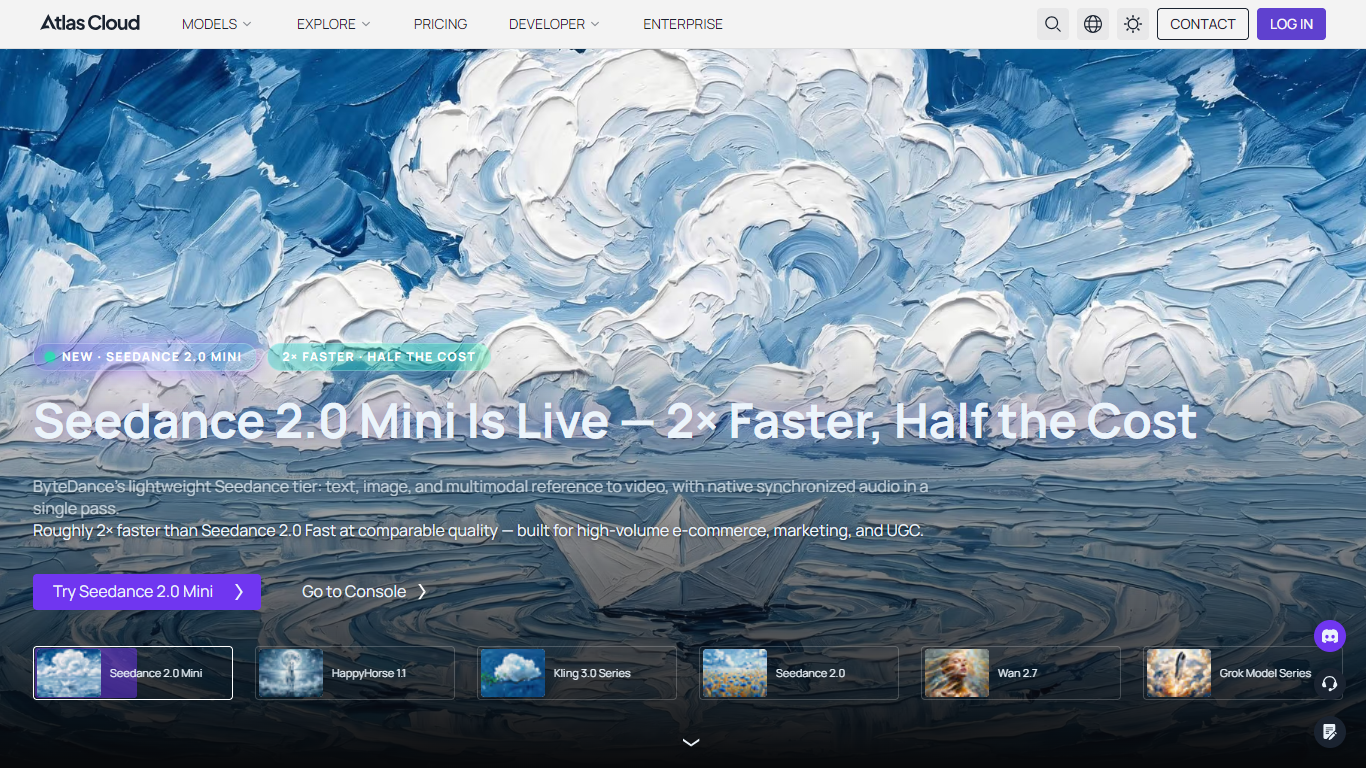
Atlas Cloud gives developers one OpenAI-compatible API for 400+ generative models across video, image, audio, LLM, and 3D workloads. Swap the model string in your existing SDK and reach Seedance, Kling, Wan, Flux, DeepSeek, Gemini, Grok, and dozens more without juggling separate vendor keys or integration formats.
Most model gateways resell a narrow slice of one modality. Atlas Cloud aggregates video, image, and language models behind a single endpoint with Day-0 access when new SOTA models launch, plus MCP servers, CLI tools, and agent skills that share the same API key. Pay-as-you-go pricing publishes per-second video rates and per-token LLM costs with no monthly minimums or seat fees.
Atlas Cloud fits AI product teams, creative studios, and agent builders who need fast access to frontier media models without running GPU infrastructure. The platform is SOC 2 certified and HIPAA compliant, with enterprise private cloud deployment for teams with stricter data requirements.
400+ curated models across video, image, audio, LLM, and 3D behind one API key
OpenAI-compatible endpoints work as a drop-in replacement by changing base URL
Day-0 access to new models like Seedance 2.5 with up to 30-second native video
MCP server, CLI, and agent skills share the same API key as REST calls
SOC 2 certified and HIPAA compliant with enterprise private cloud option
One API key covers 400+ models across every major modality
OpenAI-compatible endpoints minimize migration effort from existing code
Day-0 model launches mean new SOTA models appear without switching platforms
Transparent per-second and per-token pricing with no hidden infrastructure fees
MCP, CLI, and skills integrations extend the same API into agent workflows
Pay-as-you-go costs scale quickly on long video generations at per-second rates
Model availability and pricing vary by provider with frequent catalog changes
Enterprise private cloud requires a sales conversation with no self-serve setup
Heavy users must monitor spend manually since there is no built-in budget cap on the free tier
What models does Atlas Cloud support?
Atlas Cloud supports 400+ models across video, image, audio, LLM, and 3D. Video includes Seedance, Kling, Wan, and Veo. Images cover Flux and GPT Image. LLMs include DeepSeek, Qwen, Grok, and Gemini, all reachable through one API key.
Is Atlas Cloud compatible with the OpenAI SDK?
Yes, Atlas Cloud provides OpenAI-compatible API endpoints. Developers can point the OpenAI SDK at https://api.atlascloud.ai/v1 with an Atlas Cloud API key and swap model strings without rewriting integration code.
How does Atlas Cloud pricing work?
Atlas Cloud uses pay-as-you-go pricing with no monthly minimums or seat fees. Video models bill per second, such as Seedance 2.5 at $0.134 per second, and LLMs bill per million tokens. Rates are published on the pricing page.
Can I start using Atlas Cloud for free?
Yes, Atlas Cloud offers free account signup with no credit card required. You generate an API key from the console and pay only for the generations you run at published per-second or per-token rates.
Does Atlas Cloud support MCP for coding agents?
Yes, Atlas Cloud ships an MCP server installable via npx atlascloud-mcp. It connects coding agents in Cursor, Claude Code, and similar tools to Atlas Cloud models using the same API key as REST calls.
Is Atlas Cloud enterprise-ready?
Yes, Atlas Cloud holds SOC 2 and HIPAA compliance certifications with encryption at rest and in transit. Enterprise customers can deploy on private cloud infrastructure with dedicated GPUs and a support team.