
Last updated 07-28-2026
Category:
Reviews:
Join thousands of AI enthusiasts in the World of AI!
Base64.ai
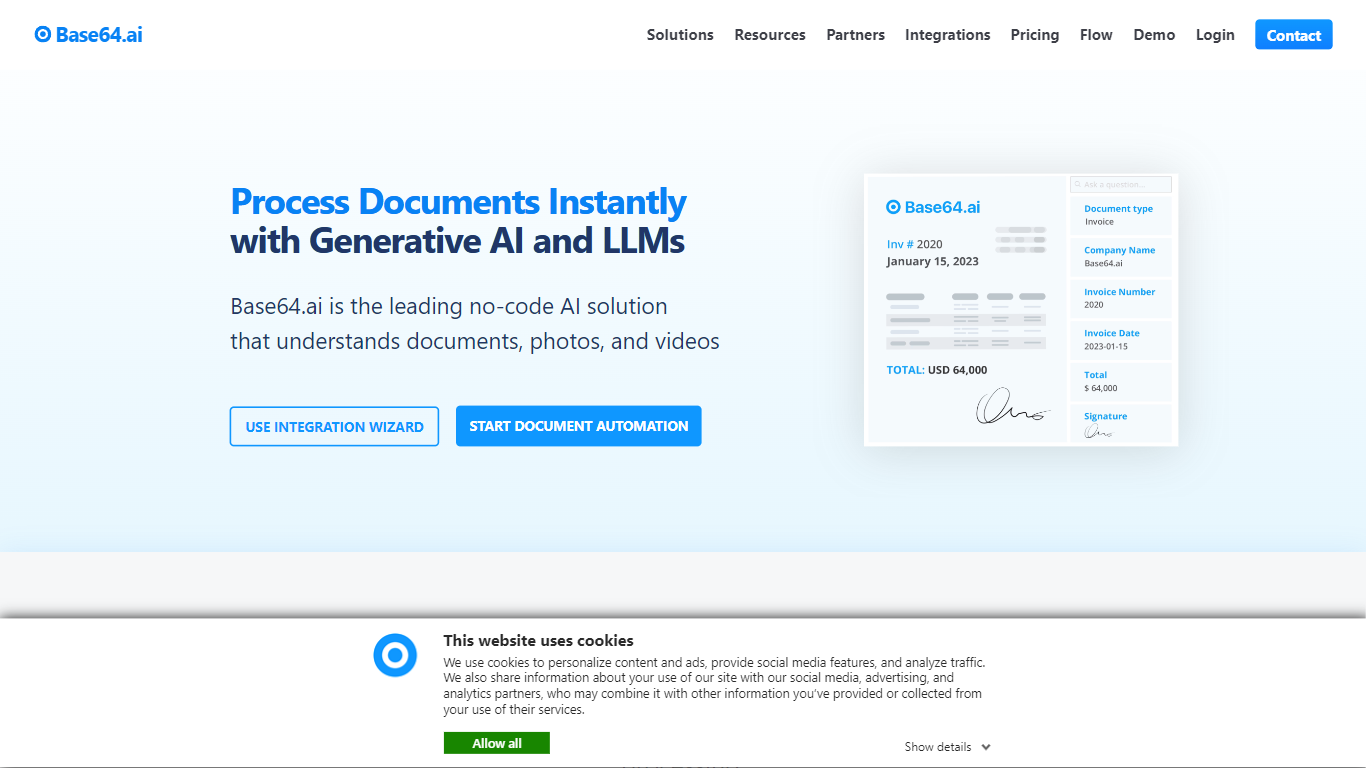
Base64.ai converts PDFs, images, DOCX files, and dozens of other formats into labeled JSON through a REST API or no-code connectors. You upload a document, it detects the type, applies a matching extraction model, and returns structured fields your downstream automation workflows can act on without manual rekeying.
Most OCR tools hand you plain text and leave classification to you. Base64.ai ships with 2,800+ pretrained document models for invoices, IDs, insurance forms, and similar paperwork, so teams rarely need consultants to train custom models. Its Flows builder chains ingestion, human review, taxonomy normalization, and integrations, and data citations show exactly where each extracted value came from in the source file.
Insurance claims teams, finance AP groups, and healthcare administrators use it for claims processing, loan origination, KYC onboarding, and invoice validation. Published case studies cite 99.7% extraction accuracy and processing times dropping from weeks to about five seconds per document.
Pricing starts with a free signup tier and usage-based OCR at one cent per page, with annual plans from 1,000 pages per month. Enterprise customers can deploy in the cloud or on-premises with ISO 27001, SOC 2, HIPAA, and GDPR certifications.
2,800+ pretrained document models classify and extract fields without custom model training
OCR supports 165+ languages and 93 file formats including handwriting
Usage-based OCR tier priced at $0.01 per page with annual plans from 1,000 pages/month
Flows builder links API ingestion, human-in-the-loop review, and hundreds of RPA integrations
PII redaction, signature verification, and facial verification available as advanced add-ons
Cloud or on-premises deployment with ISO 27001, SOC 2, HIPAA, and GDPR certifications
2,800+ pretrained models cover common regulated documents without training custom models from scratch
Data citations link every extracted field back to its location in the source file
Hundreds of no-code connectors and a REST API fit into existing RPA and scanner workflows
ISO 27001, SOC 2, HIPAA, and GDPR certifications support finance and healthcare deployments
Unlimited free seats on paid plans let full operations teams access Flows without per-user fees
Advanced add-ons like AI agents, fraud detection, and facial verification sit above the base OCR tier
On-premises and air-gapped deployments require contacting sales rather than self-serve signup
Custom Model Builder and Flow management require a login, limiting no-account platform evaluation
Is Base64.ai free to try?
Yes, Base64.ai offers free signup so you can test document extraction before committing to a paid plan. Annual usage plans start at 1,000 pages per month, and the base OCR tier charges $0.01 per page for core ingestion features.
How many document types does Base64.ai support?
Base64.ai includes 2,800+ pretrained document models that automatically classify and extract data from forms such as invoices, IDs, insurance documents, and passports. Its semantic AI and custom model builder handle document types outside that library.
What file formats does Base64.ai accept?
Base64.ai ingests structured and unstructured documents, images, and multimedia in more than 50 file formats on the homepage, and its pricing page lists 93 supported formats. OCR covers 165+ languages with handwriting recognition alongside printed text.
Can Base64.ai run on-premises?
Yes, Base64.ai supports cloud and on-premises deployment. Enterprise customers can request on-prem, air-gapped, or hybrid configurations through the sales team rather than the self-serve signup flow.
What compliance certifications does Base64.ai hold?
Base64.ai is certified for ISO 27001, ISO 20243, SOC 2 Type 1 and Type 2, HIPAA, and GDPR compliance. Compliance reports require signing an NDA and contacting [email protected] for access.
Does Base64.ai replace RPA tools?
Base64.ai is designed to complement robotic process automation rather than replace it. It converts unstructured documents into structured JSON that passes into existing RPA platforms through API and prebuilt connector integrations.