ggml.ai vs Falcon-40B on Hugging Face
In the battle of ggml.ai vs Falcon-40B on Hugging Face, which AI Large Language Model (LLM) tool comes out on top? We compare reviews, pricing, alternatives, upvotes, features, and more.
Between ggml.ai and Falcon-40B on Hugging Face, which one is superior?
Upon comparing ggml.ai with Falcon-40B on Hugging Face, which are both AI-powered large language model (llm) tools, ggml.ai stands out as the clear frontrunner in terms of upvotes. The number of upvotes for ggml.ai stands at 7, and for Falcon-40B on Hugging Face it's 6.
Disagree with the result? Upvote your favorite tool and help it win!
ggml.ai
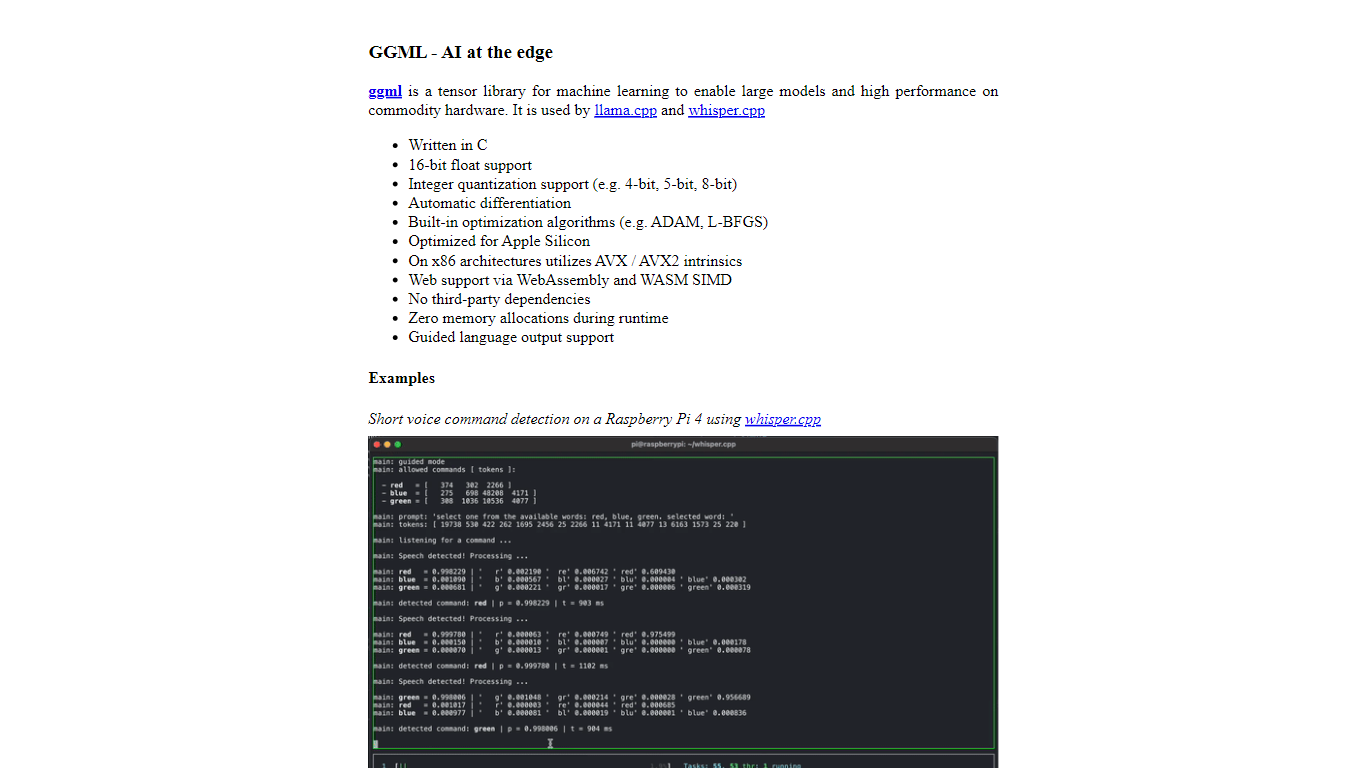

What is ggml.ai?
ggml runs large language and speech models on everyday CPUs and GPUs through a compact C tensor library built for on-device inference. ML engineers and app developers adopt it via llama.cpp and whisper.cpp when they want LLaMA or Whisper workloads without cloud-only dependencies.
Frameworks like PyTorch optimize for training clusters and heavy runtimes. ggml keeps the core library minimal with zero runtime memory allocations, no third-party dependencies, and integer quantization so llama.cpp can serve Meta LLaMA weights on laptops and Apple Silicon.
The ggml.ai company was founded in 2023 by Georgi Gerganov to support the library and was acquired by Hugging Face in 2026. The core ggml project stays MIT licensed with open development on GitHub.
Falcon-40B on Hugging Face
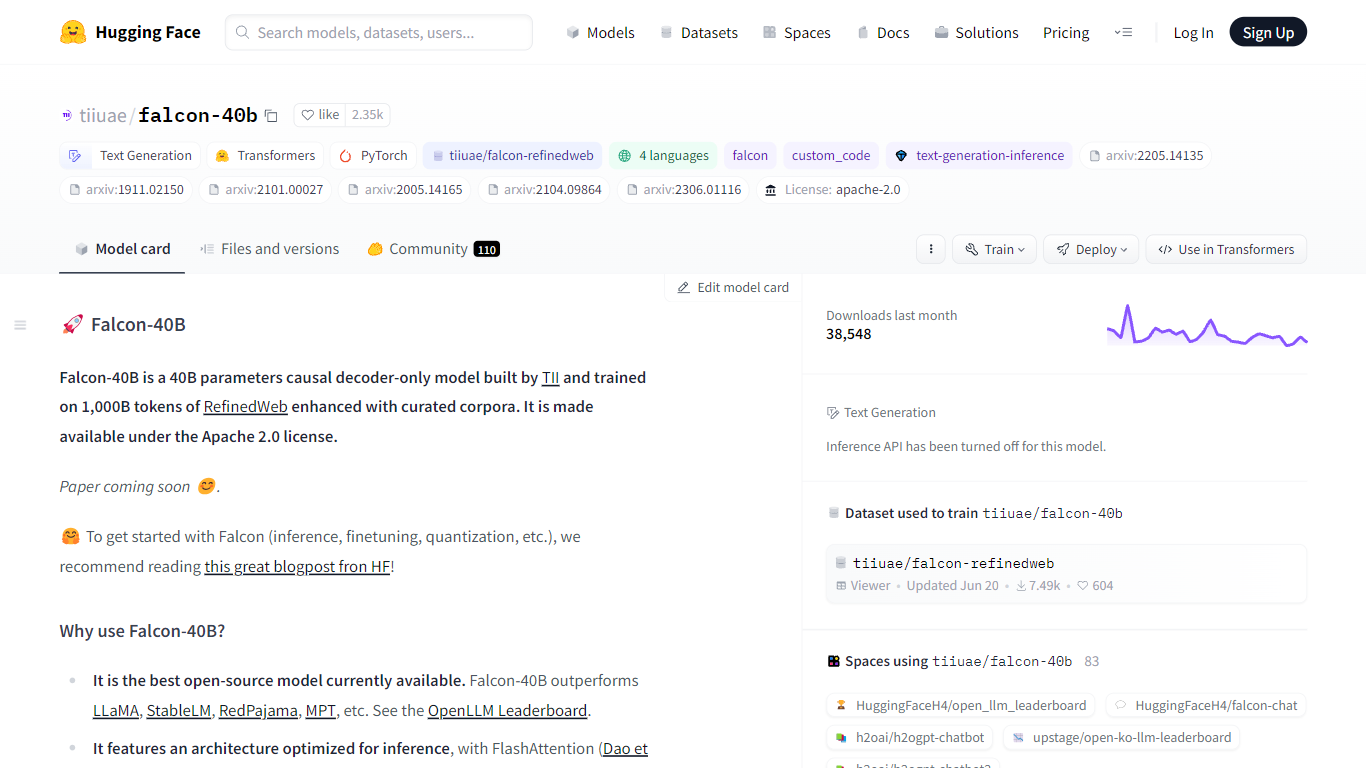
What is Falcon-40B on Hugging Face?
Falcon-40B on Hugging Face is a 40-billion-parameter causal decoder-only language model from the Technology Innovation Institute (TII), hosted as open weights on the Hugging Face Hub. You download the model and run it locally or on your own GPU cluster with Transformers, vLLM, SGLang, or quantized builds for Ollama and llama.cpp. It predicts the next token on a 2,048-token context window and ships as a raw pretrained checkpoint, not a chat-ready assistant.
Most open models at this size lean on heavily curated training mixes like The Pile. Falcon-40B was trained on 1,000 billion tokens drawn mostly from RefinedWeb, TII's filtered web crawl, with smaller slices of books, code, conversations, and technical papers. The architecture adds multiquery attention and FlashAttention on top of a GPT-3-style decoder, which TII tuned specifically for faster inference rather than chasing the widest possible task coverage out of the box.
Researchers and ML engineers reach for it as a finetuning base under the Apache 2.0 license, which allows commercial use without royalties. Running full-precision inference needs roughly 85 to 100 GB of GPU memory, so most production teams either quantize the weights or move to the smaller Falcon-7B sibling before deploying.
ggml.ai Upvotes
Falcon-40B on Hugging Face Upvotes
ggml.ai Top Features
Powers llama.cpp for Meta LLaMA inference and whisper.cpp for OpenAI Whisper speech models
Written in C with zero runtime memory allocations during inference
Integer quantization support for smaller models on commodity hardware
No third-party dependencies in the core tensor library
Cross-platform low-level implementation with broad hardware support
MIT licensed open-core library with public development on GitHub
Falcon-40B on Hugging Face Top Features
40 billion parameters trained on 1,000B tokens, 75% from the RefinedWeb crawl
Apache 2.0 license permits commercial use and redistribution without royalties
60-layer architecture with multiquery attention, FlashAttention, and 2,048-token context
Load via Transformers, vLLM, SGLang, or Docker with trust_remote_code=True
Primary languages: English, German, Spanish, and French, plus limited support for 6 more European languages
Quantized builds available for Ollama, llama.cpp, LM Studio, and Jan local apps
ggml.ai Category
- Large Language Model (LLM)
Falcon-40B on Hugging Face Category
- Large Language Model (LLM)
ggml.ai Pricing Type
- Free
Falcon-40B on Hugging Face Pricing Type
- Free