ggml.ai vs Gemini AI
In the clash of ggml.ai vs Gemini AI, which AI Large Language Model (LLM) tool emerges victorious? We assess reviews, pricing, alternatives, features, upvotes, and more.
If you had to choose between ggml.ai and Gemini AI, which one would you go for?
Let's take a closer look at ggml.ai and Gemini AI, both of which are AI-driven large language model (llm) tools, and see what sets them apart. The upvote count shows a clear preference for ggml.ai. ggml.ai has attracted 7 upvotes from aitools.fyi users, and Gemini AI has attracted 6 upvotes.
Think we got it wrong? Cast your vote and show us who's boss!
ggml.ai
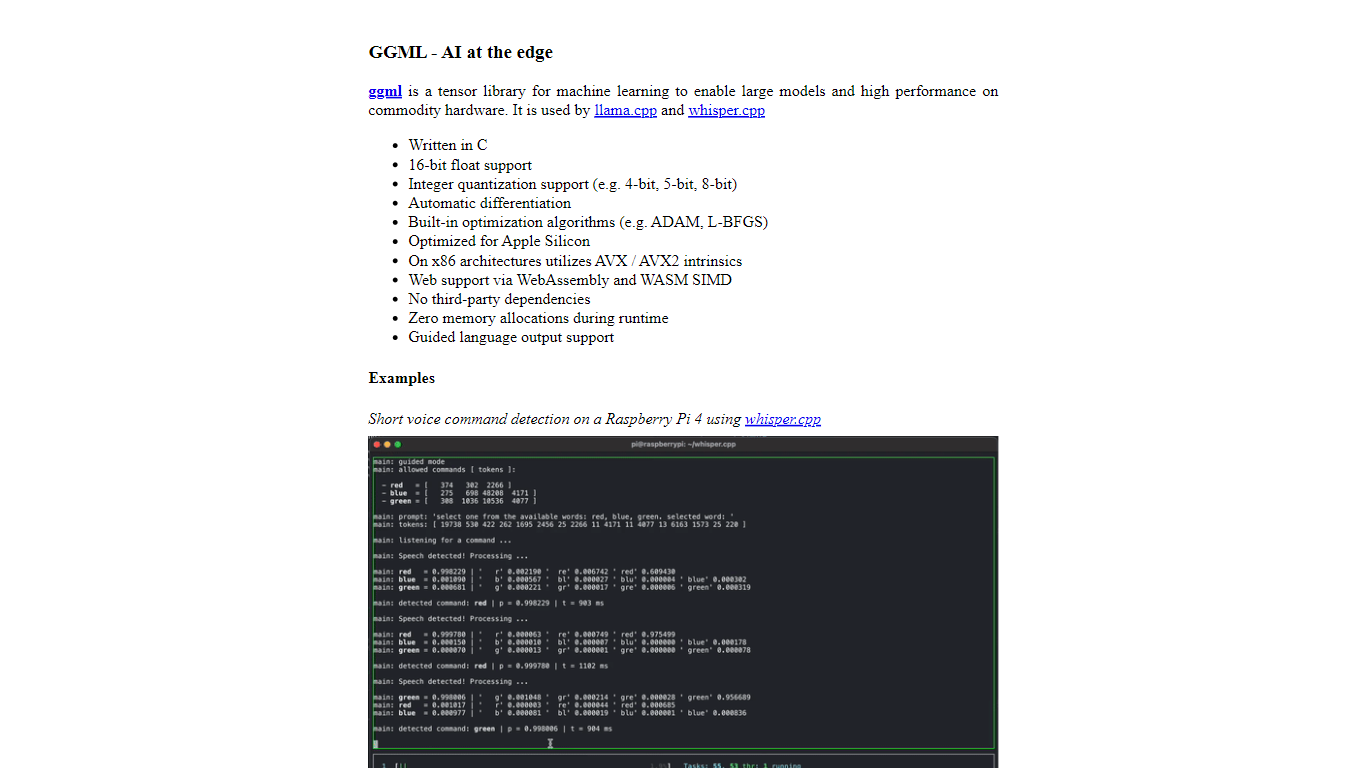

What is ggml.ai?
ggml runs large language and speech models on everyday CPUs and GPUs through a compact C tensor library built for on-device inference. ML engineers and app developers adopt it via llama.cpp and whisper.cpp when they want LLaMA or Whisper workloads without cloud-only dependencies.
Frameworks like PyTorch optimize for training clusters and heavy runtimes. ggml keeps the core library minimal with zero runtime memory allocations, no third-party dependencies, and integer quantization so llama.cpp can serve Meta LLaMA weights on laptops and Apple Silicon.
The ggml.ai company was founded in 2023 by Georgi Gerganov to support the library and was acquired by Hugging Face in 2026. The core ggml project stays MIT licensed with open development on GitHub.
Gemini AI
What is Gemini AI?
Gemini is Google's flagship family of multimodal AI models, developed by Google DeepMind and available through the Gemini app at gemini.google.com. The models handle text, images, audio, and video in a single conversation, and the consumer app positions Gemini as a personal assistant for writing, planning, brainstorming, and research.
Google ships Gemini across several tiers, from the free Gemini app to paid Google AI Plus, Pro, and Ultra subscriptions. Developers access the same underlying models through the Gemini API in Google AI Studio, with separate free and pay-as-you-go pricing for production workloads.
The model line has expanded well beyond the original Ultra, Pro, and Nano sizes announced in 2023. Current releases include Gemini 3.5 Flash, Gemini 3.1 Pro, and specialized variants for image generation, video, audio, and on-device use.
ggml.ai Upvotes
Gemini AI Upvotes
ggml.ai Top Features
Powers llama.cpp for Meta LLaMA inference and whisper.cpp for OpenAI Whisper speech models
Written in C with zero runtime memory allocations during inference
Integer quantization support for smaller models on commodity hardware
No third-party dependencies in the core tensor library
Cross-platform low-level implementation with broad hardware support
MIT licensed open-core library with public development on GitHub
Gemini AI Top Features
Chat with Gemini 3.5 Flash and Gemini 3.1 Pro for writing, coding, and complex reasoning tasks
Generate and edit images with Nano Banana directly inside the Gemini app
Create and edit videos conversationally with Gemini Omni
Run Deep Research to compile reports from web sources and uploaded documents
Switch between voice and text with Gemini Live, including camera input for visual questions
Build custom Gems for repeatable workflows and specialized assistant behavior
Use Canvas to draft documents, code, and plans alongside the chat interface
ggml.ai Category
- Large Language Model (LLM)
Gemini AI Category
- Large Language Model (LLM)
ggml.ai Pricing Type
- Free
Gemini AI Pricing Type
- Freemium