ggml.ai vs GPT-4
Compare ggml.ai vs GPT-4 and see which AI Large Language Model (LLM) tool is better when we compare features, reviews, pricing, alternatives, upvotes, etc.
Which one is better? ggml.ai or GPT-4?
When we compare ggml.ai with GPT-4, which are both AI-powered large language model (llm) tools, The upvote count reveals a draw, with both tools earning the same number of upvotes. Your vote matters! Help us decide the winner among aitools.fyi users by casting your vote.
Feeling rebellious? Cast your vote and shake things up!
ggml.ai

What is ggml.ai?
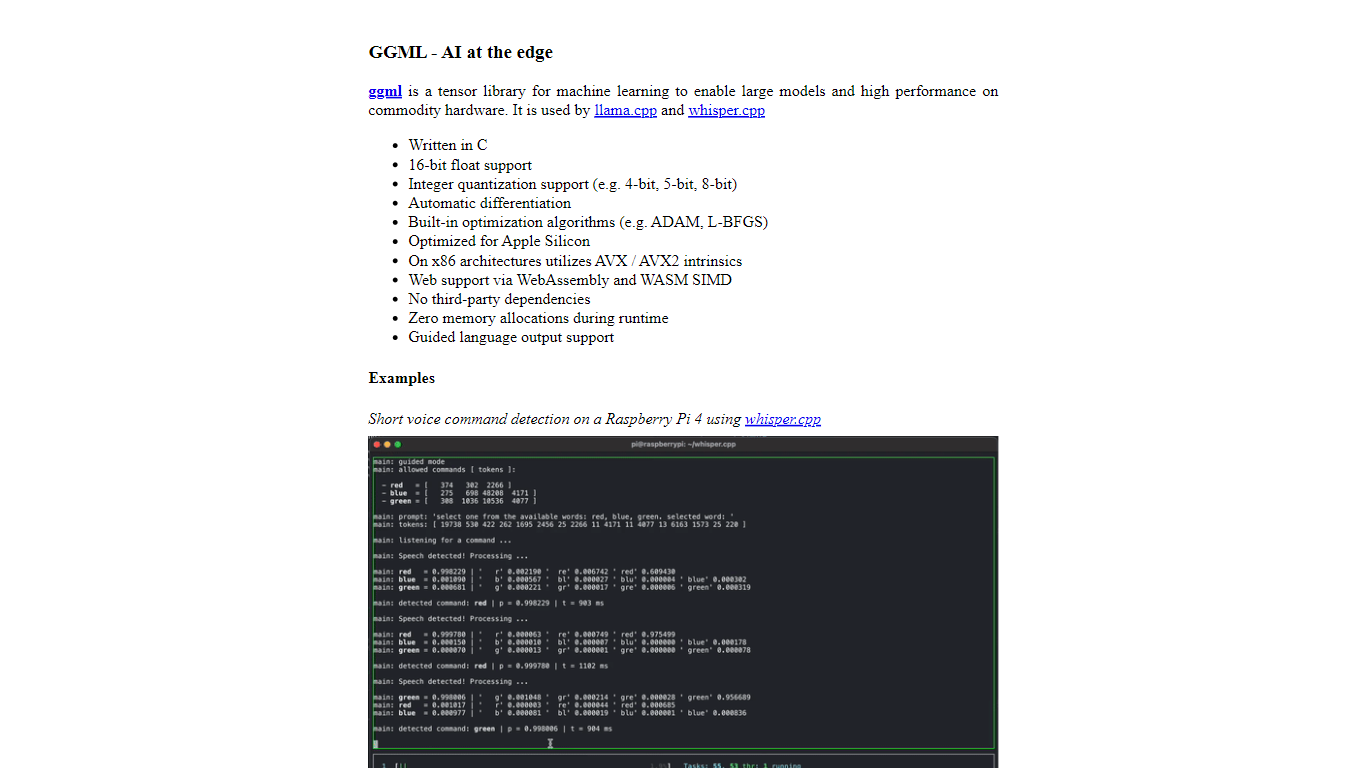
ggml runs large language and speech models on everyday CPUs and GPUs through a compact C tensor library built for on-device inference. ML engineers and app developers adopt it via llama.cpp and whisper.cpp when they want LLaMA or Whisper workloads without cloud-only dependencies.
Frameworks like PyTorch optimize for training clusters and heavy runtimes. ggml keeps the core library minimal with zero runtime memory allocations, no third-party dependencies, and integer quantization so llama.cpp can serve Meta LLaMA weights on laptops and Apple Silicon.
The ggml.ai company was founded in 2023 by Georgi Gerganov to support the library and was acquired by Hugging Face in 2026. The core ggml project stays MIT licensed with open development on GitHub.
GPT-4
What is GPT-4?
GPT-4 is OpenAI's large language model built for advanced reasoning, instruction following, and safer responses across text tasks. OpenAI positions it as the successor along the GPT research line and makes it available through ChatGPT Plus and the developer API. The product page highlights alignment work with human feedback and expert review before release.
Compared with earlier GPT-3.5 chat models, GPT-4 emphasizes measurable safety and factuality gains rather than raw parameter counts alone. OpenAI reports it is 82% less likely to answer disallowed requests and 40% more likely to give factual replies on internal tests versus GPT-3.5. That trade-off targets teams that need stronger guardrails even if latency and cost run higher than smaller models.
GPT-4 shows up in production stories from Duolingo, Be My Eyes, Stripe, and Morgan Stanley wealth management on OpenAI's site. Developers reach it through the API platform, while ChatGPT Plus subscribers access it inside the chat product. OpenAI notes ongoing limitations around bias, hallucinations, and adversarial prompts that remain under active research.
ggml.ai Upvotes
GPT-4 Upvotes
ggml.ai Top Features
Powers llama.cpp for Meta LLaMA inference and whisper.cpp for OpenAI Whisper speech models
Written in C with zero runtime memory allocations during inference
Integer quantization support for smaller models on commodity hardware
No third-party dependencies in the core tensor library
Cross-platform low-level implementation with broad hardware support
MIT licensed open-core library with public development on GitHub
GPT-4 Top Features
82% lower rate of disallowed responses versus GPT-3.5 on OpenAI internal tests
40% higher likelihood of factual answers versus GPT-3.5 on OpenAI evaluations
Alignment pipeline used feedback from over 50 expert reviewers before launch
Available through ChatGPT Plus and the OpenAI developer API
Trained on Microsoft Azure AI supercomputers per OpenAI infrastructure notes
ggml.ai Category
- Large Language Model (LLM)
GPT-4 Category
- Large Language Model (LLM)
ggml.ai Pricing Type
- Free
GPT-4 Pricing Type
- Freemium