Gopher vs ggml.ai
In the face-off between Gopher vs ggml.ai, which AI Large Language Model (LLM) tool takes the crown? We scrutinize features, alternatives, upvotes, reviews, pricing, and more.
When we put Gopher and ggml.ai head to head, which one emerges as the victor?
If we were to analyze Gopher and ggml.ai, both of which are AI-powered large language model (llm) tools, what would we find? The upvote count shows a clear preference for ggml.ai. The upvote count for ggml.ai is 7, and for Gopher it's 6.
Don't agree with the result? Cast your vote and be a part of the decision-making process!
Gopher

What is Gopher?
Gopher is a 280-billion-parameter transformer language model Google DeepMind announced in December 2021. DeepMind trained a family of models from 44 million to 280 billion parameters to study how scale affects text prediction, reading comprehension, fact-checking, and toxic-language detection.
Compared with general-purpose chatbots, Gopher was a research release, not a public app. DeepMind paired the model paper with an ethics taxonomy covering 21 risks across six themes and a separate Retrieval-Enhanced Transformer (RETRO) architecture that pulls passages from an internet-scale index to cut training cost and trace outputs back to sources.
The blog post targets AI researchers studying scaling laws, safety taxonomies, and retrieval-augmented language models. Gopher beat prior models on several Massive Multitask Language Understanding (MMLU) categories but still struggled with logical reasoning, common-sense questions, repetition, stereotypical bias, and confidently wrong answers in dialogue tests.
ggml.ai
What is ggml.ai?
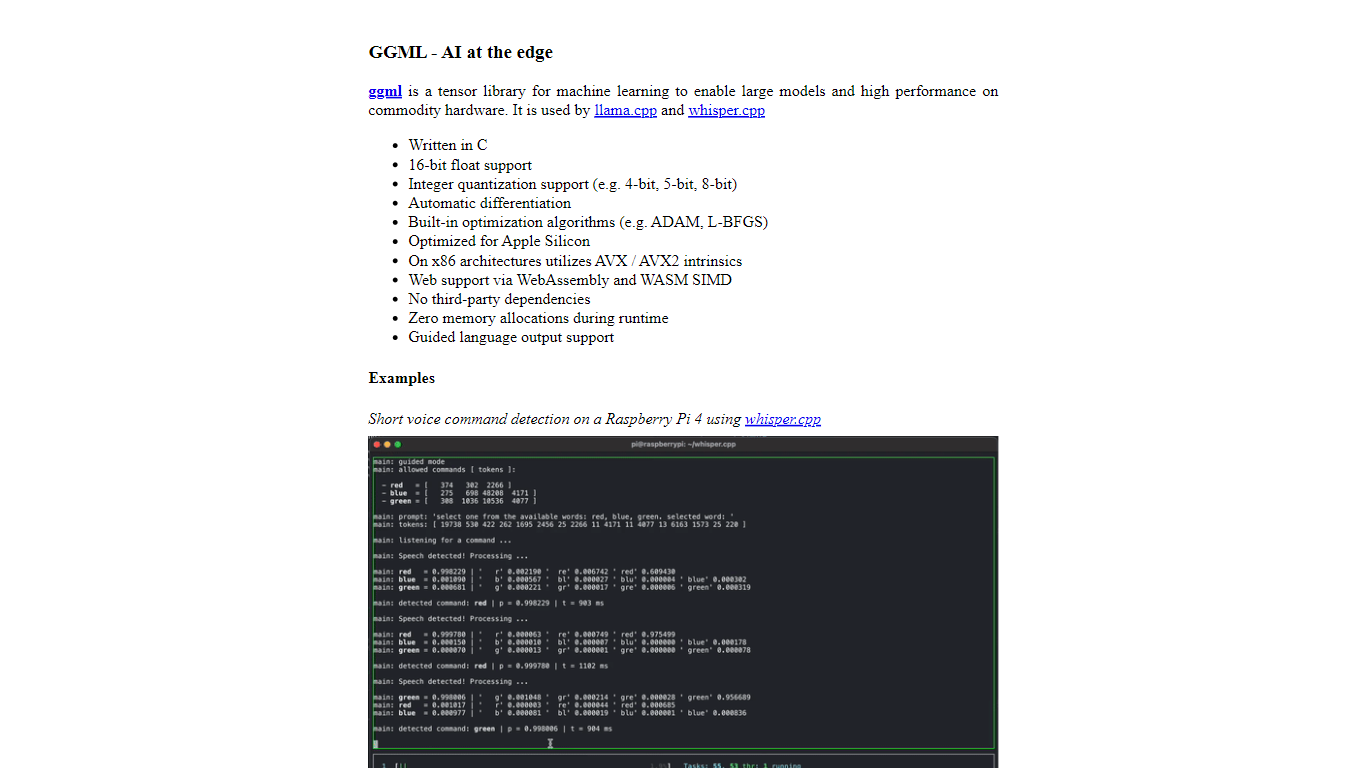
ggml runs large language and speech models on everyday CPUs and GPUs through a compact C tensor library built for on-device inference. ML engineers and app developers adopt it via llama.cpp and whisper.cpp when they want LLaMA or Whisper workloads without cloud-only dependencies.
Frameworks like PyTorch optimize for training clusters and heavy runtimes. ggml keeps the core library minimal with zero runtime memory allocations, no third-party dependencies, and integer quantization so llama.cpp can serve Meta LLaMA weights on laptops and Apple Silicon.
The ggml.ai company was founded in 2023 by Georgi Gerganov to support the library and was acquired by Hugging Face in 2026. The core ggml project stays MIT licensed with open development on GitHub.
Gopher Upvotes
ggml.ai Upvotes
Gopher Top Features
280-billion-parameter transformer model, the largest in a series scaling from 44 million parameters
Stronger reading comprehension, fact-checking, and toxic-language detection as model size grows
MMLU benchmark gains across humanities, science, medicine, and general knowledge categories
Dialogue tests where Gopher cited Wikipedia correctly on cell biology without dialogue fine-tuning
Companion ethics paper mapping 21 large language model risks across six thematic areas
RETRO retrieval architecture matches transformer quality with an order of magnitude fewer parameters
ggml.ai Top Features
Powers llama.cpp for Meta LLaMA inference and whisper.cpp for OpenAI Whisper speech models
Written in C with zero runtime memory allocations during inference
Integer quantization support for smaller models on commodity hardware
No third-party dependencies in the core tensor library
Cross-platform low-level implementation with broad hardware support
MIT licensed open-core library with public development on GitHub
Gopher Category
- Large Language Model (LLM)
ggml.ai Category
- Large Language Model (LLM)
Gopher Pricing Type
- Free
ggml.ai Pricing Type
- Free