Open Voice OS vs Fliki
Explore the showdown between Open Voice OS vs Fliki and find out which AI Video Generation tool wins. We analyze upvotes, features, reviews, pricing, alternatives, and more.
In a face-off between Open Voice OS and Fliki, which one takes the crown?
When we contrast Open Voice OS with Fliki, both of which are exceptional AI-operated video generation tools, and place them side by side, we can spot several crucial similarities and divergences. In the race for upvotes, Fliki takes the trophy. Fliki has 34 upvotes, and Open Voice OS has 7 upvotes.
You don't agree with the result? Cast your vote to help us decide!
Open Voice OS

What is Open Voice OS?
Open Voice OS lets you build custom voice-controlled interfaces on Raspberry Pi, Mycroft devices, and Linux desktops using an open voice assistant stack. Install OVOS through Docker or a Python virtual environment, then extend skills with NLP pipelines that can run offline for privacy-sensitive setups.
Commercial smart speakers lock data in vendor clouds. Open Voice OS is community-driven FOSS descended from the Mycroft ecosystem, with a customizable UI, prebuilt images for embedded screens, and an installer script for major Linux distributions plus Raspberry Pi 3, 4, and 5.
Developers, hobbyists, and organizations building DIY smart speakers use OVOS to experiment with speech recognition and text-to-speech before upstreaming features. The project received an NGI Zero Commons fund grant and welcomes contributions through its public GitHub repositories.
Fliki
What is Fliki?
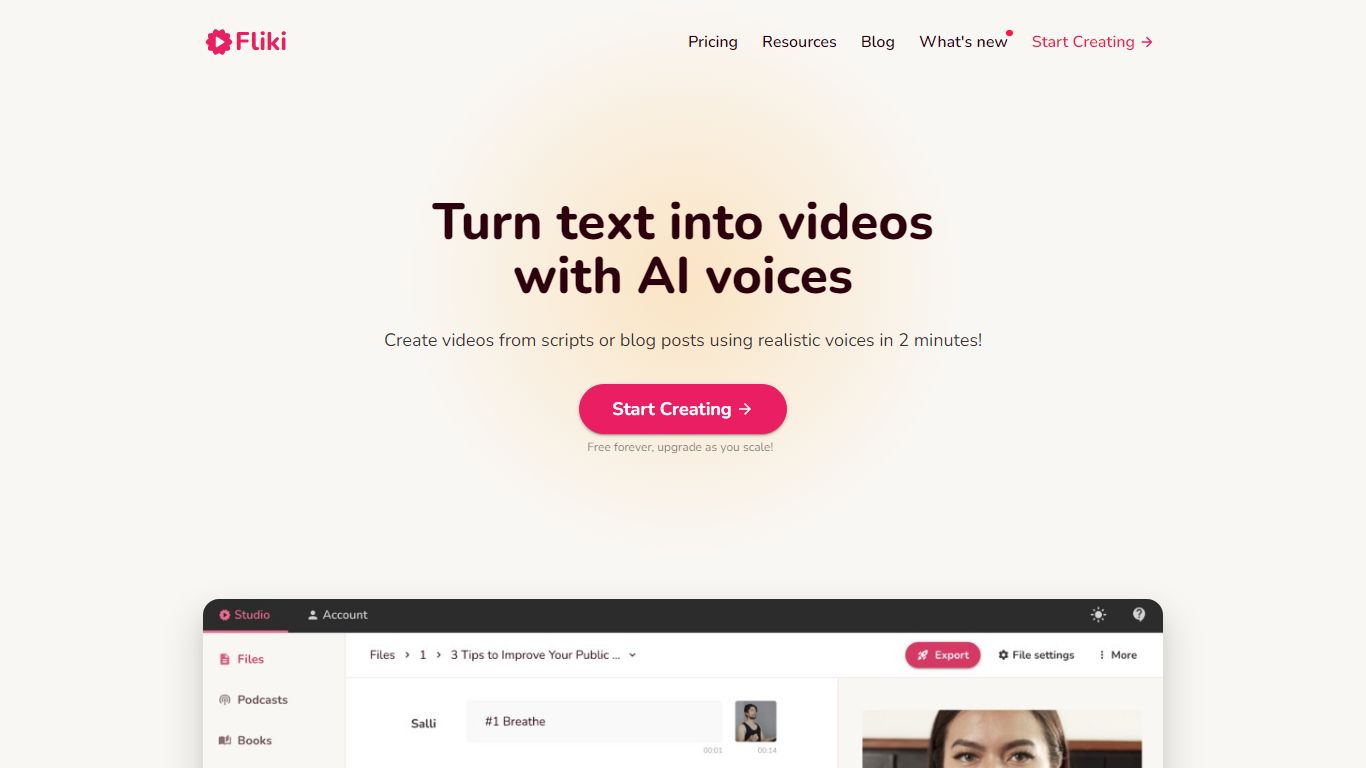
Fliki turns text into publish-ready videos with AI voiceovers, stock or generated visuals, music, and subtitles. You paste a script, blog post, or one-line prompt, and the editor drafts narration, picks media, and exports a finished clip with consistent characters in minutes.
Compared with separate voice and video tools, Fliki bundles text-to-video, text-to-speech, series planning, and a digital twin that clones your face and voice for presenter-style clips. The platform lists 2,000+ voices across 80+ languages, plus workflows for idea-to-video, PPT-to-video, and translation.
Fliki reports 100 million videos created and 12 million users. The free plan includes 3 monthly credits and 720p exports with a watermark, while Standard and Premium add 1080p output, longer runtimes up to 40 minutes, voice cloning, and API access on the top tier.
Open Voice OS Upvotes
Fliki Upvotes
Open Voice OS Top Features
Install via Docker or Python virtual environment with a one-line installer script
Supports Raspberry Pi 3, 4, and 5 plus major Linux desktop distributions
Prebuilt image for embedded headless and small touch-screen devices
Offline-capable speech recognition and text-to-speech pipelines
Customizable UI descended from the Mycroft and KDE GUI lineage
Community-driven skill development with public contribution guides
Compatible with legacy Mycroft Mark 1 and Mark 2 hardware
Fliki Top Features
Text-to-video workflow writes scripts, picks visuals, and adds voiceover plus subtitles from pasted text
2,000+ AI voices across 80+ languages with ultra-realistic tiers on paid plans
Series mode plans topics, writes scripts, and queues episodes for TikTok, YouTube, and Shorts
Digital Twin clones your face and voice for presenter videos in 80+ languages after one recording
Free plan includes 3 credits per month and 720p exports with a Fliki watermark
Premium plan supports videos up to 40 minutes, API access, and 7,200 annual credits
Open Voice OS Category
- Video Generation
Fliki Category
- Video Generation
Open Voice OS Pricing Type
- Free
Fliki Pricing Type
- Freemium