replit-code vs ggml.ai
Dive into the comparison of replit-code vs ggml.ai and discover which AI Large Language Model (LLM) tool stands out. We examine alternatives, upvotes, features, reviews, pricing, and beyond.
In a comparison between replit-code and ggml.ai, which one comes out on top?
When we compare replit-code and ggml.ai, two exceptional large language model (llm) tools powered by artificial intelligence, and place them side by side, several key similarities and differences come to light. The community has spoken, ggml.ai leads with more upvotes. ggml.ai has received 7 upvotes from aitools.fyi users, while replit-code has received 6 upvotes.
Think we got it wrong? Cast your vote and show us who's boss!
replit-code

What is replit-code?
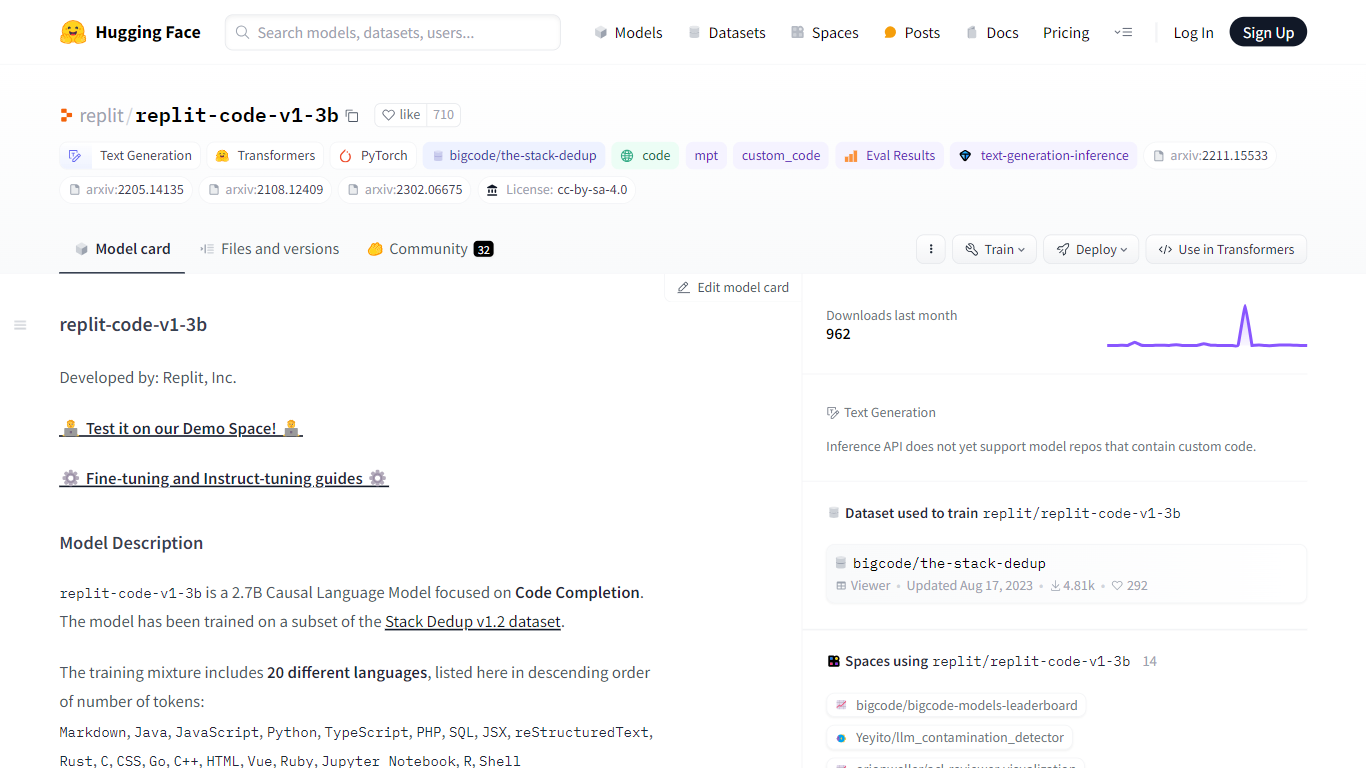
Replit's replit-code-v1-3b is a 2.7 billion parameter causal language model designed specifically for code completion tasks. Trained on a large, diverse dataset of 175 billion tokens covering 20 programming languages, it supports languages like Python, JavaScript, Java, and more. The model uses advanced techniques such as Flash Attention and AliBi positional embeddings to improve speed and handle variable context lengths efficiently. It is optimized for developers who want to fine-tune the model for specific applications without commercial restrictions, under a CC BY-SA 4.0 license.
Developed on the MosaicML platform with extensive GPU resources, replit-code-v1-3b offers compatibility with popular libraries like Transformers and supports quantization methods including 8-bit and 4-bit loading to reduce resource requirements. It also provides custom tokenization optimized for code syntax, ensuring syntactical correctness in generated completions. Users can deploy the model locally, in notebooks, or via Docker containers, with detailed guides available.
While powerful, the model may reflect biases or inappropriate content present in its training data, so caution is advised for production use. Post-processing recommendations include stopping generation at end-of-sequence tokens and trimming incomplete code snippets. The model is popular among developers and researchers seeking an open-source foundation for code generation and completion tasks.
Replit-code-v1-3b integrates well with Hugging Face's ecosystem, allowing easy access through pipelines and compatibility with inference providers. It is suitable for a wide range of coding assistance scenarios, from simple function completions to complex multi-language projects. The model benefits from ongoing community support and contributions, fostering collaborative improvement and innovation.
ggml.ai
What is ggml.ai?
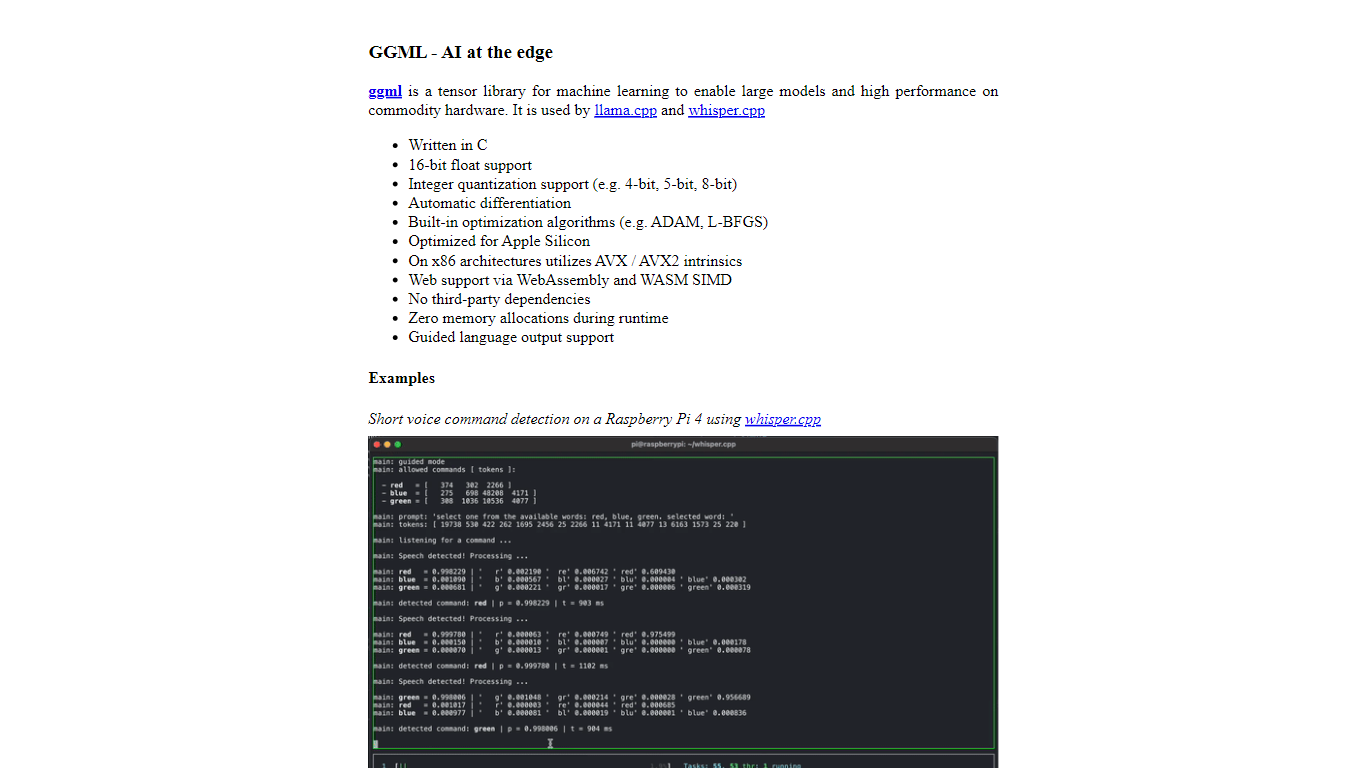
ggml runs large language and speech models on everyday CPUs and GPUs through a compact C tensor library built for on-device inference. ML engineers and app developers adopt it via llama.cpp and whisper.cpp when they want LLaMA or Whisper workloads without cloud-only dependencies.
Frameworks like PyTorch optimize for training clusters and heavy runtimes. ggml keeps the core library minimal with zero runtime memory allocations, no third-party dependencies, and integer quantization so llama.cpp can serve Meta LLaMA weights on laptops and Apple Silicon.
The ggml.ai company was founded in 2023 by Georgi Gerganov to support the library and was acquired by Hugging Face in 2026. The core ggml project stays MIT licensed with open development on GitHub.
replit-code Upvotes
ggml.ai Upvotes
replit-code Top Features
🧑💻 Supports 20 programming languages for versatile code completion
⚡ Uses Flash Attention for faster training and inference speeds
🔢 Custom tokenizer optimized for code syntax and correctness
🛠️ Compatible with 8-bit and 4-bit quantization to save resources
📦 Easy deployment via Transformers, Docker, and notebooks
ggml.ai Top Features
Powers llama.cpp for Meta LLaMA inference and whisper.cpp for OpenAI Whisper speech models
Written in C with zero runtime memory allocations during inference
Integer quantization support for smaller models on commodity hardware
No third-party dependencies in the core tensor library
Cross-platform low-level implementation with broad hardware support
MIT licensed open-core library with public development on GitHub
replit-code Category
- Large Language Model (LLM)
ggml.ai Category
- Large Language Model (LLM)
replit-code Pricing Type
- Freemium
ggml.ai Pricing Type
- Free