
Last updated 07-26-2026
Category:
Reviews:
Join thousands of AI enthusiasts in the World of AI!
replit-code
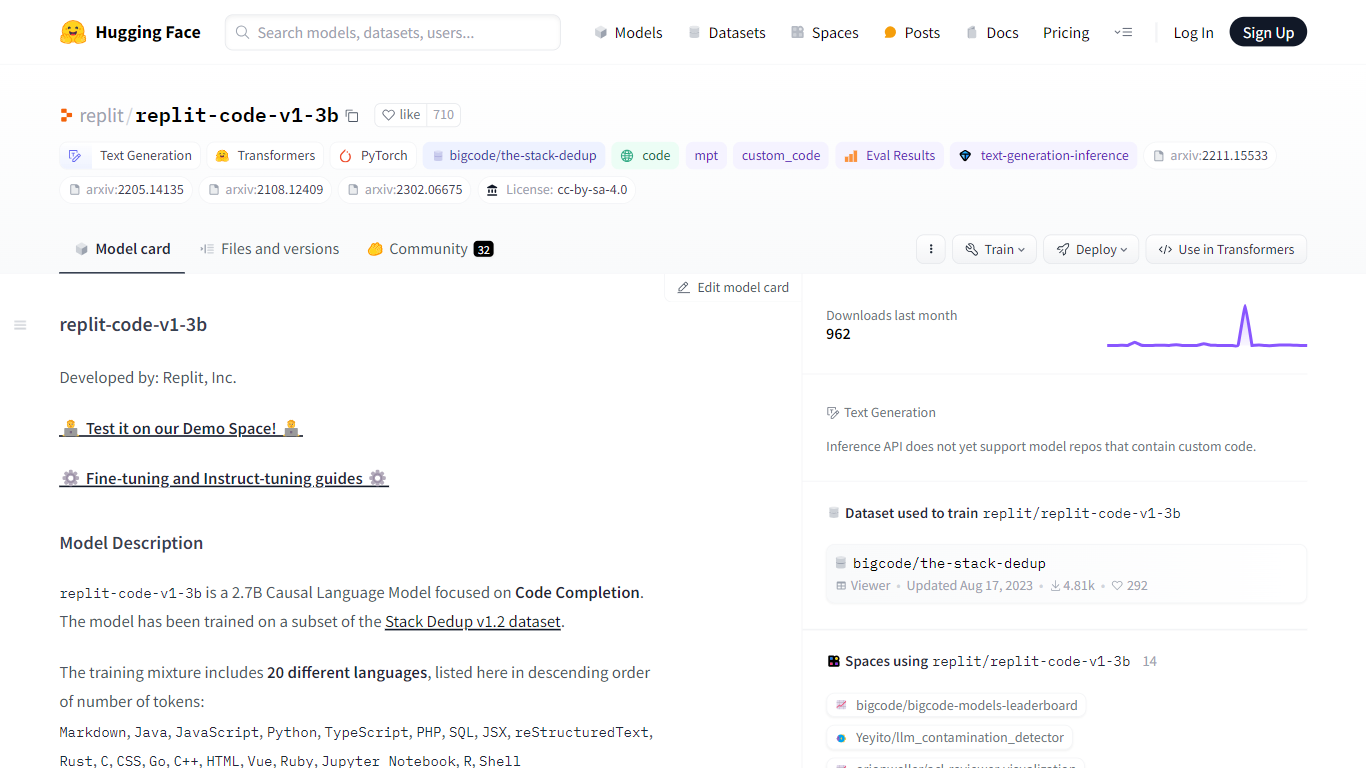
Replit's replit-code-v1-3b is a 2.7 billion parameter causal language model designed specifically for code completion tasks. Trained on a large, diverse dataset of 175 billion tokens covering 20 programming languages, it supports languages like Python, JavaScript, Java, and more. The model uses advanced techniques such as Flash Attention and AliBi positional embeddings to improve speed and handle variable context lengths efficiently. It is optimized for developers who want to fine-tune the model for specific applications without commercial restrictions, under a CC BY-SA 4.0 license.
Developed on the MosaicML platform with extensive GPU resources, replit-code-v1-3b offers compatibility with popular libraries like Transformers and supports quantization methods including 8-bit and 4-bit loading to reduce resource requirements. It also provides custom tokenization optimized for code syntax, ensuring syntactical correctness in generated completions. Users can deploy the model locally, in notebooks, or via Docker containers, with detailed guides available.
While powerful, the model may reflect biases or inappropriate content present in its training data, so caution is advised for production use. Post-processing recommendations include stopping generation at end-of-sequence tokens and trimming incomplete code snippets. The model is popular among developers and researchers seeking an open-source foundation for code generation and completion tasks.
Replit-code-v1-3b integrates well with Hugging Face's ecosystem, allowing easy access through pipelines and compatibility with inference providers. It is suitable for a wide range of coding assistance scenarios, from simple function completions to complex multi-language projects. The model benefits from ongoing community support and contributions, fostering collaborative improvement and innovation.
🧑💻 Supports 20 programming languages for versatile code completion
⚡ Uses Flash Attention for faster training and inference speeds
🔢 Custom tokenizer optimized for code syntax and correctness
🛠️ Compatible with 8-bit and 4-bit quantization to save resources
📦 Easy deployment via Transformers, Docker, and notebooks
Supports a wide variety of programming languages for diverse coding tasks
Optimized for speed with Flash Attention and efficient positional embeddings
Open-source license allows commercial fine-tuning with attribution
Flexible deployment options including local, Docker, and cloud notebooks
Supports quantization to reduce hardware requirements
May generate inappropriate content due to training data biases
Not currently deployed on any inference provider for serverless use
Requires technical knowledge to set up and fine-tune effectively
Which programming languages does replit-code-v1-3b support?
It supports 20 languages including Python, JavaScript, Java, TypeScript, PHP, SQL, Rust, C, C++, and more, covering a broad range of coding needs.
Can I fine-tune replit-code-v1-3b for commercial projects?
Yes, the model is licensed under CC BY-SA 4.0, allowing fine-tuning and commercial use with proper attribution to Replit.
How can I deploy replit-code-v1-3b locally?
You can deploy it using the Transformers library, Docker containers, or run it in notebooks like Google Colab or Kaggle with provided examples.
Does replit-code-v1-3b support quantization for lower resource usage?
Yes, it supports 8-bit and 4-bit quantization methods to reduce memory and compute requirements during inference.
What should I consider about the model's output content?
Since the training data may contain offensive or inappropriate content, users should review outputs carefully before production use.
Is there community support available for this model?
Yes, users can ask questions and share feedback in the Hugging Face community forums and discussions related to the model.
How does replit-code-v1-3b handle code tokenization?
It uses a custom SentencePiece Unigram tokenizer with a vocabulary optimized for code, ensuring syntactical correctness in generated code.