UniLM vs ggml.ai
In the clash of UniLM vs ggml.ai, which AI Large Language Model (LLM) tool emerges victorious? We assess reviews, pricing, alternatives, features, upvotes, and more.
When we put UniLM and ggml.ai head to head, which one emerges as the victor?
Let's take a closer look at UniLM and ggml.ai, both of which are AI-driven large language model (llm) tools, and see what sets them apart. With more upvotes, ggml.ai is the preferred choice. The number of upvotes for ggml.ai stands at 7, and for UniLM it's 6.
You don't agree with the result? Cast your vote to help us decide!
UniLM

What is UniLM?
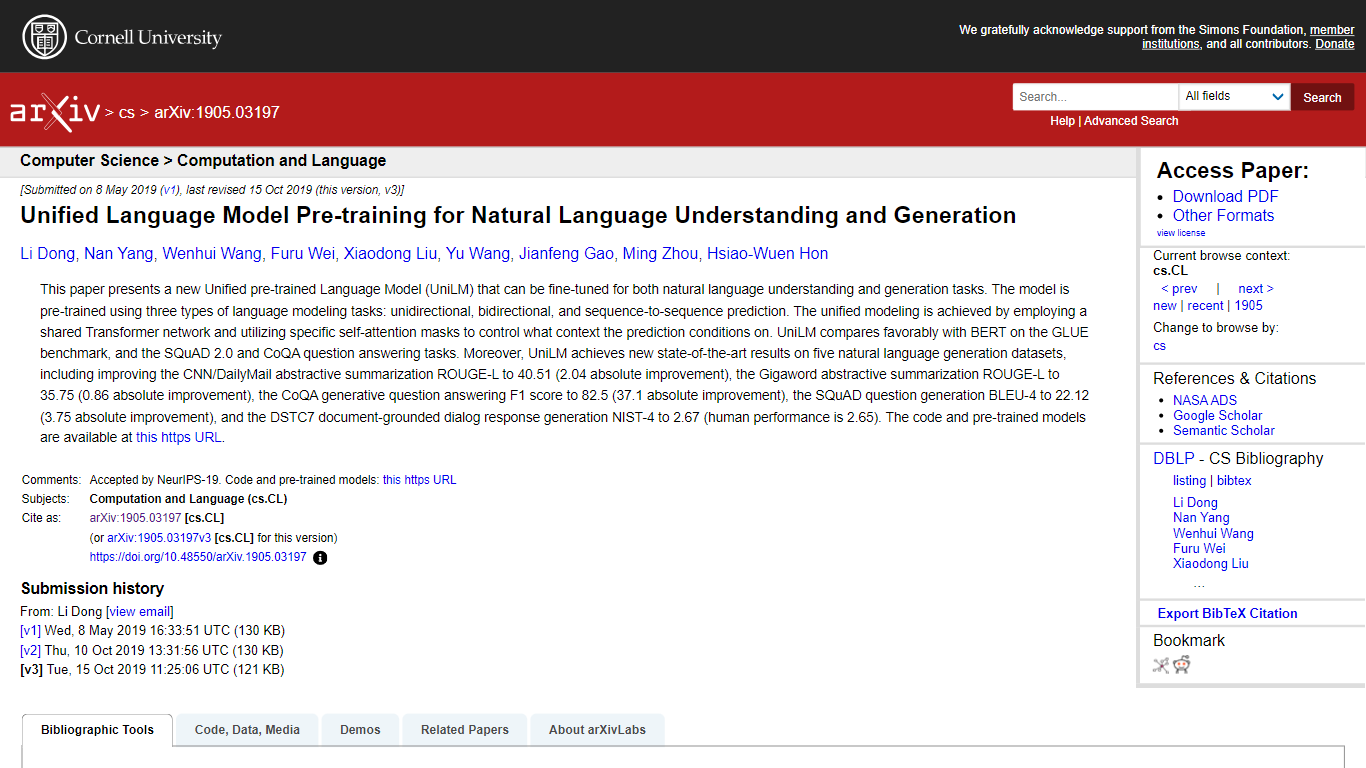
UniLM is a pre-trained language model from Microsoft Research that handles both natural language understanding and text generation from one shared Transformer. You fine-tune a single checkpoint for reading tasks like question answering and writing tasks like summarization or dialogue, without maintaining separate encoder-only and decoder-only models. Code and pretrained weights ship through the microsoft/unilm GitHub repo under an MIT license.
BERT-style models excel at reading but need a separate decoder stack for generation. UniLM trains one Transformer with three attention-mask modes: unidirectional, bidirectional, and sequence-to-sequence. That design let the same weights compete with BERT on GLUE and SQuAD while setting summarization and question-generation benchmarks in 2019, a split that most contemporaries treated as two problems.
ML researchers and NLP engineers use UniLM when they want published benchmarks, training scripts, and checkpoint files for both understanding and generation in one codebase. The repository now spans later releases like UniLMv2 (Pseudo-Masked Language Model, ICML 2020), but v1 remains the reference for the original unified masking approach described in the NeurIPS 2019 paper.
ggml.ai
What is ggml.ai?
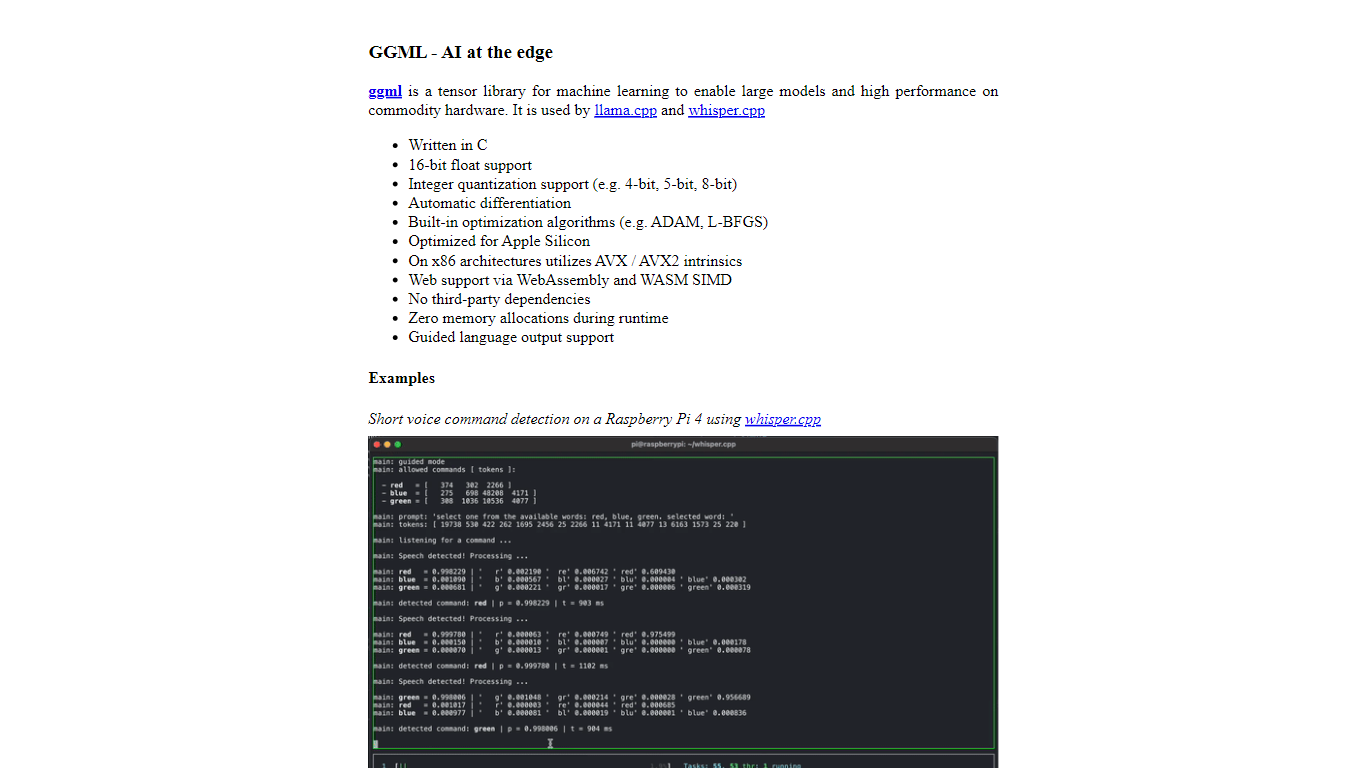
ggml runs large language and speech models on everyday CPUs and GPUs through a compact C tensor library built for on-device inference. ML engineers and app developers adopt it via llama.cpp and whisper.cpp when they want LLaMA or Whisper workloads without cloud-only dependencies.
Frameworks like PyTorch optimize for training clusters and heavy runtimes. ggml keeps the core library minimal with zero runtime memory allocations, no third-party dependencies, and integer quantization so llama.cpp can serve Meta LLaMA weights on laptops and Apple Silicon.
The ggml.ai company was founded in 2023 by Georgi Gerganov to support the library and was acquired by Hugging Face in 2026. The core ggml project stays MIT licensed with open development on GitHub.
UniLM Upvotes
ggml.ai Upvotes
UniLM Top Features
Three pre-training objectives (unidirectional, bidirectional, sequence-to-sequence) share one Transformer backbone
CNN/DailyMail abstractive summarization ROUGE-L of 40.51, a 2.04-point gain over prior work
CoQA generative question answering F1 score of 82.5 on the published benchmark
SQuAD question generation BLEU-4 of 22.12 with beam search decoding
Pre-trained checkpoints and PyTorch training scripts in the microsoft/unilm repository (22.2k GitHub stars)
MIT license with UniLM v1 and UniLMv2 code paths in the same open-source repo
ggml.ai Top Features
Powers llama.cpp for Meta LLaMA inference and whisper.cpp for OpenAI Whisper speech models
Written in C with zero runtime memory allocations during inference
Integer quantization support for smaller models on commodity hardware
No third-party dependencies in the core tensor library
Cross-platform low-level implementation with broad hardware support
MIT licensed open-core library with public development on GitHub
UniLM Category
- Large Language Model (LLM)
ggml.ai Category
- Large Language Model (LLM)
UniLM Pricing Type
- Free
ggml.ai Pricing Type
- Free