
Last updated 08-09-2026
Category:
Reviews:
Join thousands of AI enthusiasts in the World of AI!
Dabarqus
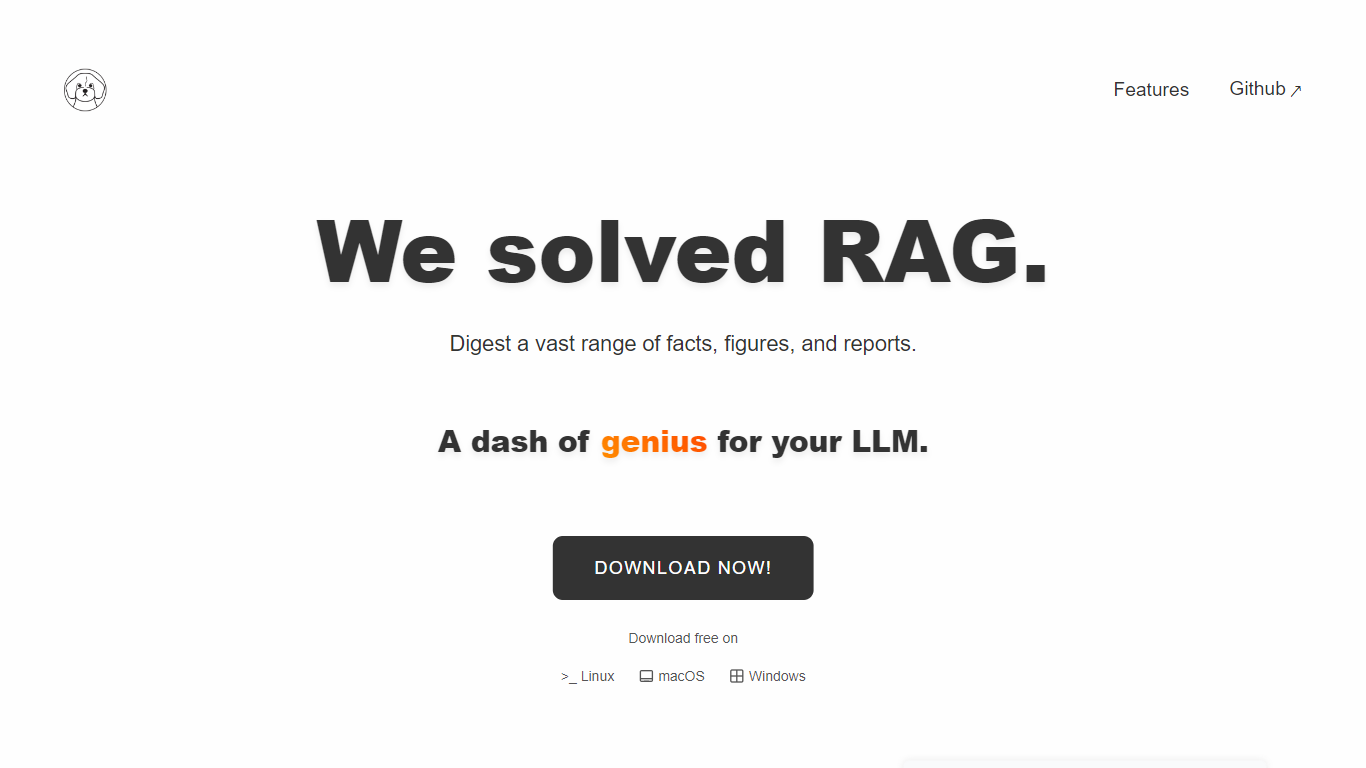
Dabarqus lets you chat with your own PDFs, emails, and other private files from a desktop install instead of uploading them to a hosted service. You load documents into portable memory banks, query them with plain LLM-style prompts, and pipe the retrieved passages into ChatGPT, Ollama, or any other model provider.
Most retrieval stacks assume you will wire up vector databases, embedding pipelines, and hosted APIs yourself. Dabarqus bundles ingestion, semantic indexing, retrieval, and optional LLM inference into one installable app for Linux, macOS, and Windows, with REST, CLI, Python, and JavaScript interfaces for developers who want to embed it.
The free Dabarqus edition caps retrieval at the top three matches per query and focuses on PDFs. Dabarqus Professional adds more file types, unlimited result counts, and advanced retrieval features like reranking and auto-merging for teams that need deeper search across mixed document sets.
It fits developers building local-first assistants, analysts who need to query report libraries on their own machines, and anyone who wants retrieval augmented generation without standing up cloud infrastructure.
Ingest PDFs, emails, databases, and APIs into separate portable memory banks
Query memory banks with the same natural-language prompts you send to your LLM
Free edition returns the top 3 matches per query across unlimited PDFs
Professional edition supports unlimited results plus reranking and auto-merging
Native desktop builds for Linux, macOS (Intel or Metal), and Windows (CPU or GPU)
REST API, barq CLI, and Python and JavaScript SDKs for integration
Runs locally on Linux, macOS, and Windows so private documents never need a cloud upload.
Plain-language prompts work for retrieval, so you do not learn a separate query syntax.
REST API, CLI, and Python/JavaScript SDKs cover both no-code testing and production integration.
Free edition limits each query to the top three matches, which may be tight for large corpora.
Professional tier pricing is not published on the marketing site.
FAQ page on dabarqus.com currently returns a 404, so support docs are thin.
What is Dabarqus used for?
Dabarqus is a desktop retrieval augmented generation app that ingests private documents into memory banks and returns relevant passages for LLM chat. You store PDFs and other files locally, query them in plain language, and feed the output to ChatGPT, Ollama, or another model.
Is Dabarqus free to download?
Yes. Dabarqus offers a free download for Linux, macOS, and Windows with a Dabarqus edition that searches unlimited PDFs and returns the top three results per query. Dabarqus Professional adds more file types and unlimited result counts for heavier workloads.
Which platforms does Dabarqus support?
Dabarqus runs natively on Linux, macOS (Intel or Metal), and Windows (CPU or GPU) with zero extra dependencies. Downloads are available from dabarqus.com and the project's GitHub repository.
Does Dabarqus have an API?
Yes. Dabarqus exposes a REST API for storing documents, querying semantic indexes, downloading models, and running LLM inference. It also ships a barq CLI plus Python and JavaScript SDKs published on PyPI and npm.
What file types can Dabarqus ingest?
The free Dabarqus edition focuses on PDFs stored in memory banks. Dabarqus Professional expands ingestion to text files, emails, reports, and additional data sources listed on the features page, with advanced filtering options.
How does Dabarqus differ from cloud RAG services?
Dabarqus runs as a local desktop application so your documents stay on your machine while you build memory banks and query them. Cloud RAG tools typically host ingestion and indexes remotely, whereas Dabarqus targets teams that want on-device control with REST and SDK hooks.