
Last updated 08-13-2026
Category:
Reviews:
Join thousands of AI enthusiasts in the World of AI!
DreamFusion
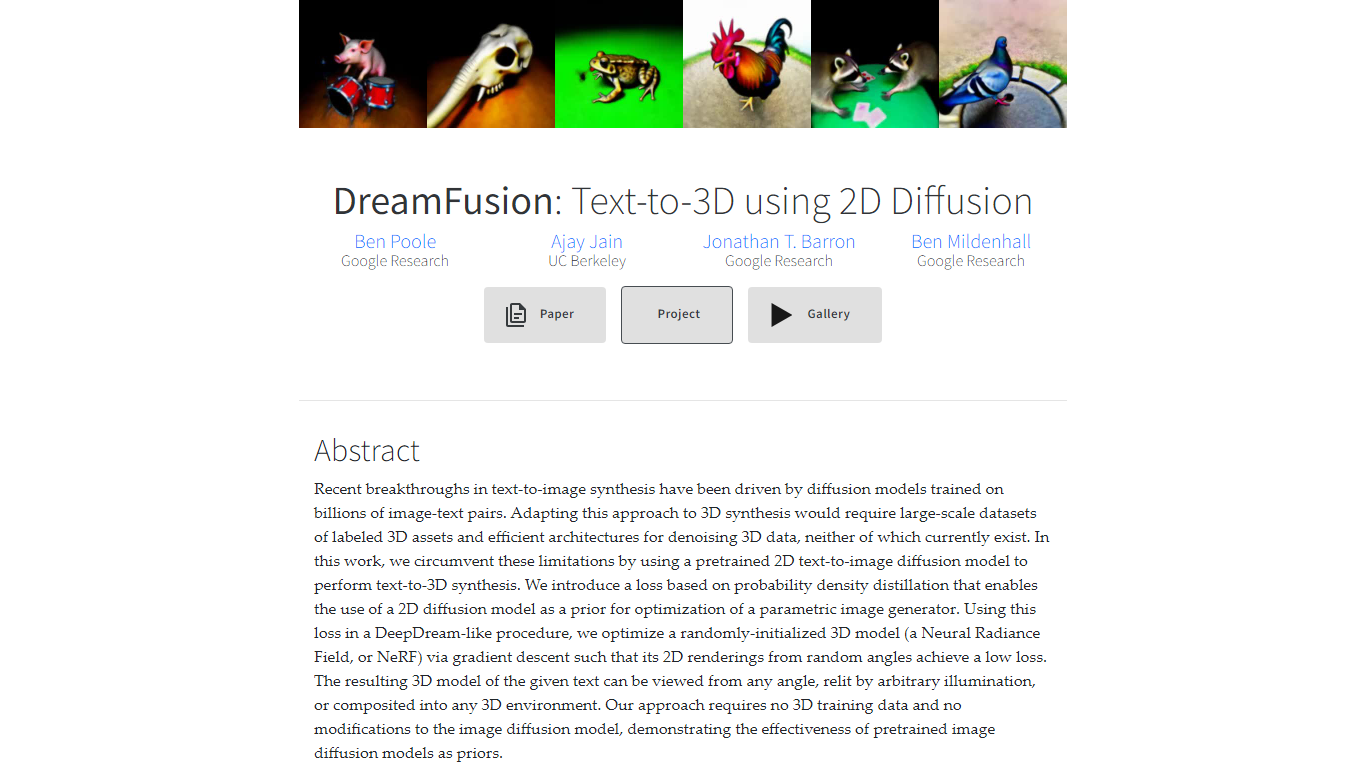
DreamFusion generates 3D objects from text captions using a pretrained 2D text-to-image diffusion model instead of 3D training data. It optimizes a Neural Radiance Field (NeRF) so random-angle 2D renderings match what Imagen expects from your prompt. The result is a relightable 3D asset you can view from any angle, export as a mesh, or place in a scene.
Unlike pipelines that need large labeled 3D datasets, DreamFusion uses Score Distillation Sampling to turn a 2D diffusion prior into a 3D optimizer. That sidesteps the missing infrastructure for 3D denoising at scale. SDS alone gives reasonable appearance; DreamFusion adds regularizers for cleaner normals, depth, and surface geometry under Lambertian shading.
Researchers, 3D artists exploring generative workflows, and ML engineers studying text-to-3D use DreamFusion as the reference implementation from Google Research and UC Berkeley. The project page hosts a searchable gallery of hundreds of generated assets and cites the 2022 arXiv paper.
Generates relightable 3D NeRF models from text captions via Imagen
Score Distillation Sampling optimizes 3D scenes without 3D training data
Exports trained NeRFs to meshes with the marching cubes algorithm
Supports arbitrary viewing angles, relighting, and scene composition
Gallery hosts hundreds of searchable text-generated 3D assets
Adds geometry regularizers beyond SDS for improved normals and depth
Generates 3D assets from text without any 3D training dataset.
NeRF output is relightable and viewable from arbitrary angles.
Mesh export supports standard 3D pipelines and modeling tools.
Open research project with cited arXiv paper and public gallery.
Research demo only; no hosted SaaS API for production generation.
Requires ML expertise to reproduce results outside the demo gallery.
Depends on Imagen as the 2D diffusion prior, which is not self-hosted here.
What is DreamFusion?
DreamFusion is a Google Research text-to-3D method that optimizes a Neural Radiance Field from a caption using a pretrained 2D diffusion model called Imagen. It produces relightable 3D objects without 3D training datasets.
Is DreamFusion free?
Yes. DreamFusion is a free research project hosted on GitHub Pages. The paper, gallery, and methodology are publicly available with no signup or payment required.
How does DreamFusion create 3D models?
DreamFusion uses Score Distillation Sampling to optimize a randomly initialized NeRF. Random-angle 2D renderings are scored against Imagen's text-to-image prior until the scene matches the caption.
Can DreamFusion export meshes?
Yes. DreamFusion NeRF models can be exported to mesh files using the marching cubes algorithm for use in 3D renderers or modeling software.
Who built DreamFusion?
DreamFusion was authored by researchers at Google Research and UC Berkeley, including Ben Poole, Ajay Jain, Jonathan T. Barron, and Ben Mildenhall. The work was published on arXiv in 2022.
Does DreamFusion need 3D training data?
No. DreamFusion requires no 3D training data and no modifications to the underlying image diffusion model. It relies on a pretrained 2D diffusion prior instead.